 Back
Study Guide: Energy, Enzymes, and Metabolism in General Biology
Study Guide - Smart Notes
 Tailored notes based on your materials, expanded with key definitions, examples, and context.
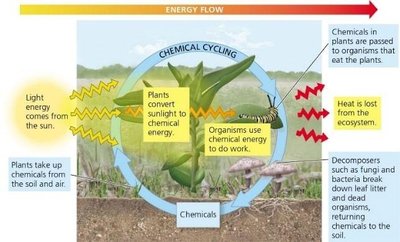
Q1. Explain the flow of energy and chemical recycling in the universe and the role of light energy.
Background
Topic: Energy Flow and Chemical Cycling in Biological Systems
This question tests your understanding of how energy moves through ecosystems and how chemicals are recycled, with a focus on the importance of light energy in these processes.
Key Terms:
Energy flow: The movement of energy through living systems, typically from the sun to producers and then to consumers.
Chemical cycling: The reuse of chemical elements (like carbon, nitrogen) within ecosystems.
Light energy: Energy from the sun that is captured by plants during photosynthesis.
Step-by-Step Guidance
Identify the main source of energy for most ecosystems (hint: it's the sun).
Describe how plants convert light energy into chemical energy through photosynthesis.
Explain how chemical energy is transferred from plants to other organisms (consumers) when they eat plants.
Discuss how decomposers recycle chemicals back into the environment after organisms die.
Consider how heat is lost from the ecosystem during these processes.
Try solving on your own before revealing the answer!
Final Answer:
Energy flows through the ecosystem starting with light energy from the sun, which is captured by plants and converted to chemical energy. This energy is transferred to consumers when they eat plants, and decomposers recycle chemicals back to the soil. Heat is lost at each step, and chemicals are reused in a cycle.
Q2. Define metabolism.
Background
Topic: Metabolism
This question is testing your ability to define metabolism and understand its role in living organisms.
Key Terms:
Metabolism: The sum of all chemical reactions that occur within a living organism.
Step-by-Step Guidance
Recall that metabolism includes both the building up and breaking down of molecules.
Think about how metabolism is essential for energy production, growth, and maintenance in cells.
Consider examples of metabolic processes, such as cellular respiration and photosynthesis.
Try solving on your own before revealing the answer!
Final Answer:
Metabolism is the total of all chemical reactions in an organism, including both anabolic (building up) and catabolic (breaking down) pathways. It is essential for energy production and cellular function.
Q3. Describe the difference between anabolic and catabolic pathways. Give an example.
Background
Topic: Metabolic Pathways
This question tests your understanding of the two main types of metabolic pathways: anabolic and catabolic.
Key Terms:
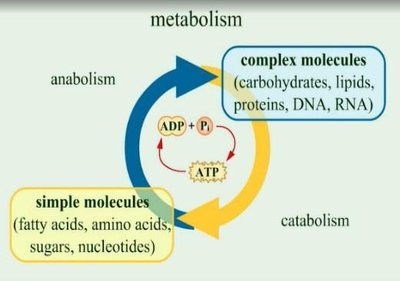
Anabolic pathway: Builds complex molecules from simpler ones, requiring energy.
Catabolic pathway: Breaks down complex molecules into simpler ones, releasing energy.
Step-by-Step Guidance
Define anabolic pathways and identify a process that builds molecules (e.g., protein synthesis).
Define catabolic pathways and identify a process that breaks down molecules (e.g., cellular respiration).
Explain how energy is involved in each pathway.
Think about how these pathways are interconnected in metabolism.
Try solving on your own before revealing the answer!
Final Answer:
Anabolic pathways build complex molecules (like proteins) from simpler ones and require energy, while catabolic pathways break down complex molecules (like glucose) into simpler ones and release energy. Example: Anabolism—protein synthesis; Catabolism—cellular respiration.
Q4. What is energy? Describe the difference between kinetic, potential, and chemical energy. Give an example for each.
Background
Topic: Types of Energy in Biology
This question tests your understanding of energy and its various forms relevant to biological systems.
Key Terms:
Energy: The capacity to do work or cause change.
Kinetic energy: Energy of motion.
Potential energy: Stored energy due to position or structure.
Chemical energy: Energy stored in chemical bonds.
Step-by-Step Guidance
Define energy in a biological context.
Describe kinetic energy and provide a biological example (e.g., movement of molecules).
Describe potential energy and provide a biological example (e.g., concentration gradient across a membrane).
Describe chemical energy and provide a biological example (e.g., ATP molecules).
Try solving on your own before revealing the answer!
Final Answer:
Energy is the ability to do work. Kinetic energy is the energy of movement (e.g., muscle contraction), potential energy is stored energy (e.g., water behind a dam or a concentration gradient), and chemical energy is stored in bonds (e.g., ATP or glucose).
Q5. Using the figure above, describe which processes are anabolic and catabolic and the types of energy for each.
Background
Topic: Metabolic Pathways and Energy Types
This question asks you to interpret a diagram showing the relationship between anabolic and catabolic processes and the types of energy involved.
Key Terms:
Anabolism: Building complex molecules from simple ones.
Catabolism: Breaking down complex molecules into simple ones.
ATP: Adenosine triphosphate, the main energy carrier in cells.
Step-by-Step Guidance
Identify which direction in the diagram represents anabolism (building up) and which represents catabolism (breaking down).
Note the types of molecules involved in each process (simple vs. complex).
Describe how ATP is used or produced in each pathway.
Explain the types of energy involved in each process (chemical energy, etc.).
Try solving on your own before revealing the answer!
Final Answer:
Anabolic processes build complex molecules from simple ones and require energy (usually from ATP), while catabolic processes break down complex molecules into simple ones and release energy (often captured as ATP).
Q6. Describe the structure of ATP and how it is able to drive biological reactions.
Background
Topic: ATP Structure and Function
This question tests your understanding of ATP's structure and its role in cellular energy transfer.
Key Terms:
ATP: Adenosine triphosphate, a molecule with three phosphate groups.
Phosphorylation: The transfer of a phosphate group to another molecule.
Step-by-Step Guidance
Describe the basic structure of ATP (adenine, ribose, three phosphate groups).
Explain how the bonds between phosphate groups store energy.
Discuss how ATP hydrolysis releases energy for cellular work.
Describe how ATP can transfer a phosphate group to another molecule (phosphorylation).
Try solving on your own before revealing the answer!
Final Answer:
ATP consists of adenine, ribose, and three phosphate groups. The high-energy bonds between phosphates release energy when broken, allowing ATP to drive biological reactions by transferring a phosphate group to other molecules.
Q7. Describe how ATP is regenerated.
Background
Topic: ATP Regeneration
This question tests your understanding of how cells replenish ATP after it is used.
Key Terms:
ATP regeneration: The process of reattaching a phosphate group to ADP to form ATP.
Cellular respiration: The process that provides energy for ATP regeneration.
Step-by-Step Guidance
Recall that ATP is regenerated from ADP and inorganic phosphate ().
Describe how energy from catabolic reactions (like cellular respiration) is used to reattach the phosphate group.
Explain the importance of ATP regeneration for continuous cellular activity.
Try solving on your own before revealing the answer!
Final Answer:
ATP is regenerated by adding a phosphate group to ADP, using energy from catabolic reactions such as cellular respiration. This allows cells to maintain a supply of ATP for energy-requiring processes.
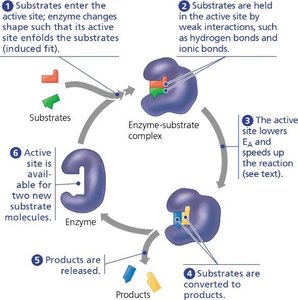
Q8. What are enzymes and describe how they work. Use the figure to the left.
Background
Topic: Enzyme Structure and Function
This question tests your understanding of enzymes as biological catalysts and their mechanism of action.
Key Terms:
Enzyme: A protein that speeds up chemical reactions in cells.
Active site: The region of the enzyme where substrates bind.
Substrate: The molecule upon which an enzyme acts.
Step-by-Step Guidance
Define enzymes and their role as catalysts.
Describe how substrates bind to the enzyme's active site.
Explain how the enzyme lowers activation energy and speeds up the reaction.
Discuss how products are released and the enzyme is ready for another cycle.
Try solving on your own before revealing the answer!
Final Answer:
Enzymes are proteins that catalyze reactions by binding substrates at their active site, lowering activation energy, converting substrates to products, and releasing them so the enzyme can be reused.
Q9. Based on what you know about protein structure, how are enzymes able to bind only specific substrates?
Background
Topic: Enzyme Specificity and Protein Structure
This question tests your understanding of how the structure of proteins determines enzyme specificity.
Key Terms:
Active site: The region of the enzyme shaped to fit specific substrates.
Induced fit: The enzyme changes shape slightly to accommodate the substrate.
Protein structure: The sequence and folding of amino acids.
Step-by-Step Guidance
Recall that enzymes are proteins with a unique three-dimensional structure.
Describe how the active site is shaped to fit only certain substrates.
Explain the induced fit model, where the enzyme adjusts to bind the substrate more tightly.
Consider how changes in protein structure can affect substrate binding.
Try solving on your own before revealing the answer!
Final Answer:
Enzymes bind specific substrates because their active sites are uniquely shaped by their protein structure, allowing only certain molecules to fit and interact. The induced fit model explains how enzymes adjust to bind substrates tightly.
Q10. Describe the role of cofactors and coenzymes in chemical reactions/metabolism.
Background
Topic: Enzyme Helpers
This question tests your understanding of how cofactors and coenzymes assist enzymes in catalyzing reactions.
Key Terms:
Cofactor: A non-protein molecule or ion required for enzyme activity (often inorganic, like metal ions).
Coenzyme: An organic molecule that helps enzymes (often derived from vitamins).
Step-by-Step Guidance
Define cofactors and coenzymes and their differences.
Describe how they bind to enzymes and assist in catalysis.
Give examples of common cofactors (e.g., Mg2+) and coenzymes (e.g., NAD+).
Explain why these helpers are essential for many metabolic reactions.
Try solving on your own before revealing the answer!
Final Answer:
Cofactors and coenzymes are molecules that assist enzymes in catalyzing reactions. Cofactors are often inorganic ions, while coenzymes are organic molecules. Both are essential for proper enzyme function in metabolism.
