 Back
Study Guide: Energy, Enzymes, and Metabolism in Biological Systems
Study Guide - Smart Notes
 Tailored notes based on your materials, expanded with key definitions, examples, and context.
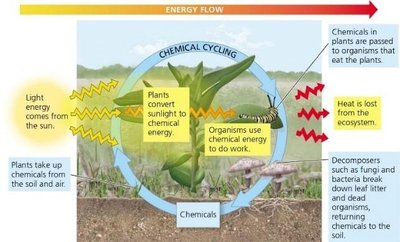
Q1. Explain the flow of energy and chemical recycling in the universe and the role of light energy.
Background
Topic: Energy Flow and Chemical Cycling in Ecosystems
This question tests your understanding of how energy moves through biological systems and how matter is recycled, with a focus on the role of light energy in these processes.
Key Terms and Concepts:
Energy flow: The movement of energy through an ecosystem, typically entering as light and leaving as heat.
Chemical cycling: The reuse of chemical elements (like carbon, nitrogen) within ecosystems.
Photosynthesis: The process by which plants convert light energy into chemical energy.
Producers, consumers, decomposers: The roles organisms play in energy flow and chemical cycling.
Step-by-Step Guidance
Describe how light energy from the sun is captured by producers (plants) through photosynthesis.
Explain how this chemical energy is transferred to consumers when they eat plants or other organisms.
Discuss how decomposers break down dead organisms, returning chemicals to the soil and air.
Note that energy flows in one direction (sun → organisms → heat), while chemicals are recycled within the ecosystem.
Try solving on your own before revealing the answer!
Q2. Define metabolism.
Background
Topic: Metabolism
This question is about understanding the overall concept of metabolism in living organisms.
Key Terms:
Metabolism: All chemical reactions that occur within a living organism to maintain life.
Step-by-Step Guidance
Think about metabolism as the sum of all chemical processes in the cell or organism.
Consider that metabolism includes both building up (anabolic) and breaking down (catabolic) reactions.
Reflect on how metabolism is essential for energy transformation and use in cells.
Try solving on your own before revealing the answer!
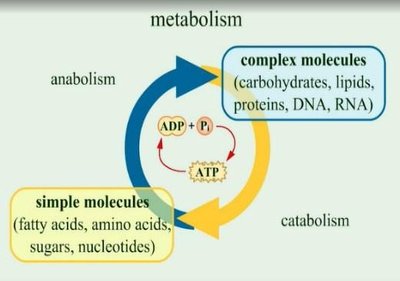
Q3. Describe the difference between anabolic and catabolic pathways. Be sure to give an example.
Background
Topic: Metabolic Pathways
This question tests your understanding of the two main types of metabolic pathways: anabolic (building up) and catabolic (breaking down).
Key Terms:
Anabolic pathway: Builds complex molecules from simpler ones, requiring energy input.
Catabolic pathway: Breaks down complex molecules into simpler ones, releasing energy.
Step-by-Step Guidance
Define anabolic pathways and provide a biological example (e.g., synthesis of proteins from amino acids).
Define catabolic pathways and provide a biological example (e.g., breakdown of glucose during cellular respiration).
Explain how these pathways are interconnected in metabolism.
Try solving on your own before revealing the answer!
Q4. What is energy? Describe the difference between the different types of energy listed below. Be sure to give an example.
Background
Topic: Types of Energy in Biology
This question is about understanding what energy is and distinguishing between kinetic, potential, and chemical energy.
Key Terms:
Kinetic energy: Energy of motion.
Potential energy: Stored energy due to position or structure.
Chemical energy: Potential energy stored in chemical bonds.
Step-by-Step Guidance
Define energy as the capacity to do work or cause change.
Describe kinetic energy and give a biological example (e.g., movement of molecules).
Describe potential energy and give a biological example (e.g., energy stored in a concentration gradient).
Describe chemical energy and give a biological example (e.g., energy stored in ATP or glucose).
Try solving on your own before revealing the answer!
Q5. Using the figure above describe which processes are anabolic and catabolic and the types of energy for each.
Background
Topic: Anabolic vs. Catabolic Processes and Energy Types
This question asks you to interpret a diagram of metabolism and identify which processes are anabolic or catabolic, and what types of energy are involved.
Key Terms:
Anabolism: Building complex molecules from simpler ones (requires energy).
Catabolism: Breaking down complex molecules into simpler ones (releases energy).
ATP: The main energy currency in cells.
Step-by-Step Guidance
Identify which arrow in the diagram represents anabolism and which represents catabolism.
Describe the direction of energy flow (ATP usage or production) in each process.
Explain what types of molecules are involved in each process (simple vs. complex).
Try solving on your own before revealing the answer!
Q6. Describe the structure of ATP and how it is able to drive biological reactions.
Background
Topic: ATP Structure and Function
This question is about understanding the molecular structure of ATP and how it provides energy for cellular processes.
Key Terms and Formulas:
ATP (adenosine triphosphate): A molecule consisting of adenine, ribose, and three phosphate groups.
Hydrolysis of ATP:
Step-by-Step Guidance
Describe the three main components of ATP (adenine, ribose, three phosphates).
Explain how the bonds between phosphate groups store potential energy.
Discuss how hydrolysis of ATP releases energy that can be used to drive endergonic (energy-requiring) reactions in cells.
Try solving on your own before revealing the answer!
Q7. Describe how ATP is regenerated.
Background
Topic: ATP Cycle
This question is about how cells regenerate ATP from ADP and inorganic phosphate.
Key Terms and Formulas:
ATP regeneration: (requires energy input)
Cellular respiration: The process that provides the energy for ATP regeneration.
Step-by-Step Guidance
Explain that ATP is regenerated by adding a phosphate group to ADP.
Describe how energy from catabolic reactions (like glucose breakdown) is used for this process.
Connect this process to the overall energy flow in cells.
Try solving on your own before revealing the answer!
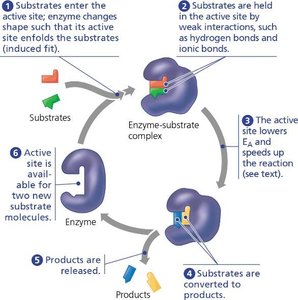
Q8. What are enzymes and describe how they work. Use the figure to the left.
Background
Topic: Enzyme Structure and Function
This question is about understanding what enzymes are and how they catalyze biochemical reactions.
Key Terms:
Enzyme: A protein that speeds up chemical reactions by lowering activation energy.
Active site: The region on the enzyme where the substrate binds.
Substrate: The molecule upon which an enzyme acts.
Step-by-Step Guidance
Describe how the substrate binds to the enzyme's active site, forming an enzyme-substrate complex.
Explain how the enzyme changes shape slightly (induced fit) to better fit the substrate.
Discuss how the enzyme lowers the activation energy, allowing the reaction to proceed faster.
Describe how the products are released and the enzyme is free to catalyze another reaction.
Try solving on your own before revealing the answer!
Q9. Based on what you know about protein structure, how are enzymes able to bind only specific substrates?
Background
Topic: Enzyme Specificity and Protein Structure
This question is about the relationship between the structure of enzymes (proteins) and their ability to bind specific substrates.
Key Terms:
Active site: The region of the enzyme with a specific shape and chemical environment.
Induced fit: The enzyme changes shape to fit the substrate more closely.
Specificity: Only substrates with the correct shape and chemical properties can bind to the enzyme's active site.
Step-by-Step Guidance
Describe how the three-dimensional structure of the enzyme determines the shape of the active site.
Explain how only substrates with a complementary shape and chemical properties can bind to the active site.
Discuss the role of amino acid side chains (R groups) in substrate binding and catalysis.
Try solving on your own before revealing the answer!
Q10. These chemical pathways need assistance to work efficiently. Describe the role of cofactors and coenzymes in chemical reactions/metabolism.
Background
Topic: Enzyme Helpers (Cofactors and Coenzymes)
This question is about understanding how non-protein molecules assist enzymes in catalyzing reactions.
Key Terms:
Cofactor: A non-protein chemical compound (often a metal ion) required for enzyme activity.
Coenzyme: An organic molecule (often derived from vitamins) that assists enzyme function.
Step-by-Step Guidance
Define cofactors and coenzymes and explain how they differ.
Describe how these molecules help enzymes catalyze reactions (e.g., by stabilizing the transition state or participating in the reaction).
Give an example of a cofactor (e.g., Mg2+ for DNA polymerase) and a coenzyme (e.g., NAD+ in cellular respiration).
Try solving on your own before revealing the answer!
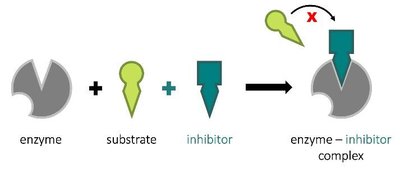
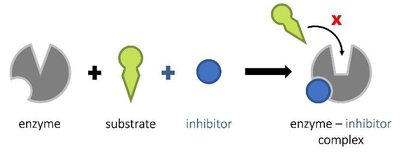
Q11. Describe competitive and non-competitive inhibition. How do they impact enzyme activity?
Background
Topic: Enzyme Inhibition
This question is about understanding how inhibitors affect enzyme activity and the difference between competitive and non-competitive inhibition.
Key Terms:
Competitive inhibitor: Binds to the active site, blocking substrate binding.
Non-competitive inhibitor: Binds to a different site, changing the enzyme's shape and reducing activity.
Step-by-Step Guidance
Define competitive inhibition and explain how it affects substrate binding and reaction rate.
Define non-competitive inhibition and explain how it affects enzyme activity regardless of substrate concentration.
Discuss how each type of inhibition changes the enzyme's ability to catalyze reactions.
Try solving on your own before revealing the answer!
Q12. Can you overcome this inhibition? If so, how?
Background
Topic: Overcoming Enzyme Inhibition
This question is about whether and how you can reverse the effects of competitive or non-competitive inhibitors.
Key Terms:
Competitive inhibition: Can sometimes be overcome by increasing substrate concentration.
Non-competitive inhibition: Usually cannot be overcome by increasing substrate concentration.
Step-by-Step Guidance
Explain why increasing substrate concentration can outcompete a competitive inhibitor for the active site.
Discuss why non-competitive inhibitors reduce enzyme activity regardless of substrate concentration.
Consider the implications for drug design and metabolic regulation.
Try solving on your own before revealing the answer!
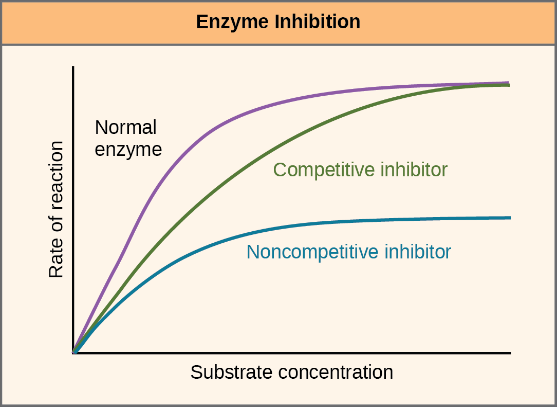
Q13. Using the graph to the right, describe how the enzyme rate of the reaction changes when a competitive inhibitor is added with the same substrate concentration (x-axis).
Background
Topic: Enzyme Kinetics and Inhibition
This question is about interpreting a graph showing the effects of competitive inhibition on enzyme reaction rates.
Key Terms:
Reaction rate: How quickly the enzyme converts substrate to product.
Substrate concentration: Amount of substrate available for the enzyme.
Step-by-Step Guidance
Locate the line representing competitive inhibition on the graph.
Compare the reaction rate at various substrate concentrations with and without the inhibitor.
Describe how the presence of a competitive inhibitor affects the rate, especially at low and high substrate concentrations.
Try solving on your own before revealing the answer!
Q14. Now describe how the rate of reaction changes for non-competitive inhibition.
Background
Topic: Non-competitive Inhibition Effects
This question is about how non-competitive inhibitors affect enzyme reaction rates, as shown in the graph.
Key Terms:
Non-competitive inhibition: Inhibitor binds to a site other than the active site, reducing maximum reaction rate (Vmax).
Step-by-Step Guidance
Locate the line representing non-competitive inhibition on the graph.
Compare the maximum reaction rate (Vmax) with and without the inhibitor.
Describe how increasing substrate concentration affects the rate in the presence of a non-competitive inhibitor.
Try solving on your own before revealing the answer!
Q15. Why does the graph level off for each line?
Background
Topic: Enzyme Kinetics (Saturation)
This question is about understanding why enzyme-catalyzed reactions reach a maximum rate (Vmax) as substrate concentration increases.
Key Terms:
Vmax: The maximum rate of an enzyme-catalyzed reaction when the enzyme is saturated with substrate.
Saturation: All enzyme active sites are occupied by substrate.
Step-by-Step Guidance
Explain what happens to enzyme activity as substrate concentration increases.
Describe why the reaction rate cannot increase beyond a certain point (Vmax).
Relate this to the concept of enzyme saturation.
Try solving on your own before revealing the answer!
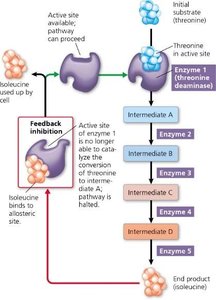
Q16. Describe feedback inhibition and why it is important to the cell.
Background
Topic: Feedback Inhibition in Metabolic Pathways
This question is about how cells regulate metabolic pathways using feedback inhibition.
Key Terms:
Feedback inhibition: The end product of a pathway inhibits an enzyme early in the pathway.
Allosteric site: A site on the enzyme other than the active site where a molecule can bind and change enzyme activity.
Step-by-Step Guidance
Describe how the end product of a metabolic pathway can bind to an enzyme and inhibit its activity.
Explain why this regulation is important for conserving resources and maintaining homeostasis in the cell.
Give an example of a metabolic pathway regulated by feedback inhibition.
Try solving on your own before revealing the answer!
Q17. What would happen if enzyme 3 in the pathway shown stops functioning?
Background
Topic: Enzyme Pathways and Blockages
This question is about the consequences of a non-functional enzyme in a metabolic pathway.
Key Terms:
Metabolic pathway: A series of enzyme-catalyzed reactions.
Enzyme deficiency/blockage: When an enzyme is missing or non-functional, the pathway is interrupted.
Step-by-Step Guidance
Identify where enzyme 3 acts in the pathway and what intermediate it processes.
Predict what will happen to the levels of intermediates before and after enzyme 3.
Consider the effects on the production of the final product.
Try solving on your own before revealing the answer!
Q18. Describe denaturation and how does this impact enzyme structure and function.
Background
Topic: Protein Denaturation
This question is about what happens when proteins (including enzymes) lose their structure due to environmental changes.
Key Terms:
Denaturation: The process by which a protein loses its native structure due to external stress (e.g., heat, pH change).
Loss of function: Denatured enzymes can no longer catalyze reactions effectively.
Step-by-Step Guidance
Describe what happens to the secondary, tertiary, and quaternary structure of a protein during denaturation.
Explain why the loss of structure leads to loss of enzyme activity.
Give examples of conditions that can cause denaturation (e.g., high temperature, extreme pH).
Try solving on your own before revealing the answer!
Q19. Environmental conditions in the cell can affect how proteins function. Describe what conditions can alter protein structure and function. How does this happen?
Background
Topic: Environmental Effects on Protein Structure
This question is about how factors like temperature, pH, and chemicals can change protein structure and function.
Key Terms:
Temperature: High temperatures can cause denaturation.
pH: Extreme pH values can disrupt ionic and hydrogen bonds.
Chemicals: Some chemicals can disrupt protein structure.
Step-by-Step Guidance
List environmental factors that can affect protein structure (temperature, pH, chemicals).
Explain how each factor can disrupt the bonds that maintain protein structure.
Describe the consequences for protein (enzyme) function.
Try solving on your own before revealing the answer!
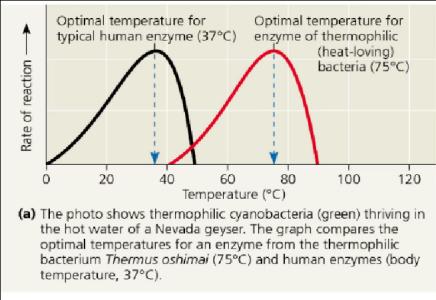
Q20. Below is a graph of a human enzyme at its optimal temperature. Write a detailed description of this figure below. Be sure to describe what is happening on the x axis with respect to the y-axis. Also compare both lines. How does this agree with the concept that environmental factors affect protein structure? (fig 6.16)
Background
Topic: Enzyme Activity and Temperature
This question is about interpreting a graph showing enzyme activity at different temperatures for human and thermophilic (heat-loving) bacteria enzymes.
Key Terms:
Optimal temperature: The temperature at which enzyme activity is highest.
Denaturation: Loss of enzyme activity at high temperatures.
Step-by-Step Guidance
Describe what the x-axis (temperature) and y-axis (rate of reaction) represent.
Compare the optimal temperatures for the human enzyme and the thermophilic bacterial enzyme.
Explain why enzyme activity decreases at temperatures above the optimum.
Try solving on your own before revealing the answer!
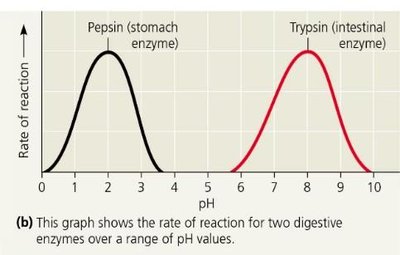
Q21. This graph shows the enzyme activity for an enzyme at various pH values. Label which line would represent an enzyme in the stomach under acidic conditions? What about the small intestine at basic conditions?
Background
Topic: Enzyme Activity and pH
This question is about interpreting a graph showing enzyme activity at different pH values for two digestive enzymes.
Key Terms:
Optimal pH: The pH at which enzyme activity is highest.
Pepsin: Stomach enzyme with acidic optimum.
Trypsin: Intestinal enzyme with basic optimum.
Step-by-Step Guidance
Identify which curve corresponds to pepsin and which to trypsin based on their optimal pH values.
Label the axes and the peaks of each curve.
Explain why each enzyme works best at its respective pH.
Try solving on your own before revealing the answer!
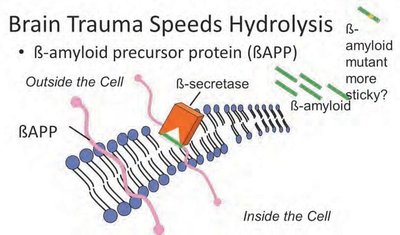
Q22. Using the picture above and the information in the paragraph, describe how beta amyloid peptide causes Alzheimer's disease.
Background
Topic: Protein Processing and Disease
This question is about the role of beta-amyloid peptide in Alzheimer's disease and how it is produced from its precursor protein.
Key Terms:
Beta-amyloid precursor protein (APP): The protein that is cleaved to form beta-amyloid.
Beta-secretase: The enzyme that cleaves APP to produce beta-amyloid.
Beta-amyloid: The peptide that accumulates and forms plaques in Alzheimer's disease.
Step-by-Step Guidance
Describe how APP is processed by beta-secretase to produce beta-amyloid peptide.
Explain how accumulation of beta-amyloid leads to plaque formation in the brain.
Discuss how these plaques are associated with the symptoms of Alzheimer's disease.
Try solving on your own before revealing the answer!
Q23. In an enzyme reaction you have the following equation: substrate + enzyme = product. Based on the abstract above identify the enzyme, substrate, and product. What type of macromolecule are the substrate, enzyme, and product? What specific structures are important for enzyme activity?
Background
Topic: Enzyme Reactions and Macromolecules
This question is about identifying the components of an enzyme-catalyzed reaction and the types of macromolecules involved.
Key Terms:
Enzyme: Protein that catalyzes the reaction (e.g., beta-secretase).
Substrate: The molecule acted upon by the enzyme (e.g., APP).
Product: The result of the reaction (e.g., beta-amyloid peptide).
Step-by-Step Guidance
Identify the enzyme, substrate, and product in the context of the beta-amyloid pathway.
Classify each as a type of macromolecule (protein, peptide, etc.).
Discuss the importance of the enzyme's active site and protein structure for its activity.
Try solving on your own before revealing the answer!
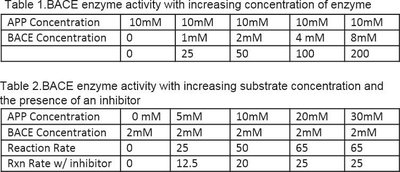
Q24. Draw graphs of both experiments in the space below. Be sure to label the independent and dependent variables.
Background
Topic: Experimental Design and Data Representation
This question is about graphing experimental data to visualize enzyme activity under different conditions.
Key Terms:
Independent variable: The variable you change (e.g., substrate or enzyme concentration).
Dependent variable: The variable you measure (e.g., reaction rate).
Step-by-Step Guidance
Identify the independent and dependent variables for each experiment.
Set up axes for your graphs (x-axis: independent variable, y-axis: dependent variable).
Plot the data points from the tables provided.

Try solving on your own before revealing the answer!
