 Back
Study Guide: Energy, Enzymes, and Metabolism in General Biology
Study Guide - Smart Notes
 Tailored notes based on your materials, expanded with key definitions, examples, and context.
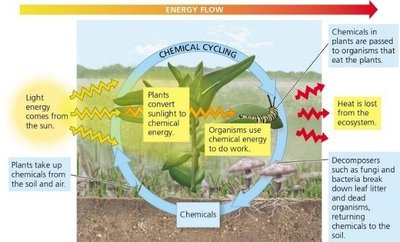
Q1. Explain the flow of energy and chemical recycling in the universe and the role of light energy.
Background
Topic: Energy Flow and Chemical Cycling in Biological Systems
This question tests your understanding of how energy moves through ecosystems and how chemicals are recycled, with a focus on the importance of light energy in these processes.
Key Terms:
Energy flow: The movement of energy through living systems, typically from the sun to producers and then to consumers.
Chemical cycling: The reuse and movement of chemical elements (like carbon, nitrogen) within ecosystems.
Light energy: Energy from the sun, captured by plants during photosynthesis.
Step-by-Step Guidance
Start by identifying the main source of energy for most ecosystems: sunlight.
Describe how plants (producers) convert light energy into chemical energy through photosynthesis.
Explain how this chemical energy is transferred to consumers (animals) when they eat plants.
Discuss how decomposers break down dead organisms, returning chemicals to the soil for reuse by plants.
Consider how energy is lost as heat at each step, and how chemicals are recycled but energy is not.
Try solving on your own before revealing the answer!
Final Answer:
Energy flows through the ecosystem from the sun to plants (producers), then to animals (consumers), and finally to decomposers. Light energy is captured by plants and converted to chemical energy, which is used by organisms to do work. Chemicals are recycled as decomposers return nutrients to the soil, but energy is lost as heat at each step.
Q2. Define metabolism.
Background
Topic: Metabolism
This question is testing your ability to define metabolism and understand its role in living organisms.
Key Terms:
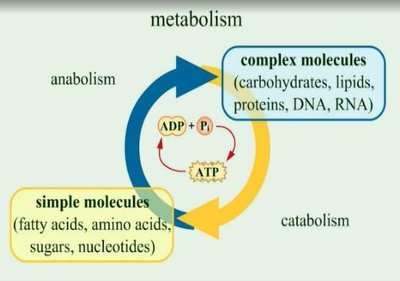
Metabolism: The sum of all chemical reactions that occur within a living organism.
Anabolism: Building up complex molecules from simpler ones.
Catabolism: Breaking down complex molecules into simpler ones.
Step-by-Step Guidance
Begin by stating that metabolism includes all chemical reactions in the cell.
Explain that these reactions are organized into metabolic pathways.
Describe how metabolism includes both anabolic (building) and catabolic (breaking down) processes.
Try solving on your own before revealing the answer!
Final Answer:
Metabolism is the sum of all chemical reactions in a cell, including both anabolic (building up) and catabolic (breaking down) pathways. These reactions allow cells to grow, reproduce, and maintain their structures.
Q3. Describe the difference between anabolic and catabolic pathways. Give an example.
Background
Topic: Metabolic Pathways
This question tests your understanding of the two main types of metabolic pathways and their functions.
Key Terms:
Anabolic pathway: Builds complex molecules from simpler ones, requiring energy.
Catabolic pathway: Breaks down complex molecules into simpler ones, releasing energy.
Step-by-Step Guidance
Define anabolic pathways and describe their role in biosynthesis (e.g., building proteins from amino acids).
Define catabolic pathways and describe their role in breaking down molecules (e.g., cellular respiration breaking down glucose).
Explain how energy is required for anabolism and released during catabolism.
Provide an example for each pathway, but stop before stating the specific example.
Try solving on your own before revealing the answer!
Final Answer:
Anabolic pathways build complex molecules (like proteins) from simpler ones (like amino acids), requiring energy. Catabolic pathways break down complex molecules (like glucose) into simpler ones (like CO2 and H2O), releasing energy. For example, protein synthesis is anabolic, and cellular respiration is catabolic.
Q4. What is energy? Describe the difference between kinetic, potential, and chemical energy. Give an example.
Background
Topic: Types of Energy in Biology
This question tests your understanding of energy and its various forms relevant to biological systems.
Key Terms:
Energy: The capacity to do work or cause change.
Kinetic energy: Energy of motion.
Potential energy: Stored energy due to position or structure.
Chemical energy: Energy stored in chemical bonds.
Step-by-Step Guidance
Define energy in the context of biology.
Describe kinetic energy and provide a biological example (e.g., movement of molecules).
Describe potential energy and provide a biological example (e.g., concentration gradients).
Describe chemical energy and provide a biological example (e.g., ATP molecules).
Set up examples for each type, but stop before stating the specific examples.
Try solving on your own before revealing the answer!
Final Answer:
Energy is the ability to do work. Kinetic energy is the energy of movement (e.g., muscle contraction), potential energy is stored energy (e.g., a molecule on one side of a membrane), and chemical energy is stored in bonds (e.g., ATP).
Q5. Using the figure above, describe which processes are anabolic and catabolic and the types of energy for each.
Background
Topic: Metabolic Pathways and Energy Types
This question tests your ability to interpret a diagram of metabolism and identify anabolic and catabolic processes, as well as the types of energy involved.
Key Terms:
Anabolism: Building complex molecules, requires energy.
Catabolism: Breaking down complex molecules, releases energy.
ATP: Adenosine triphosphate, the main energy carrier in cells.
Step-by-Step Guidance
Examine the diagram and identify the direction of anabolic and catabolic pathways.
Describe how anabolic processes use ATP to build complex molecules from simple ones.
Describe how catabolic processes break down complex molecules, releasing energy and producing ATP.
Identify the types of energy involved in each process, but stop before stating the specific energy types.
Try solving on your own before revealing the answer!
Final Answer:
Anabolic processes build complex molecules (like proteins) from simple ones (like amino acids) using ATP. Catabolic processes break down complex molecules (like carbohydrates) into simple ones, releasing energy and producing ATP.
Q6. Describe the structure of ATP and how it is able to drive biological reactions.
Background
Topic: ATP Structure and Function
This question tests your understanding of ATP (adenosine triphosphate) and its role in cellular energy transfer.
Key Terms:
ATP: Adenosine triphosphate, a molecule with three phosphate groups.
Phosphorylation: Addition of a phosphate group to a molecule.
Energy coupling: Using energy released from ATP hydrolysis to drive other reactions.
Step-by-Step Guidance
Describe the structure of ATP: adenine, ribose, and three phosphate groups.
Explain how breaking the bond between the second and third phosphate releases energy.
Discuss how ATP hydrolysis is used to drive endergonic (energy-requiring) reactions in cells.
Set up the equation for ATP hydrolysis, but stop before stating the products.
Try solving on your own before revealing the answer!
Final Answer:
ATP consists of adenine, ribose, and three phosphate groups. When the terminal phosphate is removed (hydrolysis), energy is released and used to drive biological reactions. The equation is: .
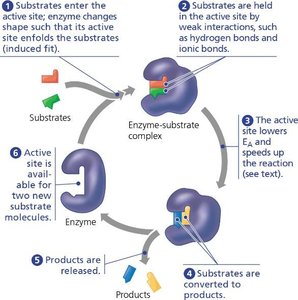
Q8. What are enzymes and describe how they work. Use the figure to the left.
Background
Topic: Enzyme Function
This question tests your understanding of enzymes as biological catalysts and their mechanism of action.
Key Terms:
Enzyme: Protein that speeds up chemical reactions.
Active site: Region of the enzyme where substrate binds.
Substrate: The molecule upon which an enzyme acts.
Enzyme-substrate complex: Temporary association between enzyme and substrate.
Step-by-Step Guidance
Describe how substrates enter the active site of the enzyme.
Explain how the enzyme changes shape to fit the substrate (induced fit).
Discuss how the active site lowers activation energy and speeds up the reaction.
Describe how products are released and the enzyme is ready for another cycle.
Try solving on your own before revealing the answer!
Final Answer:
Enzymes are proteins that catalyze reactions by binding substrates at their active site, lowering activation energy, converting substrates to products, and releasing them. The enzyme is then ready to repeat the process.
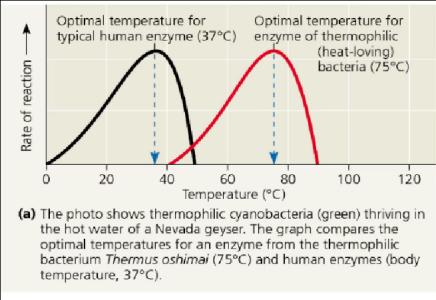
Q20. Below is a graph of a human enzyme at its optimal temperature. Write a detailed description of this figure below. Be sure to describe what is happening on the x axis with respect to the y-axis. Also compare both lines. How does this agree with the concept that environmental factors affect protein structure? (fig 6.16)
Background
Topic: Enzyme Activity and Environmental Factors
This question tests your ability to interpret a graph showing enzyme activity at different temperatures and relate it to protein structure and function.
Key Terms:
Optimal temperature: The temperature at which enzyme activity is highest.
Thermophilic bacteria: Bacteria that thrive at high temperatures.
Denaturation: Loss of protein structure and function due to environmental changes.
Step-by-Step Guidance
Examine the x-axis (temperature) and y-axis (rate of reaction) of the graph.
Describe how the rate of reaction increases with temperature up to an optimal point for each enzyme.
Compare the optimal temperature for human enzymes (37°C) and thermophilic bacteria enzymes (75°C).
Discuss how enzyme activity drops off after the optimal temperature, indicating denaturation.
Try solving on your own before revealing the answer!
Final Answer:
The graph shows that human enzymes have optimal activity at 37°C, while thermophilic bacteria enzymes peak at 75°C. As temperature increases past the optimum, enzyme activity decreases due to denaturation. This demonstrates that environmental factors like temperature affect protein structure and function.
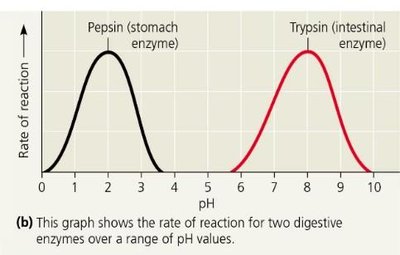
Q21. This graph shows the enzyme activity for an enzyme at various pH values. Label which line would represent an enzyme in the stomach under acidic conditions? What about the small intestine at basic conditions?
Background
Topic: Enzyme Activity and pH
This question tests your ability to interpret a graph showing enzyme activity at different pH values and relate it to digestive enzymes in the stomach and small intestine.
Key Terms:
Optimal pH: The pH at which enzyme activity is highest.
Pepsin: Stomach enzyme with optimal activity at acidic pH (~2).
Trypsin: Intestinal enzyme with optimal activity at basic pH (~8).
Step-by-Step Guidance
Examine the x-axis (pH) and y-axis (rate of reaction) of the graph.
Identify which curve peaks at low pH and which at high pH.
Relate the low pH peak to stomach enzymes and the high pH peak to intestinal enzymes.
Try solving on your own before revealing the answer!
Final Answer:
The black line represents pepsin, a stomach enzyme with optimal activity at acidic pH (~2). The red line represents trypsin, an intestinal enzyme with optimal activity at basic pH (~8).
