 Back
BackStudy Guide: Enzymes & Energy (Bio 121, Chapter 5)
Study Guide - Smart Notes
 Tailored notes based on your materials, expanded with key definitions, examples, and context.
Q1. A steer must eat at least 100 pounds of grain to gain less than 10 pounds of muscle tissue. What does this illustrate?
Background
Topic: Laws of Thermodynamics in Biology
This question tests your understanding of how energy is transferred and transformed in biological systems, specifically the efficiency of energy conversion in living organisms.
Key Terms:
First Law of Thermodynamics: Energy cannot be created or destroyed, only transformed.
Second Law of Thermodynamics: Every energy transfer increases the entropy (disorder) of the universe; energy conversions are not 100% efficient.
Energy Efficiency: The proportion of input energy converted to useful output.
Step-by-Step Guidance
Consider what happens to the energy in the grain as the steer eats and digests it. Not all energy is converted to muscle tissue; some is lost as heat or used for other metabolic processes.
Recall which law of thermodynamics explains why energy conversions are not 100% efficient and why some energy is always lost as heat.
Think about whether energy is destroyed or simply transformed into less useful forms during these conversions.
Try solving on your own before revealing the answer!
Q2. When a cell uses chemical energy to perform work, it uses the energy released from a(n) ______ reaction to drive a(n) ______ reaction.
Background
Topic: Coupled Reactions in Cellular Metabolism
This question is about how cells couple energy-releasing (exergonic) reactions to energy-consuming (endergonic) reactions to perform work.
Key Terms:
Exergonic Reaction: Releases energy (e.g., breakdown of glucose).
Endergonic Reaction: Requires energy input (e.g., synthesis of macromolecules).
Coupling: Using the energy from one reaction to drive another.
Step-by-Step Guidance
Recall which type of reaction releases energy and which requires energy input.
Think about how ATP hydrolysis is used in cells to drive processes that would not occur spontaneously.
Match the terms "exergonic" and "endergonic" to the correct blanks in the question.
Try solving on your own before revealing the answer!
Q3. When an enzyme catalyzes a reaction, what does it do?
Background
Topic: Enzyme Function
This question tests your understanding of how enzymes affect the activation energy and rate of biochemical reactions.
Key Terms:
Enzyme: A biological catalyst that speeds up reactions without being consumed.
Activation Energy (Ea): The energy required to start a reaction.
Step-by-Step Guidance
Recall the role of enzymes in lowering the activation energy barrier for reactions.
Consider whether enzymes are changed or used up during the reaction.
Think about whether enzymes act as reactants or products in the reaction.
Try solving on your own before revealing the answer!
Q4. Substrates bind to an enzyme's ________ site.
Background
Topic: Enzyme Structure and Function
This question is about the specific region of an enzyme where the substrate binds and the reaction occurs.
Key Terms:
Substrate: The reactant that an enzyme acts on.
Active Site: The region on the enzyme where the substrate binds.
Allosteric Site: A site other than the active site that can regulate enzyme activity.
Step-by-Step Guidance
Recall the definition of the active site and its role in enzyme specificity.
Consider the difference between the active site and other regulatory sites on the enzyme.
Match the correct term to the blank in the question.
Try solving on your own before revealing the answer!
Q5. Which of the following statements regarding enzyme function is false?
Background
Topic: Properties of Enzymes
This question tests your understanding of the characteristics and behavior of enzymes during catalysis.
Key Terms:
Specificity: Enzymes are specific to their substrates due to their shape.
Reusability: Enzymes are not consumed in the reaction.
Three-dimensional Shape: The function of an enzyme depends on its structure.
Step-by-Step Guidance
Review each statement and recall what you know about enzyme function.
Identify which statement contradicts the general properties of enzymes.
Remember that enzymes are not used up in reactions and can be reused.
Try solving on your own before revealing the answer!
Q6. Heating inactivates enzymes by ________.
Background
Topic: Enzyme Denaturation
This question is about how temperature affects enzyme structure and function.
Key Terms:
Denaturation: Loss of enzyme structure and function due to environmental changes.
Peptide Bonds: Bonds that link amino acids in proteins.
Three-dimensional Shape: Critical for enzyme activity.
Step-by-Step Guidance
Recall what happens to proteins (including enzymes) when they are exposed to high heat.
Think about whether heat breaks peptide bonds or disrupts weaker interactions (like hydrogen bonds).
Consider how changes in shape affect enzyme activity.
Try solving on your own before revealing the answer!
Q7. Bacterial production of the enzymes needed for the synthesis of the amino acid tryptophan declines with increasing levels of tryptophan and increases as tryptophan levels decline. This is an example of ________.
Background
Topic: Enzyme Regulation
This question is about feedback mechanisms that regulate enzyme activity and metabolic pathways.
Key Terms:
Feedback Inhibition: The end product of a pathway inhibits an earlier step.
Competitive Inhibition: Inhibitor binds to the active site.
Noncompetitive Inhibition: Inhibitor binds elsewhere, changing enzyme shape.
Step-by-Step Guidance
Consider how the cell regulates the production of tryptophan based on its concentration.
Recall which type of inhibition involves the end product of a pathway inhibiting its own synthesis.
Match the correct inhibition type to the scenario described.
Try solving on your own before revealing the answer!
Q8. How does inhibition of an enzyme-catalyzed reaction by a competitive inhibitor differ from inhibition by a noncompetitive inhibitor?
Background
Topic: Enzyme Inhibition
This question tests your understanding of the mechanisms by which inhibitors affect enzyme activity.
Key Terms:
Competitive Inhibitor: Binds to the active site, blocking substrate binding.
Noncompetitive Inhibitor: Binds to an allosteric site, changing enzyme shape.
Allosteric Site: A site other than the active site that can regulate enzyme activity.
Step-by-Step Guidance
Recall where each type of inhibitor binds on the enzyme.
Think about how each inhibitor affects the enzyme's ability to bind substrate and catalyze the reaction.
Match the correct descriptions to competitive and noncompetitive inhibition.
Try solving on your own before revealing the answer!
Q9. Which of the following processes is endergonic?
Background
Topic: Energy in Chemical Reactions
This question is about distinguishing between energy-releasing (exergonic) and energy-requiring (endergonic) processes.
Key Terms:
Endergonic Reaction: Requires energy input (e.g., synthesis of glucose).
Exergonic Reaction: Releases energy (e.g., burning of wood, cellular respiration).
Step-by-Step Guidance
Review the definitions of endergonic and exergonic reactions.
Identify which process involves the synthesis of complex molecules from simpler ones, requiring energy input.
Match the correct process to the definition of endergonic.
Try solving on your own before revealing the answer!
Q10. Which of the following would be the same in both an enzyme-catalyzed and a noncatalyzed reaction?
Background
Topic: Enzyme Catalysis and Reaction Energy Diagrams
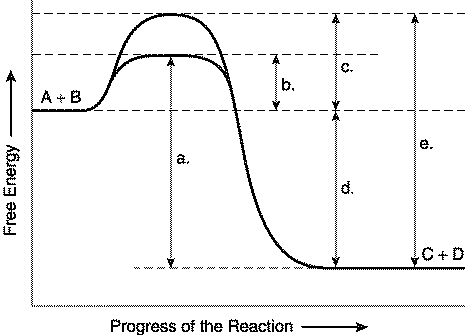
This question uses a reaction energy diagram to compare catalyzed and uncatalyzed reactions. It tests your understanding of what changes and what stays the same when an enzyme is present.
Key Terms:
Activation Energy (Ea): The energy required to start a reaction.
Free Energy Change (ΔG): The difference in energy between reactants and products.
Step-by-Step Guidance
Examine the diagram and identify which labeled distances represent activation energy and which represent the overall free energy change.
Recall that enzymes lower activation energy but do not change the overall free energy change (ΔG) of the reaction.
Determine which labeled value would be the same with or without the enzyme.
Try solving on your own before revealing the answer!
Q11. Which of the following represents the activation energy required for the “non-enzyme-catalyzed reaction”?
Background
Topic: Activation Energy in Reaction Diagrams
This question asks you to identify the activation energy for the uncatalyzed reaction on the energy diagram.
Key Terms:
Activation Energy (Ea): The energy barrier that must be overcome for a reaction to proceed.
Energy Diagram: Visual representation of energy changes during a reaction.
Step-by-Step Guidance
Look at the diagram and find the curve representing the reaction without the enzyme (higher peak).
Identify which labeled distance (a, b, c, d, or e) corresponds to the activation energy for the non-catalyzed reaction.
Remember that activation energy is the energy difference between the reactants and the highest point on the curve.
Try solving on your own before revealing the answer!
Q12. Which part of the ATP molecule breaks free of the rest when an ATP molecule is used for energy?
Background
Topic: ATP Structure and Function
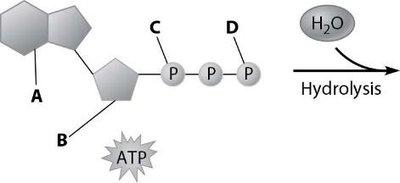
This question is about the structure of ATP and what happens during ATP hydrolysis to release energy for cellular work.
Key Terms:
ATP (Adenosine Triphosphate): The main energy currency of the cell.
Phosphate Groups: ATP contains three phosphate groups; breaking one off releases energy.
Hydrolysis: The chemical process that splits ATP into ADP and a free phosphate group.
Step-by-Step Guidance
Examine the ATP diagram and identify the three phosphate groups (C, D, and the third one).
Recall that ATP hydrolysis involves breaking the bond between the second and third phosphate groups.
Determine which labeled part (A, B, C, or D) is the phosphate group that is released during hydrolysis.
Try solving on your own before revealing the answer!
