 Back
Study Guide: Evolution and Diversity of Animals (General Biology) Chapter 17
Study Guide - Smart Notes
 Tailored notes based on your materials, expanded with key definitions, examples, and context.
Q1. Which hypothesis might best explain the rapid appearance of so many kinds of animals during the Cambrian period?
Background
Topic: Cambrian Explosion & Animal Evolution
This question explores the possible explanations for the sudden increase in animal diversity seen in the fossil record during the Cambrian period, a major event in evolutionary biology.
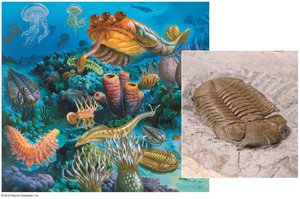
Key Terms:
Cambrian Explosion: A period about 541 million years ago when most major animal phyla appeared.
Hox genes: Regulatory genes that control body plan development.
Predator-prey relationships: Interactions that can drive evolutionary change.
Oxygen accumulation: Increased atmospheric oxygen may have enabled more active animal lifestyles.
Step-by-Step Guidance
Consider the role of environmental changes, such as increased oxygen levels, in supporting more active and complex animal life.
Think about how new genetic mechanisms, like the evolution of Hox genes, could allow for greater diversity in animal body plans.
Reflect on how ecological interactions, such as predator-prey relationships, might drive rapid diversification.
Evaluate whether multiple factors could have contributed simultaneously, and why more evidence might be needed to confirm the main cause.
Try solving on your own before revealing the answer!
Final Answer:
All three hypotheses—complex predator-prey relationships, increased oxygen, and the evolution of Hox genes—could have contributed to the rapid diversification of animals during the Cambrian period. More evidence is needed to determine the primary cause, but it is likely that multiple factors worked together.
Q2. What is the body plan feature shared by most animals?
Background
Topic: Animal Body Plans & Evolution
This question tests your understanding of the key structural features that are common among most animal groups, as revealed by evolutionary relationships.
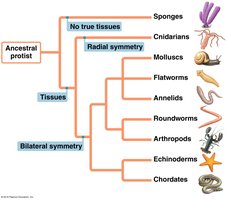
Key Terms:
True tissues: Groups of cells with a common structure and function.
Bilateral symmetry: Body plan with left and right sides that are mirror images.
Radial symmetry: Body plan arranged around a central axis.
Step-by-Step Guidance
Review the evolutionary tree of animals to see which features are present in most groups.
Compare the presence of true tissues, bilateral symmetry, and radial symmetry across major animal phyla.
Identify which feature is most widespread among animals, especially those with complex body plans.
Consider the evolutionary significance of this feature in terms of movement and organ development.
Try solving on your own before revealing the answer!
Final Answer:
Bilateral symmetry is the body plan feature shared by most animals. This symmetry allows for directional movement and the development of complex organs.
Q3. What adaptation allowed land vertebrates to complete their life cycle on land?
Background
Topic: Vertebrate Evolution & Adaptations
This question focuses on the evolutionary innovations that enabled vertebrates to reproduce and survive entirely on land, overcoming the limitations of amphibians.
Key Terms:
Amniotic egg: An egg with a protective shell and membranes, allowing development away from water.
Endothermic regulation: Maintaining body temperature internally.
Keratin: Protein that waterproofs skin.
Feathers: Adaptation for flight and insulation.
Step-by-Step Guidance
Recall the life cycle of amphibians and why they require water for reproduction.
Identify the adaptation that allows vertebrates to lay eggs and develop embryos on land.
Compare the listed adaptations and determine which is directly related to completing the life cycle away from water.
Think about how this adaptation changed vertebrate evolution and allowed colonization of terrestrial environments.
Try solving on your own before revealing the answer!
Final Answer:
The amniotic egg—a "self-contained pond"—is the adaptation that allowed land vertebrates to complete their life cycle on land. It protects the embryo and provides a stable environment away from water.
Q4. Between 5 and 7 million years ago, humans and apes diverged from which ancestor?
Background
Topic: Human Evolution & Primate Relationships
This question examines the evolutionary lineage of humans and apes, focusing on their common ancestor and divergence timeline.
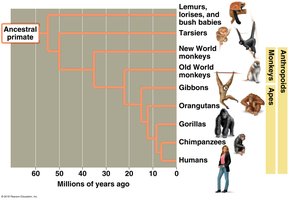
Key Terms:
Ape-like ancestor: The last common ancestor shared by humans and modern apes.
New World monkeys: Primates found in the Americas.
Old World monkeys: Primates found in Africa and Asia.
Prosimians: Early primates, including lemurs and tarsiers.
Step-by-Step Guidance
Examine the primate evolutionary tree to identify the branching point between humans and apes.
Compare the listed groups and determine which is closest to the divergence point.
Consider the characteristics of the ancestor shared by humans and apes.
Think about the timeline and which group humans and apes diverged from most recently.
Try solving on your own before revealing the answer!
Final Answer:
Humans and apes diverged from an ape-like ancestor between 5 and 7 million years ago. This ancestor was not a modern monkey or prosimian, but a species with characteristics shared by both groups.
Q5. Which hominin shows a dramatic jump in brain size?
Background
Topic: Hominin Evolution & Brain Development
This question tests your knowledge of the evolutionary history of hominins and the changes in brain size that occurred over time.
Key Terms:
Hominins: The group that includes modern humans and their extinct relatives.
Australopithecus: Early hominin genus.
Homo habilis: Early member of the genus Homo.
Paranthropus: Extinct hominin genus.
Step-by-Step Guidance
Review the timeline of hominin evolution and the changes in brain size.
Compare the brain sizes of Australopithecus, Homo habilis, and Paranthropus species.
Identify which hominin is associated with a significant increase in brain volume.
Consider the implications of increased brain size for tool use and behavior.
Try solving on your own before revealing the answer!
Final Answer:
Homo habilis shows a dramatic jump in brain size compared to earlier hominins like Australopithecus. This increase is linked to more advanced tool use and cognitive abilities.
Q6. Walking through a tropical rainforest, you suddenly realize that there is a worm-like creature sucking your blood while attached to your skin. What is it?
Background
Topic: Animal Diversity & Parasitism
This question tests your ability to identify animal groups based on their behavior and ecological role, specifically parasitic organisms.
Key Terms:
Leech: Parasitic annelid known for sucking blood.
Earthworm: Non-parasitic annelid.
Roundworm: Parasitic or free-living nematode.
Flatworm: Includes parasitic and free-living species.
Arachnid: Includes spiders and ticks, not worm-like.
Step-by-Step Guidance
Consider the physical description: worm-like and attached to skin.
Recall which animal groups are known for blood-sucking behavior.
Eliminate options that do not fit the description or behavior (e.g., earthworm, arachnid).
Identify the most likely candidate based on parasitic lifestyle and habitat.
Try solving on your own before revealing the answer!
Final Answer:
The creature is a leech, a parasitic annelid that attaches to skin and sucks blood.
