 Back
Study Guide: Evolution of Microbial Life & Protists Chapter 15
Study Guide - Smart Notes
 Tailored notes based on your materials, expanded with key definitions, examples, and context.
Q1. The first prokaryotes appeared on Earth approximately _______ years ago.
Background
Topic: Early Evolution of Life
This question tests your understanding of the timeline of life's origins, specifically when prokaryotes first appeared on Earth.
Key Terms:
Prokaryotes: Simple, single-celled organisms without a nucleus.
Geological time scale: The history of Earth divided into eons, eras, and periods.
Step-by-Step Guidance
Recall that prokaryotes are the earliest forms of life, predating eukaryotes.
Consider the age of Earth (about 4.6 billion years) and when life is thought to have first appeared.
Compare the answer choices to the timeline of major biological events.
Eliminate options that are too recent or too old for the first prokaryotes.
Try solving on your own before revealing the answer!
Final Answer: 3.5 billion years ago
The first prokaryotes appeared about 3.5 billion years ago, shortly after Earth cooled enough to support life.
Q2. The appearance of modern humans, Homo sapiens, occurred approximately _______ years ago.
Background
Topic: Human Evolution
This question is about the timeline for the emergence of Homo sapiens, our own species.
Key Terms:
Homo sapiens: The scientific name for modern humans.
Evolution: The process by which species change over time.
Step-by-Step Guidance
Recall the approximate age of the Earth and the timeline for the evolution of humans.
Consider the fossil record and genetic evidence for the origin of Homo sapiens.
Compare the answer choices to what you know about human evolution.
Eliminate options that are inconsistent with the scientific consensus.
Try solving on your own before revealing the answer!
Final Answer: 195,000 years ago
Modern humans, Homo sapiens, appeared about 195,000 years ago, based on fossil and genetic evidence.
Q3. Which of the following do the Archaea and the Bacteria have in common?
Background
Topic: Domains of Life
This question tests your understanding of the similarities and differences between the two prokaryotic domains: Archaea and Bacteria.
Key Terms:
Prokaryotes: Organisms without a membrane-bound nucleus.
Archaea: One domain of prokaryotes, often found in extreme environments.
Bacteria: Another domain of prokaryotes, found in many environments.
Step-by-Step Guidance
Review the characteristics of prokaryotes and the two domains.
Consider which features are shared by both Archaea and Bacteria.
Evaluate each answer choice for accuracy.
Eliminate options that are not true for both domains.
Try solving on your own before revealing the answer!
Final Answer: Both domains consist of prokaryotes.
Archaea and Bacteria are both prokaryotic domains, meaning their cells lack a membrane-bound nucleus.
Q4. In what way are the protozoan flagellates and dinoflagellates similar to each other?
Background
Topic: Protist Diversity
This question is about the similarities between two groups of protists: protozoan flagellates and dinoflagellates.
Key Terms:
Flagella: Whip-like structures used for movement.
Protozoan flagellates: Protists that move using flagella.
Dinoflagellates: Mostly aquatic protists, some of which are photosynthetic and have flagella.
Step-by-Step Guidance
Recall the main features of protozoan flagellates and dinoflagellates.
Consider their methods of movement and whether they share other characteristics.
Evaluate each answer choice for accuracy.
Eliminate options that are not true for both groups.
Try solving on your own before revealing the answer!
Final Answer: Both have one or more flagella for movement.
Both protozoan flagellates and dinoflagellates use flagella to move, which is a key similarity.
Q5. If you found a new kind of photosynthetic protist with glass around its cells, you would have a _______.
Background
Topic: Protist Classification
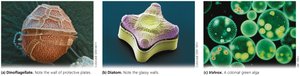
This question tests your ability to identify protists based on their structural features, specifically the presence of a glass-like cell wall.
Key Terms:
Photosynthetic protist: A protist capable of photosynthesis.
Diatom: A type of protist with a silica (glass-like) cell wall.
Dinoflagellate, red alga, green alga, brown alga: Other types of protists and algae with different cell wall structures.
Step-by-Step Guidance
Recall which protists have a glass-like (silica) cell wall.
Compare the structural features of diatoms, dinoflagellates, and various algae.
Use the image provided to identify the protist with glass around its cells.
Eliminate answer choices that do not match the description.
Try solving on your own before revealing the answer!
Final Answer: Diatom
Diatoms are photosynthetic protists with a glass-like (silica) cell wall, as shown in the image.
