 Back
BackStudy Guide for Aerobic Cellular Respiration and Fermentation (BIOLOGY 189 Lab 10)
Study Guide - Smart Notes
 Tailored notes based on your materials, expanded with key definitions, examples, and context.
Q1. What is the difference between cellular respiration and breathing?
Background
Topic: Cellular Respiration vs. Breathing
This question is testing your understanding of the distinction between the physiological process of breathing and the biochemical process of cellular respiration.
Key Terms:
Cellular Respiration: The process by which cells convert glucose and oxygen into ATP, carbon dioxide, and water.
Breathing: The physical act of inhaling oxygen and exhaling carbon dioxide from the lungs.
Step-by-Step Guidance
Consider the location and purpose of each process: Breathing occurs in the respiratory system, while cellular respiration occurs inside cells.
Think about what each process accomplishes: Breathing brings oxygen into the body and removes carbon dioxide, while cellular respiration uses oxygen to produce energy (ATP).
Reflect on how these processes are connected: Oxygen obtained from breathing is used in cellular respiration, and carbon dioxide produced by cellular respiration is expelled during breathing.
Try solving on your own before revealing the answer!
Final Answer:
Breathing is the physical process of moving air in and out of the lungs, while cellular respiration is the chemical process in cells that uses oxygen to convert glucose into ATP, producing carbon dioxide and water as byproducts.
Cellular respiration depends on oxygen supplied by breathing, and the carbon dioxide produced is removed from the body by breathing.
Q2. What is the chemical reaction for aerobic cellular respiration?
Background
Topic: Aerobic Cellular Respiration Equation
This question is testing your ability to recall and write the balanced chemical equation for aerobic cellular respiration.
Key Terms and Formula:
Glucose ()
Oxygen ()
Carbon Dioxide ()
Water ()
ATP (energy molecule)
Key formula:
Step-by-Step Guidance
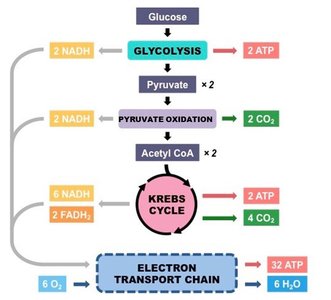
Identify the reactants: glucose and oxygen.
Identify the products: carbon dioxide, water, and energy (ATP).
Balance the equation so that the number of atoms for each element is equal on both sides.
Try solving on your own before revealing the answer!
Final Answer:
The balanced chemical equation for aerobic cellular respiration is:
This equation shows that glucose and oxygen are converted into carbon dioxide, water, and energy.
Q3. What are the chemical pathways in aerobic cellular respiration?
Background
Topic: Pathways of Aerobic Cellular Respiration
This question is testing your knowledge of the sequence of metabolic pathways involved in aerobic cellular respiration.
Key Terms:
Glycolysis
Pyruvate Oxidation (Transition Reaction)
Krebs Cycle (Citric Acid Cycle)
Electron Transport Chain/Oxidative Phosphorylation
Step-by-Step Guidance
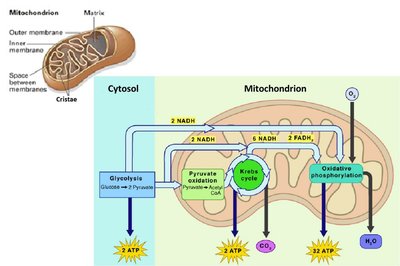
Recall the first pathway: Glycolysis occurs in the cytosol and breaks down glucose into pyruvate.
Remember the second pathway: Pyruvate oxidation converts pyruvate into Acetyl CoA in the mitochondrial matrix.
Identify the third pathway: The Krebs cycle processes Acetyl CoA to produce NADH, FADH2, ATP, and CO2.
Recognize the final pathway: The electron transport chain uses NADH and FADH2 to generate ATP and water on the inner mitochondrial membrane.
Try solving on your own before revealing the answer!
Final Answer:
The four main pathways are: glycolysis, pyruvate oxidation (transition reaction), Krebs cycle (citric acid cycle), and electron transport chain/oxidative phosphorylation.
Each pathway occurs in a specific location within the cell and contributes to the overall production of ATP.
Q4. What did blowing into the water do to the pH of the water? Why did this happen?
Background
Topic: Carbon Dioxide and pH Change
This question is testing your understanding of how exhaled carbon dioxide affects the pH of water and the chemical reactions involved.
Key Terms and Formula:
Carbon Dioxide ()
Water ()
Carbonic Acid ()
pH: A measure of acidity or alkalinity
Step-by-Step Guidance
Recall that exhaled breath contains carbon dioxide.
When carbon dioxide dissolves in water, it forms carbonic acid.
Carbonic acid dissociates into hydrogen ions and bicarbonate, lowering the pH (making the solution more acidic).
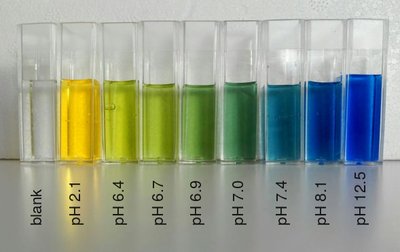
Observe the color change in the pH indicator (BTB) as the pH decreases.
Try solving on your own before revealing the answer!
Final Answer:
Blowing into the water decreased the pH, making it more acidic. This happened because carbon dioxide from your breath dissolved in the water, forming carbonic acid, which releases hydrogen ions and lowers the pH.
The color change in BTB from blue to yellow indicates this acidification.
Q5. What is the difference between fermentation and aerobic respiration?
Background
Topic: Fermentation vs. Aerobic Respiration
This question is testing your understanding of the differences between fermentation and aerobic respiration, including their requirements and products.
Key Terms:
Aerobic Respiration: Requires oxygen, produces large amounts of ATP.
Fermentation: Occurs without oxygen, produces much less ATP.
ATP: Adenosine triphosphate, the energy currency of the cell.
Step-by-Step Guidance
Recall that aerobic respiration uses oxygen and produces more ATP.
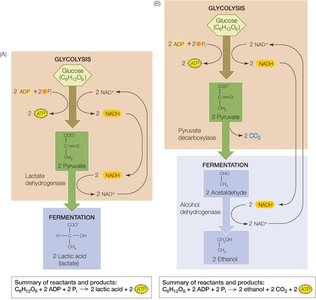
Fermentation occurs in the absence of oxygen and allows glycolysis to continue, but produces much less ATP.
Compare the end products: aerobic respiration produces CO2 and H2O, while fermentation produces lactic acid or ethanol and CO2 (depending on the organism).
Try solving on your own before revealing the answer!
Final Answer:
Aerobic respiration requires oxygen and produces much more ATP, while fermentation occurs without oxygen and produces much less ATP, allowing glycolysis to continue.
Fermentation results in different end products depending on the organism (lactic acid, ethanol, etc.).
