 Back
Study Guide for Exam 3: Cellular Respiration & Redox Reactions
Study Guide - Smart Notes
 Tailored notes based on your materials, expanded with key definitions, examples, and context.
Q1. What are chemical reactions involving the transfer of electrons called?
Background
Topic: Redox Reactions
This question tests your understanding of the terminology used for reactions where electrons are transferred between molecules, which is fundamental in cellular metabolism.
Key Terms:
Oxidation: Loss of electrons
Reduction: Gain of electrons
Redox Reaction: A chemical reaction involving both reduction and oxidation.
Step-by-Step Guidance
Recall the definition of oxidation and reduction.
Think about the term that combines both processes.
Consider examples from cellular respiration where electrons are transferred.
Try solving on your own before revealing the answer!
Final Answer: Redox reactions
These reactions are called redox reactions because they involve both reduction and oxidation processes.
Q2. What are the electron donors in cells?
Background
Topic: Electron Donors in Metabolism
This question is about identifying molecules that provide electrons during metabolic reactions, especially in cellular respiration.
Key Terms:
Electron donor: A molecule that loses electrons (is oxidized).
NADH, FADH2: Common electron donors in cells.
Step-by-Step Guidance
Recall which molecules are oxidized during cellular respiration.
Think about the role of NADH and FADH2 in the electron transport chain.
Consider the initial sources of electrons in glycolysis and the citric acid cycle.
Try solving on your own before revealing the answer!
Final Answer: NADH and FADH2
These molecules donate electrons to the electron transport chain, enabling ATP production.
Q3. What happens when a reactant becomes oxidized?
Background
Topic: Oxidation in Redox Reactions
This question tests your understanding of what occurs at the molecular level when a reactant is oxidized.
Key Terms:
Oxidation: Loss of electrons, often accompanied by loss of hydrogen or gain of oxygen.
Step-by-Step Guidance
Recall the definition of oxidation.
Think about what happens to the electron count of the molecule.
Consider how this affects the molecule's charge or bonding.
Try solving on your own before revealing the answer!
Final Answer: The reactant loses electrons
When a reactant is oxidized, it loses electrons and often becomes more positively charged or gains oxygen atoms.
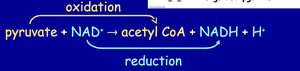
Q4. Identify the oxidizing agent and the reducing agent in the reaction: pyruvate + NAD+ → acetyl CoA + NADH + H+
Background
Topic: Identifying Agents in Redox Reactions
This question asks you to determine which molecule is the oxidizing agent and which is the reducing agent in a key metabolic reaction.
Key Terms:
Oxidizing agent: The molecule that gains electrons (is reduced).
Reducing agent: The molecule that loses electrons (is oxidized).
Step-by-Step Guidance
Examine the reaction: pyruvate + NAD+ → acetyl CoA + NADH + H+.
Identify which molecule is losing electrons (being oxidized).
Identify which molecule is gaining electrons (being reduced).
Assign the roles of oxidizing agent and reducing agent based on these changes.
Try solving on your own before revealing the answer!
Final Answer: NAD+ is the oxidizing agent; pyruvate is the reducing agent
NAD+ accepts electrons and is reduced to NADH, making it the oxidizing agent. Pyruvate loses electrons and is oxidized to acetyl CoA, making it the reducing agent.
Q5. How many pathways are there in aerobic respiration? What are the pathways?
Background
Topic: Pathways of Cellular Respiration
This question tests your knowledge of the main stages of aerobic respiration in cells.
Key Terms:
Aerobic respiration: Cellular process that uses oxygen to produce ATP.
Pathways: Glycolysis, Citric Acid Cycle, Electron Transport Chain.
Step-by-Step Guidance
Recall the overall process of aerobic respiration.
List the main metabolic pathways involved.
Think about the order in which these pathways occur.
Try solving on your own before revealing the answer!
Final Answer: Three pathways—Glycolysis, Citric Acid Cycle, Electron Transport Chain
Aerobic respiration consists of glycolysis, the citric acid cycle (Krebs cycle), and the electron transport chain.
Q6. How many ATP are yielded per molecule of glucose during aerobic respiration?
Background
Topic: ATP Yield in Cellular Respiration
This question tests your understanding of the total energy output from one glucose molecule in aerobic respiration.
Key Terms:
ATP: Adenosine triphosphate, the energy currency of the cell.
Yield: Total number produced per glucose.
Step-by-Step Guidance
Recall the ATP produced in glycolysis, citric acid cycle, and electron transport chain.
Add up the ATP from each pathway.
Consider the theoretical maximum yield versus actual yield.
Try solving on your own before revealing the answer!
Final Answer: About 30–32 ATP per glucose
The theoretical maximum is 38 ATP, but the actual yield is typically 30–32 due to losses and inefficiencies.
Q7. How many ATP are made during each step of cellular respiration?
Background
Topic: ATP Production by Pathway
This question asks you to break down ATP production by glycolysis, citric acid cycle, and electron transport chain.
Key Terms:
Glycolysis: Produces a small amount of ATP.
Citric Acid Cycle: Produces a small amount of ATP.
Electron Transport Chain: Produces most ATP.
Step-by-Step Guidance
Recall the ATP produced in glycolysis (substrate-level phosphorylation).
Recall the ATP produced in the citric acid cycle (substrate-level phosphorylation).
Recall the ATP produced in the electron transport chain (oxidative phosphorylation).
Add up the ATP from each step to get the total.
Try solving on your own before revealing the answer!
Final Answer: Glycolysis: 2 ATP; Citric Acid Cycle: 2 ATP; Electron Transport Chain: 26–28 ATP
Most ATP is produced during oxidative phosphorylation in the electron transport chain.
Q8. What type of phosphorylation is used to produce ATP in the electron transport chain?
Background
Topic: ATP Production Mechanisms
This question tests your knowledge of how ATP is synthesized in the final stage of cellular respiration.
Key Terms:
Oxidative phosphorylation: ATP production using energy from electron transport and chemiosmosis.
Step-by-Step Guidance
Recall the mechanism of ATP synthesis in the electron transport chain.
Identify the type of phosphorylation involved.
Consider the role of oxygen and the proton gradient.
Try solving on your own before revealing the answer!
Final Answer: Oxidative phosphorylation
ATP is produced by oxidative phosphorylation in the electron transport chain.
Q9. What type of phosphorylation is used to produce ATP in glycolysis?
Background
Topic: ATP Production in Glycolysis
This question tests your understanding of the mechanism of ATP synthesis during glycolysis.
Key Terms:
Substrate-level phosphorylation: Direct transfer of a phosphate group to ADP from a substrate.
Step-by-Step Guidance
Recall how ATP is produced in glycolysis.
Identify the type of phosphorylation involved.
Consider the difference between substrate-level and oxidative phosphorylation.
Try solving on your own before revealing the answer!
Final Answer: Substrate-level phosphorylation
ATP is produced by substrate-level phosphorylation during glycolysis.
Q10. What type of phosphorylation is used to produce ATP in the citric acid cycle?
Background
Topic: ATP Production in Citric Acid Cycle
This question tests your understanding of the mechanism of ATP synthesis during the citric acid cycle.
Key Terms:
Substrate-level phosphorylation: Direct transfer of a phosphate group to ADP from a substrate.
Step-by-Step Guidance
Recall how ATP (or GTP) is produced in the citric acid cycle.
Identify the type of phosphorylation involved.
Compare with the electron transport chain mechanism.
Try solving on your own before revealing the answer!
Final Answer: Substrate-level phosphorylation
ATP (or GTP) is produced by substrate-level phosphorylation in the citric acid cycle.
Q11. What is oxidative phosphorylation?
Background
Topic: Oxidative Phosphorylation
This question tests your understanding of the process that produces most ATP in aerobic respiration.
Key Terms:
Oxidative phosphorylation: ATP synthesis powered by the transfer of electrons through the electron transport chain and chemiosmosis.
Electron transport chain: Series of protein complexes that transfer electrons and pump protons.
ATP synthase: Enzyme that synthesizes ATP using the proton gradient.
Step-by-Step Guidance
Recall the steps of the electron transport chain.
Understand how the proton gradient is established.
Consider how ATP synthase uses this gradient to produce ATP.
Think about the role of oxygen as the final electron acceptor.
Try solving on your own before revealing the answer!
Final Answer: Oxidative phosphorylation is the process of ATP synthesis powered by electron transport and chemiosmosis
It occurs in the mitochondria, where electrons are transferred through the electron transport chain, creating a proton gradient that drives ATP production via ATP synthase.
