 Back
BackStudy Guide: Fossil Record, Mass Extinctions, and Adaptive Radiation
Study Guide - Smart Notes
 Tailored notes based on your materials, expanded with key definitions, examples, and context.
Q1. Explain how the fossil record and the geological record document life’s history on the planet. Focus on figure 23.4.
Background
Topic: Fossil Record & Geological Record
This question tests your understanding of how scientists use evidence from fossils and geological layers to reconstruct the history of life on Earth. Figure 23.4 likely illustrates key events or patterns in the fossil/geological record.
Key Terms:
Fossil Record: The collection of all known fossils and their placement in rock formations and sedimentary layers.
Geological Record: The layers of rock (strata) that provide a timeline of Earth's history, including major events.
Stratigraphy: The study of rock layers and layering.
Step-by-Step Guidance
Consider how fossils are formed and preserved in sedimentary rocks over time. Fossils provide snapshots of organisms that lived at different points in Earth's history.
Think about how the geological record is organized into layers, with older layers beneath younger ones. This helps scientists date fossils and events.
Review figure 23.4 (if available) to identify major transitions or extinction events shown in the fossil/geological record.
Reflect on how changes in the fossil record correspond to changes in Earth's environment, such as mass extinctions or periods of rapid diversification.
Try solving on your own before revealing the answer!
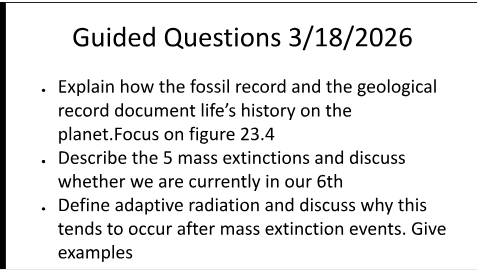
Q2. Describe the 5 mass extinctions and discuss whether we are currently in our 6th.
Background
Topic: Mass Extinctions
This question is about the major mass extinction events in Earth's history and the evidence for a possible ongoing sixth extinction.
Key Terms:
Mass Extinction: A period when a large percentage of Earth's species die out in a relatively short time.
Permian Extinction: The largest mass extinction event, occurring about 252 million years ago.
Cretaceous Extinction: The event that wiped out the dinosaurs about 66 million years ago.
Step-by-Step Guidance
List the five recognized mass extinction events: Ordovician, Devonian, Permian, Triassic, and Cretaceous.
For each event, briefly note the approximate time period and the types of organisms most affected.
Consider the causes proposed for each extinction (e.g., climate change, volcanic activity, asteroid impact).
Reflect on current biodiversity loss and discuss evidence for a possible sixth mass extinction driven by human activity.
Try solving on your own before revealing the answer!
Q3. Define adaptive radiation and discuss why this tends to occur after mass extinction events. Give examples.
Background
Topic: Adaptive Radiation
This question tests your understanding of how new species evolve rapidly when ecological niches become available, often after mass extinctions.
Key Terms:
Adaptive Radiation: The rapid evolution of diversely adapted species from a common ancestor.
Ecological Niche: The role and position a species has in its environment.
Step-by-Step Guidance
Define adaptive radiation and explain the conditions that favor it (e.g., availability of new habitats or resources).
Discuss why mass extinction events create opportunities for adaptive radiation by eliminating competitors and opening niches.
Provide examples, such as the diversification of mammals after the Cretaceous extinction or the evolution of finches on the Galápagos Islands.
Consider the evolutionary mechanisms (mutation, selection, genetic drift) that drive adaptive radiation.
Try solving on your own before revealing the answer!
