 Back
Study Guide: How Biological Diversity Evolves (Speciation & Cladistics) Chapter 14
Study Guide - Smart Notes
 Tailored notes based on your materials, expanded with key definitions, examples, and context.
Q1. Which defines a species?
Background
Topic: Species Concepts
This question tests your understanding of how biologists define a species. There are several definitions, including the biological, morphological, and phylogenetic species concepts.
Key Terms:
Biological species concept: Defines a species as a group of organisms that can interbreed and produce fertile offspring.
Morphological species concept: Defines a species based on observable and measurable traits.
Phylogenetic species concept: Defines a species based on unique genetic history.
Step-by-Step Guidance
Review the three main species concepts: biological, morphological, and phylogenetic.
Consider how each concept applies to different organisms (e.g., animals, plants, bacteria).
Think about situations where one concept might be more useful than another (e.g., fossils, asexual organisms).
Reflect on whether a single definition fits all cases, or if the definition depends on the context.
Try solving on your own before revealing the answer!
Final Answer: All of the above, depending on the specific question
Biologists use different species concepts depending on the context and the organisms being studied. No single definition works for all cases.
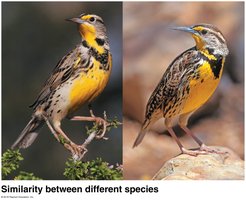
Q2. These two meadowlarks are two separate species, the eastern meadowlark (Sturnella magna) and the western meadowlark (Sturnella neglecta). Although they look very similar and have similar habitats, they are considered different species because:
Background
Topic: Reproductive Isolation & Speciation
This question is about why two populations that look similar are considered different species. It focuses on reproductive isolation, a key concept in the biological species concept.
Key Terms:
Reproductive isolation: When two populations cannot interbreed or produce fertile offspring.
Habitat: The environment where an organism lives.
Range: The geographic area where a species is found.
Step-by-Step Guidance
Recall the biological species concept: species are defined by their ability to interbreed.
Consider whether the two meadowlarks interbreed in nature.
Think about other possible reasons for separation: range, habitat, song differences.
Focus on which factor prevents them from producing fertile offspring together.
Try solving on your own before revealing the answer!
Final Answer: The two do not normally interbreed.
Despite their similarities, reproductive isolation (not interbreeding) is the key reason they are considered separate species under the biological species concept.
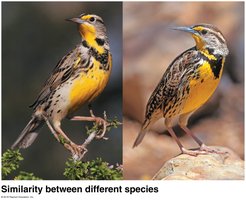
Q3. What might have geologically isolated these different bird populations, leading to speciation?
Background
Topic: Allopatric Speciation
This question tests your understanding of how geographic barriers can lead to the formation of new species (allopatric speciation).
Key Terms:
Allopatric speciation: Speciation that occurs when populations are separated by a physical barrier.
Geological isolation: Separation caused by physical features like rivers, mountains, or glaciers.
Step-by-Step Guidance
Identify which options are geological features (e.g., rivers, glaciation).
Consider how each feature could physically separate populations.
Think about whether the feature is permanent or temporary.
Focus on the feature that would most likely prevent gene flow between populations.
Try solving on your own before revealing the answer!
Final Answer: The Mississippi River
A large river like the Mississippi can act as a physical barrier, leading to allopatric speciation by preventing populations from interbreeding.
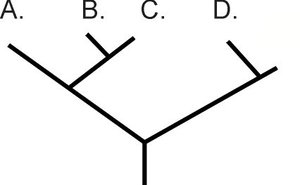
Q4. This cladogram represents an imaginary group of organisms—A, B, C, D, and E. Which position number identifies the common ancestor for species C and E?
Background
Topic: Cladistics & Phylogenetic Trees
This question tests your ability to interpret cladograms, which show evolutionary relationships and common ancestors.
Key Terms:
Cladogram: A diagram that shows relationships among species based on shared ancestry.
Common ancestor: The most recent ancestral species from which two or more species evolved.
Step-by-Step Guidance
Locate species C and E on the cladogram.
Trace back from both species to the point where their branches meet.
Identify the position number at this intersection.
Remember, the common ancestor is at the node where the two lineages diverge.
Try solving on your own before revealing the answer!
Final Answer: Position 3
Position 3 on the cladogram is the node where the lineages of C and E meet, indicating their most recent common ancestor.
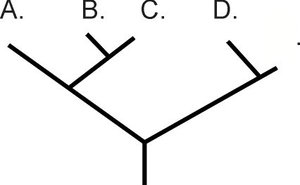
Q5. This cladogram represents an imaginary group of organisms—A, B, C, D, and E. Which two living species are the most closely related?
Background
Topic: Cladistics & Relatedness
This question tests your ability to determine which species share the most recent common ancestor using a cladogram.
Key Terms:
Closely related: Species that share a recent common ancestor.
Node: The point on a cladogram where lineages diverge.
Step-by-Step Guidance
Examine the cladogram and look for pairs of species whose branches meet at the most recent node.
Compare the options: A and B, B and C, C and D, A and D.
Identify which pair shares the closest node (furthest to the right or top, depending on the diagram).
Remember, the most closely related species are those that diverged most recently.
Try solving on your own before revealing the answer!
Final Answer: B and C
B and C share the most recent common ancestor, making them the most closely related among the living species shown.
Q6. If two salamanders from different species cannot mate because one mates in spring and the other in fall, this is what kind of isolation?
Background
Topic: Reproductive Barriers
This question tests your understanding of prezygotic barriers, specifically those related to timing of reproduction.
Key Terms:
Temporal isolation: When species reproduce at different times.
Other barriers: Gametic, habitat, mechanical, behavioral.
Step-by-Step Guidance
Review the types of reproductive isolation: temporal, habitat, mechanical, behavioral, gametic.
Focus on the timing of reproduction as described in the question.
Match the description to the correct type of isolation.
Consider why mating at different times prevents interbreeding.
Try solving on your own before revealing the answer!
Final Answer: Temporal isolation
Temporal isolation occurs when two species breed at different times, preventing them from interbreeding.
Q7. Which could lead to allopatric speciation by two populations of snail?
Background
Topic: Allopatric Speciation
This question tests your understanding of how physical barriers can lead to speciation in populations.
Key Terms:
Allopatric speciation: Speciation due to geographic separation.
Physical barrier: Something that prevents populations from interbreeding (e.g., mountain range).
Step-by-Step Guidance
Identify which option involves a physical barrier between populations.
Consider whether the other options involve changes within a population rather than separation.
Think about how a mountain range could prevent gene flow between snail populations.
Focus on the definition of allopatric speciation: separation by a physical barrier.
Try solving on your own before revealing the answer!
Final Answer: Creation of a new mountain range between two populations
A mountain range acts as a physical barrier, leading to allopatric speciation by preventing gene flow between the two snail populations.
