 Back
Study Guide: Human Reproductive Systems and Related Concepts
Study Guide - Smart Notes
 Tailored notes based on your materials, expanded with key definitions, examples, and context.
Reproductive Systems
The Male Reproductive System
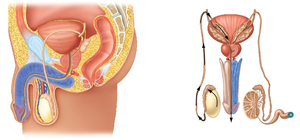
The male reproductive system is specialized for the production, maturation, and delivery of sperm. It consists of several organs and accessory glands that work together to ensure successful fertilization.
Testes: Produce sperm and testosterone. Located in the scrotum, which maintains a lower temperature optimal for sperm production.
Seminiferous Tubules: Site of sperm production within the testes.
Epididymis: Sperm mature and are stored here.
Ductus Deferens: Transports sperm from the epididymis to the ejaculatory duct.
Accessory Glands: Include seminal vesicles (secrete fructose and seminal fluid), prostate gland (secretes alkaline fluid), and bulbourethral gland (secretes lubricating mucus).
Route of Sperm: Seminiferous tubules → Epididymis → Ductus deferens → Ejaculatory duct → Urethra/Penis.
Sperm Formation and Cell Division
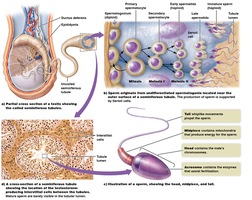
Sperm production involves several cell divisions, including mitosis and meiosis, resulting in haploid gametes. Sertoli cells provide support and nourishment during this process.
Sequence of Cell Types: Spermatogonia (2n) → Primary spermatocyte (2n) → Secondary spermatocyte (n) → Spermatids (n) → Sperm (n).
Haploid: Sperm and eggs contain half the number of chromosomes compared to somatic cells.
Hormonal Regulation of Male Reproduction
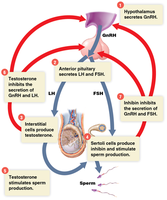
Testosterone, produced by interstitial cells in the testes, is essential for male reproductive function. Hormones from the hypothalamus and pituitary gland regulate testosterone and sperm production.
GnRH: Gonadotropin-releasing hormone from the hypothalamus stimulates release of LH and FSH.
LH: Stimulates testosterone production.
FSH: Enhances sperm formation by stimulating Sertoli cells.
Inhibin: Produced by Sertoli cells, inhibits FSH secretion.
Negative Feedback: Maintains constant testosterone levels.
The Female Reproductive System
Structure and Function
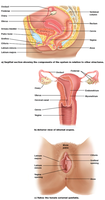
The female reproductive system produces eggs (oocytes), supports fertilization, and nurtures the developing embryo. It undergoes cyclic changes to prepare for pregnancy.
Ovaries: Release oocytes and secrete estrogen and progesterone.
Oviduct (Fallopian Tube): Site of fertilization; transports oocyte to uterus.
Uterus: Hollow organ where embryo develops; consists of endometrium (implantation site), myometrium (muscle layer), and cervix (opening for sperm entry and birth).
Vagina: Organ of intercourse and birth canal.
External Genitalia: Vulva, labia majora/minora, clitoris (important in sexual response).
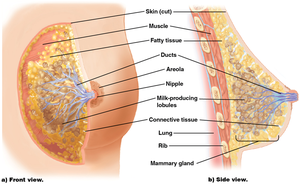
Mammary Glands and Lactation
Mammary glands in the breasts are specialized for milk production and nourishment of the infant. Their development and function are regulated by hormones.
Prolactin: Stimulates milk production.
Oxytocin: Stimulates milk ejection.
The Menstrual Cycle
Ovarian and Uterine Cycles
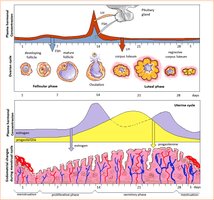
The menstrual cycle consists of two linked cycles: the ovarian cycle (oocyte maturation) and the uterine cycle (changes in endometrial lining). Both are regulated by hormones.
Ovarian Cycle: Controlled by FSH and LH; involves growth, maturation, and release of oocytes.
Uterine Cycle: Controlled by estrogen and progesterone; prepares endometrium for implantation.
Oocyte Maturation and Ovulation
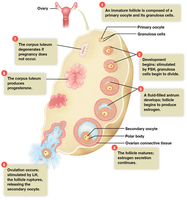
Oocytes mature and are released from the ovary in a regular pattern. The process is tightly regulated by hormonal signals.
Follicle Development: Immature follicle (primary oocyte + granulosa cells) develops; granulosa cells produce zona pellucida.
Hormonal Regulation: FSH and LH stimulate follicle maturation and estrogen/progesterone production.
Ovulation: Surge in LH causes release of secondary oocyte.
Corpus Luteum: Forms from follicle; produces progesterone to prepare endometrium.
Fertilization and Early Development
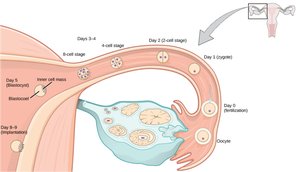
Fertilization occurs when a sperm penetrates the egg in the oviduct. The embryo undergoes several cell divisions before implantation in the uterus.
Chorion: Secretes hCG, which maintains corpus luteum and hormone production.
Placenta: Takes over hormone production after 9–10 weeks.
If no fertilization: Corpus luteum degenerates, hormone levels fall, and cycle restarts.
Phases of the Uterine Cycle
The uterine cycle prepares the endometrium for possible pregnancy and consists of three phases:
Menstrual Phase (Days 1–5): Estrogen and progesterone decrease; endometrial lining degenerates and menstruation occurs.
Proliferative Phase (Days 6–14): Estrogen and progesterone increase; endometrial lining proliferates.
Secretory Phase (Days 15–28): Corpus luteum produces hormones; endometrium matures and prepares for implantation.
Hormonal Regulation and Feedback
Hormonal cycles involve both positive and negative feedback mechanisms to regulate ovulation and endometrial changes.
Positive Feedback: Rising estrogen causes LH surge and ovulation.
Negative Feedback: Steady estrogen and progesterone inhibit LH and FSH release.
Birth Control Methods
Hormonal Methods
Hormonal birth control methods include pills, injections, patches, rings, and implants. They are effective in blocking ovulation and have additional health benefits and risks.
Mechanism: Combination of synthetic estrogen and progesterone inhibits FSH and LH release.
Advantages: Reduced cramps, menstrual flow, protection against certain cancers, reduced acne.
Disadvantages: Side effects (acne, headaches, fluid retention, high blood pressure, blood clots); do not protect against STDs.
Other Birth Control Methods
IUDs: Prevent fertilization or implantation; some contain hormones.
Barrier Methods: Diaphragms, cervical caps, condoms, and spermicides.
Natural Methods: Fertility awareness, withdrawal.
Emergency Contraception: Pills taken after intercourse to prevent ovulation or implantation.
Surgical Sterilization: Vasectomy (male), tubal ligation or cauterization (female).
Infertility and Assisted Reproductive Technologies
Causes and Treatments
Infertility is the inability to conceive after a year of trying. It can be caused by issues in either partner and may be treated with various technologies.
Male Infertility: Low sperm count, poor sperm quality, varicocele, hormonal or immune disorders.
Female Infertility: Hormonal imbalances, irregular cycles, blocked oviducts, endometriosis, age-related decline.
ARTs: Artificial insemination, in vitro fertilization (IVF), fertility drugs, surrogate motherhood.
Sexually Transmitted Diseases (STDs)
Bacterial STDs
Bacterial STDs include syphilis, gonorrhea, and chlamydia. They are treatable with antibiotics but can cause serious complications if untreated.
Syphilis: Caused by Treponema pallidum; progresses through multiple phases; treated with penicillin.
Gonorrhea: Caused by Neisseria gonorrhoeae; can cause PID and infertility; treated with antibiotics.
Chlamydia: Caused by Chlamydia trachomatis; often asymptomatic; can cause PID and infertility; treated with antibiotics.
Viral STDs
HIV: Causes AIDS; transmitted by blood and body fluids; no cure, but treatment can achieve remission.
Hepatitis B: Affects liver; vaccine available.
HPV: Causes genital warts and cancers; vaccines available.
Genital Herpes: Caused by HSV; painful blisters; no cure, but outbreaks can be suppressed.
Other STDs
Yeast Infections: Caused by Candida albicans; treated with antifungal medication.
Trichomoniasis: Caused by Trichomonas vaginalis; treated with Flagyl.
Pubic Lice: Tiny arthropods; cause itching; treated with anti-lice medication.
Protecting Against STDs
Choose partners wisely
Communicate openly
Use suitable barriers (condoms)
Get tested and treated
Get vaccinated (Hepatitis B, HPV)
Summary Table: Key Differences Between Male and Female Reproductive Systems
Feature | Male | Female |
|---|---|---|
Primary Gamete | Sperm | Egg (Oocyte) |
Site of Gamete Production | Testes | Ovaries |
Hormones | Testosterone | Estrogen, Progesterone |
Accessory Structures | Seminal vesicles, prostate, bulbourethral gland | Oviduct, uterus, vagina |
Cycle | Continuous sperm production | Monthly menstrual cycle |
Additional info: This study guide covers the essential concepts of human reproductive systems, including anatomy, physiology, hormonal regulation, menstrual cycle, birth control, infertility, and sexually transmitted diseases, as outlined in General Biology college courses.
