 Back
Study Guide: Introduction to Biology – Unifying Themes, Organization, Natural Selection, and Scientific Inquiry
Study Guide - Smart Notes
 Tailored notes based on your materials, expanded with key definitions, examples, and context.
Q1. What are the four major unifying themes of biology? Give examples for each.
Background
Topic: Unifying Themes of Biology
This question tests your understanding of the foundational concepts that connect all areas of biology. Recognizing these themes helps you see the bigger picture and how different biological processes are interrelated.
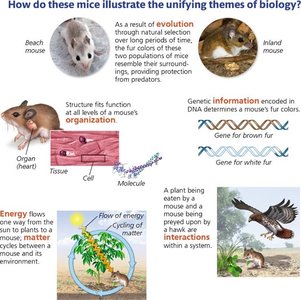
Key Terms and Concepts:
Organization: Biological systems are structured in a hierarchy, from molecules to the biosphere.
Information: Genetic information (DNA) guides the growth, development, and functioning of organisms.
Energy and Matter: Life requires the transfer and transformation of energy and matter.
Interactions: Organisms interact with each other and their environment, affecting survival and evolution.
Step-by-Step Guidance
List each of the four unifying themes: organization, information, energy and matter, and interactions.
For each theme, write a brief definition in your own words.
Think of a specific example for each theme. For instance, for organization, consider how cells form tissues, which form organs.
Review the image provided for visual examples that connect each theme to real biological phenomena (e.g., DNA for information, food webs for energy and matter, predator-prey for interactions).
Try solving on your own before revealing the answer!
Q2. Define the levels of biological organization and explain how they relate to heart disease.
Background
Topic: Levels of Biological Organization
This question asks you to connect the hierarchical structure of life to a real-world health issue, demonstrating how changes at one level can impact others.
Key Terms:
Molecule: Smallest chemical units (e.g., proteins, lipids).
Organelle: Specialized structures within cells (e.g., mitochondria).
Cell: Basic unit of life.
Tissue: Groups of similar cells performing a function.
Organ: Structures composed of tissues (e.g., heart).
Organ System: Groups of organs working together (e.g., circulatory system).
Organism: Individual living being.
Population: Group of organisms of the same species.
Community: Different populations living together.
Ecosystem: Community plus the physical environment.
Step-by-Step Guidance
Define each level of organization, starting from molecule up to ecosystem.
For each level, briefly describe how it could be involved in heart disease (e.g., a mutation at the molecular level affecting a protein in heart cells).
Think about how a problem at one level (like a faulty protein) can cascade to higher levels (tissues, organs, systems).
Use the heart as your example organ and trace how disease can progress through the levels.
Try solving on your own before revealing the answer!
Q3. What is an emergent property? Describe the example given in the textbook and find a new example.
Background
Topic: Emergent Properties
This question focuses on the concept that new properties arise at each level of organization that are not present at the previous level.
Key Terms:
Emergent Property: A characteristic that appears when components interact at a higher level of organization.
Step-by-Step Guidance
Define what an emergent property is in your own words.
Summarize the example from your textbook (e.g., how heart cells together can pump blood, but a single cell cannot).
Think of a new example from another biological system (e.g., consciousness in the brain, or flocking behavior in birds).
Explain why the property is considered 'emergent' and not present at lower levels.
Try solving on your own before revealing the answer!
Q4. Describe the Three Domains of Life. Name each domain, the kingdoms within them, and give an example organism.
Background
Topic: Classification of Life
This question tests your understanding of the broadest categories used to classify living organisms and their diversity.
Key Terms:
Domain: The highest taxonomic rank in the classification of life.
Kingdom: The next level below domain, grouping similar organisms.
Step-by-Step Guidance
List the three domains: Bacteria, Archaea, and Eukarya.
For each domain, name the kingdoms (if applicable) and provide an example organism (e.g., E. coli for Bacteria, yeast for Eukarya).
Briefly describe a distinguishing feature of each domain.
Use the image provided to help visualize the differences between domains.
Try solving on your own before revealing the answer!
Q11. Describe each type of graph and give an example of when you would use each.
Background
Topic: Data Representation in Biology
This question is about understanding how to choose the correct graph to represent different types of biological data.
Key Terms:
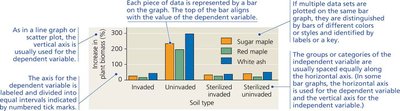
Bar Graph: Used for categorical data.
Line Graph: Used for continuous data over time.
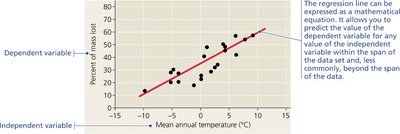
Scatter Plot: Used to show the relationship between two continuous variables.
Step-by-Step Guidance
Define each type of graph (bar, line, scatter plot).
Describe what kind of data is best represented by each graph (e.g., categories for bar graphs, trends over time for line graphs).
Give a specific example for each type (e.g., antibiotic groups for bar graph, solute concentration over time for line graph, relationship between temperature and diffusion rate for scatter plot).
Refer to the images for visual examples and explanations of how to interpret each graph type.
Try solving on your own before revealing the answer!
