 Back
Study Guide: Key Features and Life Cycles of Fungi and Animals
Study Guide - Smart Notes
 Tailored notes based on your materials, expanded with key definitions, examples, and context.
Q1. Fill out the table with key features/derived characteristics of the following fungal groups.
Background
Topic: Fungal Diversity and Adaptations
This question asks you to compare major fungal phyla by identifying their unique traits and explaining why these traits are adaptive. This is a foundational concept in understanding fungal evolution and ecology.
Key Terms and Concepts:
Derived/unique traits: Characteristics that evolved in a particular group and distinguish it from others.
Adaptation: A trait that increases an organism's fitness in its environment.
Fungal phyla: Major groups include Cryptomycetes, Microsporidia, Chytrids, Zoopagomycetes, Basidiomycetes.
Step-by-Step Guidance
Review your lecture notes and textbook summary tables for each fungal group. Focus on traits that are unique to each phylum (e.g., flagellated spores in chytrids, complex fruiting bodies in basidiomycetes).
For each phylum, write a brief description of the trait and explain how it helps the fungus survive or reproduce in its environment.
Compare the traits across groups to see how they reflect evolutionary relationships and ecological roles.
Think about how these traits might be placed on a phylogenetic tree to show evolutionary history.
Try solving on your own before revealing the answer!
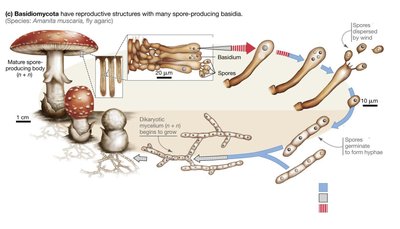
Q2. Label the life cycle of a basidiomycete with when the fungus is haploid, diploid, and heterokaryotic. Label the lifecycle with mitosis, meiosis, plasmogamy, and karyogamy. Briefly explain what happens in each process.
Background
Topic: Fungal Life Cycles (Basidiomycetes)
This question tests your understanding of the sexual life cycle of basidiomycete fungi, including the timing of key cellular processes and ploidy changes.
Key Terms and Concepts:
Haploid (n): One set of chromosomes.
Diploid (2n): Two sets of chromosomes.
Heterokaryotic: Cells with two or more genetically distinct nuclei.
Mitosis: Cell division producing identical nuclei.
Meiosis: Cell division reducing chromosome number by half, producing spores.
Plasmogamy: Fusion of cytoplasm from two parent mycelia.
Karyogamy: Fusion of nuclei to form a diploid cell.
Step-by-Step Guidance
Identify the stages in the basidiomycete life cycle where cells are haploid, diploid, or heterokaryotic. Use your notes and the diagram for reference.
Label where mitosis, meiosis, plasmogamy, and karyogamy occur in the cycle. Briefly describe what happens in each process (e.g., plasmogamy = cytoplasmic fusion).
Explain how each process contributes to genetic diversity and the formation of spores.
Use the diagram to help visualize the transitions between stages.
Try solving on your own before revealing the answer!
Q3. Fill out the table with key features of the following animal groups. Compare with summary tables and lecture notes. Consider where you might place those traits on a phylogeny of all animal groups.
Background
Topic: Animal Diversity and Evolution
This question asks you to summarize the body plan features and derived traits of major animal phyla and vertebrate groups, and to consider their evolutionary significance.
Key Terms and Concepts:
Body plan: The general structure and organization of an animal (e.g., symmetry, segmentation, coelom type).
Derived/unique traits: Features that evolved in a particular group and provide adaptive advantages.
Phylogeny: Evolutionary relationships among groups.
Step-by-Step Guidance
For each animal phylum, list examples, body plan features (e.g., symmetry, tissue layers), and unique traits. Explain why these traits are adaptive.
For vertebrate groups, focus on the derived traits that define each group (e.g., jaws in gnathostomes, amniotic egg in amniotes).
Use your lecture notes and textbook tables to compare traits across groups and place them on a phylogenetic tree.
Think about how each trait might have contributed to the evolutionary success of the group.
Try solving on your own before revealing the answer!
