 Back
Study Guide: Lipids and Fatty Acids in General Biology
Study Guide - Smart Notes
 Tailored notes based on your materials, expanded with key definitions, examples, and context.
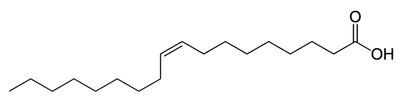
Q1. Oleic acid is shown below. Is oleic acid a saturated or unsaturated fatty acid? If it were part of a fat, would the fat be liquid or solid at room temperature? Why?
Background
Topic: Lipids – Fatty Acids
This question tests your understanding of the structural differences between saturated and unsaturated fatty acids, and how these differences affect the physical properties of fats at room temperature.
Key Terms and Concepts:
Saturated fatty acid: A fatty acid with no double bonds between carbon atoms; all carbons are fully "saturated" with hydrogen atoms.
Unsaturated fatty acid: A fatty acid that contains one or more double bonds in its hydrocarbon chain.
Physical state at room temperature: Saturated fats tend to be solid, while unsaturated fats tend to be liquid.
Step-by-Step Guidance
Examine the structure of oleic acid. Look for the presence or absence of double bonds in the hydrocarbon chain.
Recall that a double bond in the hydrocarbon chain indicates that the fatty acid is unsaturated. If there are no double bonds, it is saturated.
Consider how the presence of double bonds affects the shape of the molecule. Double bonds introduce kinks, preventing the molecules from packing closely together.
Think about how molecular packing influences the physical state of fats at room temperature. Molecules that pack closely (saturated) are usually solid, while those that cannot (unsaturated) are usually liquid.
Based on your observations, determine whether oleic acid would make a fat that is liquid or solid at room temperature, and explain why.
Try solving on your own before revealing the answer!
Final Answer:
Oleic acid is an unsaturated fatty acid because it contains a double bond in its hydrocarbon chain (visible as the kink in the structure). If oleic acid is part of a fat, the fat would be liquid at room temperature. This is because the double bond creates a bend in the molecule, preventing the fatty acid chains from packing closely together, which lowers the melting point and keeps the fat liquid at room temperature.
