 Back
BackStudy Guide: Mechanisms of Evolution and Hardy-Weinberg Equilibrium
Study Guide - Smart Notes
 Tailored notes based on your materials, expanded with key definitions, examples, and context.
Q1. What could cause a population to NOT be in Hardy-Weinberg equilibrium?
Background
Topic: Hardy-Weinberg Equilibrium
This question tests your understanding of the conditions required for a population to remain in Hardy-Weinberg equilibrium and what factors can disrupt it.
Key Terms:
Hardy-Weinberg equilibrium: A theoretical state where allele and genotype frequencies remain constant from generation to generation in the absence of evolutionary forces.
Evolutionary forces: Natural selection, gene flow, genetic drift, mutation, and non-random mating.
Step-by-Step Guidance
Recall the five conditions required for Hardy-Weinberg equilibrium: no mutation, random mating, no gene flow, infinite population size (no genetic drift), and no natural selection.
Consider what happens if any of these conditions are violated. For example, if natural selection occurs, certain genotypes may be favored, changing allele frequencies.
Think about gene flow: movement of individuals into or out of the population can introduce new alleles or change allele frequencies.
Non-random mating can increase the frequency of certain genotypes, disrupting equilibrium.
Genetic drift, especially in small populations, can cause random changes in allele frequencies.
Try solving on your own before revealing the answer!
Q2. What is the probability of a gamete having the A1 or A2 allele in a population where 35% of alleles are A1 and 65% are A2?
Background
Topic: Allele Frequency
This question tests your ability to interpret allele frequencies and relate them to probabilities in gametes.
Key Terms:
Allele frequency: The proportion of a specific allele among all alleles in a population.
Gamete: A reproductive cell (egg or sperm) carrying a single allele for each gene.
Step-by-Step Guidance
Identify the allele frequencies given: A1 = 0.35, A2 = 0.65.
Understand that the probability of a gamete carrying a particular allele is equal to the allele frequency in the population.
Express your answer in decimal form to two decimal places.
Try solving on your own before revealing the answer!
Q3. Predict the proportion of individuals with each genotype (A1A1, A1A2, A2A2) in Hardy-Weinberg equilibrium given allele frequencies of A1 = 0.35 and A2 = 0.65.
Background
Topic: Hardy-Weinberg Genotype Frequencies
This question tests your ability to use the Hardy-Weinberg equation to predict genotype frequencies from allele frequencies.
Key Formula:
Where:
= frequency of A1 allele (0.35)
= frequency of A2 allele (0.65)
= frequency of A1A1 genotype
= frequency of A1A2 genotype
= frequency of A2A2 genotype
Step-by-Step Guidance
Write down the Hardy-Weinberg equation: .
Plug in the values for and : , .
Calculate for A1A1 genotype: .
Calculate for A1A2 genotype: .
Calculate for A2A2 genotype: .
Try solving on your own before revealing the answer!
Q4. If 49% of individuals have the A1A1 genotype, what is the frequency of the A1 allele (assuming Hardy-Weinberg equilibrium)?
Background
Topic: Calculating Allele Frequency from Genotype Frequency
This question tests your ability to use genotype frequencies to determine allele frequencies under Hardy-Weinberg equilibrium.
Key Formula:
Step-by-Step Guidance
Identify the frequency of the A1A1 genotype: .
Take the square root of to find : .
Interpret as the frequency of the A1 allele in the population.
Try solving on your own before revealing the answer!
Q5. Match each mechanism of evolution to its description.
Background
Topic: Mechanisms of Evolution
This question tests your understanding of the different mechanisms that drive evolutionary change.
Key Terms:
Mutation: Generates new alleles and genes.
Natural selection: Results in adaptation and acts on differences in fitness among phenotypes.
Genetic drift: Can result in loss of genetic diversity, especially in small populations.
Gene flow: Movement of alleles between populations, making them more similar.
Step-by-Step Guidance
Read each description and identify the mechanism it matches.
Recall the definitions and effects of mutation, natural selection, genetic drift, and gene flow.
Think about how each mechanism affects genetic diversity and adaptation.
Try solving on your own before revealing the answer!
Q6. Why are observed and expected genotype numbers significantly different in a population with incomplete dominance?
Background
Topic: Natural Selection and Genotype Frequencies
This question tests your ability to interpret differences between observed and expected genotype frequencies and relate them to evolutionary mechanisms.
Key Terms:
Incomplete dominance: Heterozygotes have a phenotype intermediate between homozygotes.
Natural selection: Can favor certain genotypes, leading to deviations from Hardy-Weinberg expectations.
Step-by-Step Guidance
Compare the observed and expected numbers for each genotype.
Notice if one genotype is overrepresented or underrepresented compared to expectations.
Consider which evolutionary mechanism could explain the pattern (e.g., selection favoring heterozygotes).
Try solving on your own before revealing the answer!
Q7. What happens to genotype frequencies in a population experiencing inbreeding?
Background
Topic: Inbreeding and Genotype Frequencies
This question tests your understanding of how inbreeding affects the proportion of homozygotes and heterozygotes in a population.
Key Terms:
Inbreeding: Mating between genetically similar individuals.
Homozygote: An individual with two identical alleles for a gene.
Heterozygote: An individual with two different alleles for a gene.
Step-by-Step Guidance
Recall that inbreeding increases the probability of offspring inheriting identical alleles from both parents.
Understand that this leads to more homozygotes and fewer heterozygotes than expected under random mating.
Consider the consequences for population health and genetic diversity.
Try solving on your own before revealing the answer!
Q8. Which population would experience the greatest changes in allele frequencies due to genetic drift?
Background
Topic: Genetic Drift
This question tests your understanding of how population size affects the impact of genetic drift.
Key Terms:
Genetic drift: Random changes in allele frequencies, most pronounced in small populations.
Population size: Smaller populations are more affected by drift.
Step-by-Step Guidance
Compare the sizes of the populations listed.
Recall that genetic drift has a larger effect in smaller populations.
Identify the smallest population among the options.
Try solving on your own before revealing the answer!
Q9. What is the impact of different types of mutations on the protein coded by a gene?
Background
Topic: Mutations and Protein Synthesis
This question tests your ability to interpret how changes in DNA and mRNA affect the resulting protein.
Key Terms:
Frameshift mutation: Insertion or deletion of nucleotides changes the reading frame.
Missense mutation: Changes a single amino acid.
Nonsense mutation: Changes a codon to a stop codon, ending translation prematurely.
Silent mutation: Changes a codon but does not affect the amino acid sequence.
Step-by-Step Guidance
For each mutation, identify the type (frameshift, missense, nonsense, silent).
Use a codon table to determine the effect on the amino acid sequence.
Consider how the change affects protein function and structure.
Try solving on your own before revealing the answer!
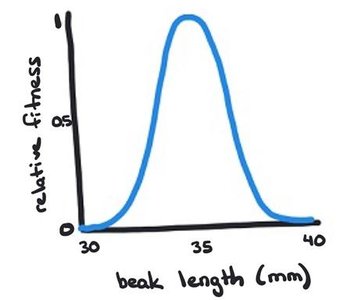
Q18. What type of selection is illustrated by the fitness curve for beak length, and what is the predicted outcome over generations?
Background
Topic: Types of Natural Selection
This question tests your ability to interpret fitness curves and predict evolutionary outcomes.
Key Terms:
Stabilizing selection: Selection favors intermediate phenotypes, reducing variation.
Relative fitness: The reproductive success of a phenotype compared to others.
Step-by-Step Guidance
Examine the fitness curve: highest fitness is at intermediate beak lengths, lower fitness at extremes.
Recognize this as stabilizing selection, which reduces variation and favors average phenotypes.
Predict that, over generations, the population will have more individuals with intermediate beak lengths and fewer with extreme lengths.
Try solving on your own before revealing the answer!
