 Back
BackStudy Guide: Meiosis and Sexual Life Cycles
Study Guide - Smart Notes
 Tailored notes based on your materials, expanded with key definitions, examples, and context.
Q1. Define the following terms: gene, locus, gametes, male gamete, female gamete, somatic cells, genome, asexual reproduction, sexual reproduction.
Background
Topic: Basic Genetics Vocabulary
This question tests your understanding of foundational terms in genetics and cell biology, which are essential for studying inheritance and reproduction.
Key Terms:
Gene: A unit of heredity that is transferred from a parent to offspring and determines some characteristic of the offspring.
Locus: The specific location of a gene or DNA sequence on a chromosome.
Gametes: Reproductive cells (sperm and egg) that unite during fertilization to form a new organism.
Male gamete: Sperm cell.
Female gamete: Egg cell.
Somatic cells: All body cells except gametes; they are diploid.
Genome: The complete set of genes or genetic material present in a cell or organism.
Asexual reproduction: Reproduction without the fusion of gametes, producing genetically identical offspring.
Sexual reproduction: Reproduction involving the fusion of gametes, resulting in genetically diverse offspring.
Step-by-Step Guidance
Review the definitions above and try to write them in your own words.
Think about examples for each term (e.g., what is a somatic cell vs. a gamete?).
Consider how these terms relate to the process of meiosis and inheritance.
Try solving on your own before revealing the answer!
Q2. How many chromosomes are in human somatic cells?
Background
Topic: Chromosome Number in Humans
This question tests your knowledge of the basic genetic makeup of human cells.
Key Terms:
Somatic cells: Diploid cells containing two sets of chromosomes.
Chromosome: A structure of DNA and protein that carries genetic information.
Step-by-Step Guidance
Recall that somatic cells are diploid (2n).
Remember the standard chromosome number for humans.
Compare this to the chromosome number in gametes (haploid).
Try solving on your own before revealing the answer!
Q3. Describe a chromosome.
Background
Topic: Chromosome Structure
This question asks you to explain what a chromosome is and its role in genetics.
Key Terms:
Chromosome: DNA molecule with associated proteins, carrying genetic information.
Chromatid: Each of the two thread-like strands into which a chromosome divides during cell division.
Step-by-Step Guidance
Think about the physical structure of a chromosome (DNA + proteins).
Consider how chromosomes are organized in the nucleus.
Reflect on the function of chromosomes in inheritance.
Try solving on your own before revealing the answer!
Q4. Which type of reproduction will result in genetically identical offspring?
Background
Topic: Types of Reproduction
This question tests your understanding of the difference between asexual and sexual reproduction.
Key Terms:
Asexual reproduction: Produces offspring genetically identical to the parent.
Sexual reproduction: Produces genetically diverse offspring.
Step-by-Step Guidance
Recall the definitions of asexual and sexual reproduction.
Think about examples of organisms that reproduce asexually.
Consider the genetic consequences of each type.
Try solving on your own before revealing the answer!
Q5. How does a somatic cell compare to a gamete in terms of chromosome number?
Background
Topic: Chromosome Number in Different Cell Types
This question tests your understanding of diploid vs. haploid cells.
Key Terms:
Somatic cell: Diploid (2n), contains two sets of chromosomes.
Gamete: Haploid (n), contains one set of chromosomes.
Step-by-Step Guidance
Recall the chromosome number in human somatic cells and gametes.
Think about how meiosis changes chromosome number.
Compare the genetic content of somatic cells and gametes.
Try solving on your own before revealing the answer!
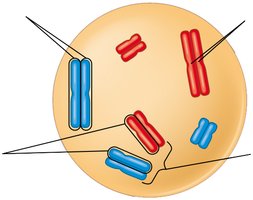
Q12. In the cell below, the chromosomes are shaded in two colors to represent the parent of origin, red for maternal and blue for paternal. On this sketch, label the following: a) sister chromatids, b) homologous chromosomes, c) centromere, d) duplicated chromosome, e) maternal chromosomes.
Background
Topic: Chromosome Structure and Inheritance
This question tests your ability to identify key chromosome features and distinguish between maternal and paternal chromosomes.
Key Terms:
Sister chromatids: Two identical copies of a chromosome connected by a centromere.
Homologous chromosomes: Chromosome pairs, one from each parent, with the same genes but possibly different alleles.
Centromere: The region where sister chromatids are joined.
Duplicated chromosome: A chromosome that has been copied, consisting of two sister chromatids.
Maternal chromosomes: Chromosomes inherited from the mother.
Step-by-Step Guidance
Examine the diagram and identify the pairs of chromosomes by color (red = maternal, blue = paternal).
Locate the centromere, which is the constricted region joining sister chromatids.
Identify the duplicated chromosomes (each consisting of two sister chromatids).
Find the homologous pairs (one red, one blue chromosome of similar size and shape).
Try solving on your own before revealing the answer!
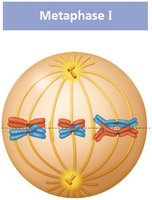
Q21. The figure below shows metaphase I of meiosis. How is the arrangement of chromosomes here different from the metaphase of mitosis?
Background
Topic: Chromosome Arrangement in Cell Division
This question tests your understanding of the differences between meiosis and mitosis, specifically in how chromosomes align during metaphase.
Key Terms:
Metaphase I (meiosis): Homologous chromosome pairs align at the metaphase plate.
Metaphase (mitosis): Individual chromosomes align at the metaphase plate.
Step-by-Step Guidance
Observe the diagram and note how chromosomes are paired (homologous pairs) in meiosis.
Recall that in mitosis, chromosomes line up individually, not in pairs.
Think about the consequences for genetic diversity and chromosome separation.
Try solving on your own before revealing the answer!
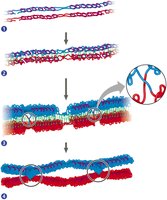
Q26. Prophase I of meiosis is a very busy time! The signature event of crossing over occurs during prophase I. Using Figure 10.9, label and explain what occurs in the four steps shown by the numbers in the diagram.
Background
Topic: Crossing Over in Meiosis
This question tests your understanding of the process of crossing over and synapsis during prophase I of meiosis.
Key Terms:
Synapsis: The pairing of homologous chromosomes.
Crossing over: Exchange of genetic material between nonsister chromatids.
Chiasmata: The physical site where crossing over occurs.
Step-by-Step Guidance
Step 1: Chromosomes duplicate and begin to condense; homologs pair up.
Step 2: Synaptonemal complex forms, holding homologs together; DNA breaks occur at corresponding points.
Step 3: Crossing over occurs as DNA breaks are repaired, joining nonsister chromatids; chiasmata form.
Step 4: Synaptonemal complex disassembles; homologs remain attached at chiasmata.
Try solving on your own before revealing the answer!
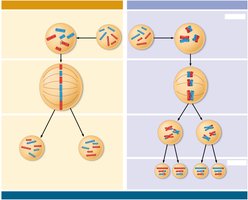
Q28. Use Figure 10.10 in your text to compare mitosis and meiosis. Add these labels: parent cell, mitosis, meiosis, synapsis, homologous chromosomes, duplicated chromosomes, sister chromatids, daughter cells, meiosis I, meiosis II, and crossing over.
Background
Topic: Comparison of Mitosis and Meiosis
This question tests your ability to distinguish between the processes of mitosis and meiosis, including key events and outcomes.
Key Terms:
Mitosis: Cell division producing identical daughter cells.
Meiosis: Cell division producing genetically diverse gametes.
Synapsis: Pairing of homologous chromosomes in meiosis.
Crossing over: Exchange of genetic material during meiosis.
Step-by-Step Guidance
Examine the diagram and identify the parent cell in both processes.
Label the stages of mitosis and meiosis, noting where synapsis and crossing over occur.
Compare the arrangement and separation of chromosomes in each process.
Identify the number and genetic makeup of daughter cells produced by each process.
Try solving on your own before revealing the answer!
