 Back
Study Guide: Meiosis, Chromosome Behavior, and Genetic Variation
Study Guide - Smart Notes
 Tailored notes based on your materials, expanded with key definitions, examples, and context.
Reproduction and Types
Asexual and Sexual Reproduction
Reproduction is the biological process by which new individual organisms are produced from their parent(s), ensuring the continuation of a species. There are two main types:
Asexual reproduction: Involves one parent organism replicating its DNA and splitting into two, producing genetically identical offspring (clones). Examples include aphids, zebra sharks, strawberries, banyan trees, starfish, boa constrictors, garlic, and slime molds.
Sexual reproduction: Involves two parents, where an egg fuses with a sperm, resulting in offspring with genetic diversity. This diversity increases the chance of survival in changing environments.
Genetic Diversity in Sexual Reproduction
Sexual reproduction produces genetically diverse offspring through three main mechanisms:
Independent assortment of chromosomes
Crossing over
Random fertilization
Chromosome Types and Cell Types
Gametes and Somatic Cells
Gametes: Reproductive cells (sperm and egg), produced by meiosis.
Somatic cells: All other body cells, produced by mitosis.
Chromosome Sets
Haploid (n): One set of chromosomes. Most unicellular organisms are haploid.
Diploid (2n): Two sets of chromosomes. Most cells in sexually reproducing organisms are diploid.
Polyploid: More than two sets of chromosomes, common in plants (e.g., tetraploid, hexaploid).
Chromosome Numbers in Species
Cabbage: 18 chromosomes (haploid number 9)
Elephant: 56 chromosomes (haploid number 28)
Human: 46 chromosomes (haploid number 23)
Chromosome Structure and Function
Homologous Chromosomes and Chromatids
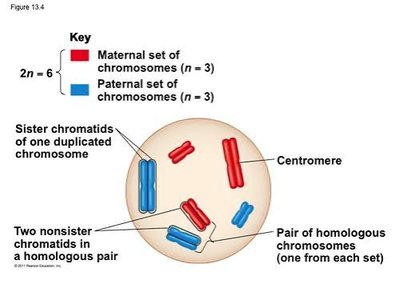
Homologous chromosomes are pairs that are similar in length and gene content, providing backup for genes. After DNA replication, each chromosome consists of identical sister chromatids.
Autosomes: Numbered chromosomes, same in males and females.
Sex chromosomes: Denoted by letters, determine sex.
Centromere and Kinetochore
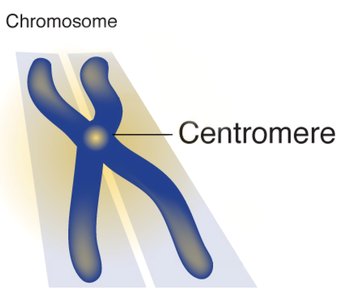
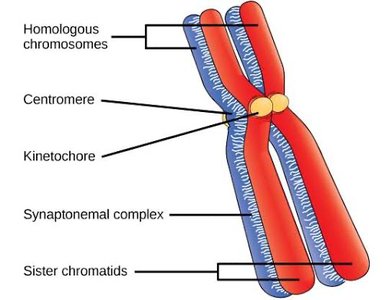
Centromere: The constricted region joining sister chromatids, attachment site for spindle fibers.
Kinetochore: Protein complex assembled on the centromere, links chromosomes to spindle microtubules and ensures proper segregation.
Meiosis and Life Cycle
Meiosis Overview
Meiosis is the process that reduces chromosome number from diploid (2n) to haploid (n), producing gametes. Fertilization and meiosis alternate in sexual life cycles to maintain a constant chromosome number across generations.
One diploid cell produces four haploid cells.
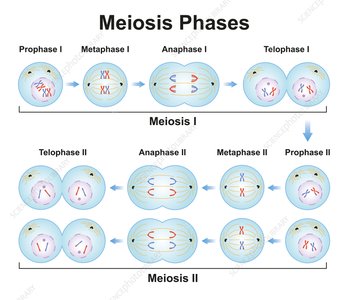
Phases include Meiosis I and Meiosis II.
Phases of Meiosis
Prophase I: Homologous chromosomes pair up and form tetrads, synaptonemal complex assembles, crossing over occurs.
Metaphase I: Tetrads align at the metaphase plate, independent assortment occurs.
Anaphase I: Homologous chromosomes separate.
Telophase I: Cells divide, each with half the chromosome number.
Meiosis II: Sister chromatids separate, resulting in four haploid cells.
Tetrad, Synaptonemal Complex, and Chiasmata
Tetrad: Structure formed by two homologous chromosomes (four chromatids) during prophase I.
Synaptonemal complex: Protein lattice holding homologs together, facilitating crossing over.
Chiasmata: Sites where crossing over occurs, holding homologs together after synaptonemal complex breaks down.
Genetic Variation Mechanisms
Crossing Over and Recombinant Chromatids
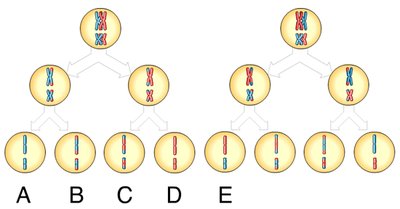
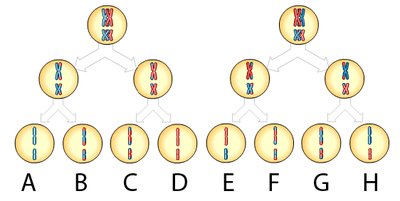
Crossing over occurs during prophase I, where non-sister chromatids exchange DNA segments, producing recombinant chromatids and increasing genetic diversity.
On average, 1-3 crossover events per chromosome pair in humans.
Recombinant chromatids contain DNA from both parents.
Parental chromatids retain original DNA.
Independent Assortment
Occurs during metaphase I.
Chromosome pairs align randomly, resulting in unique combinations in gametes.
Random Fertilization
Any male gamete can fuse with any female gamete.
Produces a zygote with about 70 trillion possible diploid combinations.
Mutations
Mutations create different versions of genes (alleles).
Physical traits such as hair color and freckles originate from chromosomal mutations.
Meiosis vs. Mitosis
Comparison Table
Process | Outcome | Chromosome Number |
|---|---|---|
Mitosis | Two diploid daughter cells | Same as parent (2n) |
Meiosis | Four haploid daughter cells | Half of parent (n) |
Key Terms and Concepts
Clone: Genetically identical individual produced asexually.
Zygote: Fertilized egg cell, undergoes mitosis to produce multicellular offspring.
Spermatogenesis: Produces four sperm cells per germ cell.
Oogenesis: Produces one egg cell per germ cell.
Sample Questions and Answers
Asexual reproduction: Can result in offspring genetically identical to the parent.
Human somatic cell: 44 autosomes and 2 sex chromosomes.
Karyotype purpose: Determine sex, screen for chromosome number, detect abnormalities.
Sister chromatids vs. homologous chromosomes: Sister chromatids are identical copies; homologous chromosomes have same gene loci but may differ in alleles.
Meiosis II chromosome set: Each gamete has 1 set (haploid).
Meiosis I daughter cells: Sister chromatids are no longer identical.
Meiosis II daughter cells vs. parent: Parent is diploid; daughter cells are haploid with one quarter of DNA.
Meiosis I events: Crossing over, homologous pairs at metaphase plate. Meiosis II events: Chromatids separate, individual chromosomes at metaphase plate.
Mitosis vs. meiosis: Mitosis produces two diploid cells; meiosis produces four haploid cells.
Meiosis unique event: Synapsis occurs.
Heritable variation: Required for evolution.
Genetic variation processes: Independent assortment, random fertilization, crossing over.
Gametes with recombinant chromosomes: B and C (see diagram).
Crossing over: Exchange of homologous portions of nonsister chromatids.
Independent alignment: Metaphase I.
Crossing over occurs between: Nonsister chromatids of homologous chromosomes.
Human crossover events: 2-3 per chromosome pair.
Gametes with recombinant chromosomes: B, C, F, and G (see diagram).
Genetic variation: Occurs during fertilization and meiosis.
Equations and Formulas
Chromosome number reduction:
Possible combinations from independent assortment: (where n = haploid number)
Possible zygote combinations:
Summary Table: Genetic Variation Mechanisms
Mechanism | Stage | Effect |
|---|---|---|
Crossing Over | Prophase I | Recombinant chromosomes |
Independent Assortment | Metaphase I | Unique chromosome combinations |
Random Fertilization | Fertilization | Random gamete fusion |
