 Back
BackStudy Guide: Mendelian Genetics and Beyond
Study Guide - Smart Notes
 Tailored notes based on your materials, expanded with key definitions, examples, and context.
Q1. What is the Law of Segregation and how does it relate to predicting offspring using a Punnett Square?
Background
Topic: Mendelian Genetics – Law of Segregation and Punnett Squares
This question tests your understanding of Mendel's Law of Segregation, which states that allele pairs separate or segregate during gamete formation, and how this principle is used to predict the genetic makeup of offspring using Punnett squares.
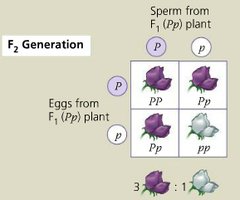
Key Terms and Formulas:
Allele: Variant form of a gene.
Dominant allele: Expressed when present (capital letter, e.g., P).
Recessive allele: Only expressed when two copies are present (lowercase letter, e.g., p).
Punnett Square: Diagram used to predict the outcome of a genetic cross.
Law of Segregation:
Step-by-Step Guidance
Identify the genotypes of the parent plants. For example, in the F1 generation, both parents are heterozygous ().
Set up a Punnett square with the possible gametes from each parent. Each parent can contribute either a or allele.
Fill in the Punnett square to show all possible combinations of alleles in the offspring.
Count the number of each genotype and phenotype in the Punnett square. For example, , , and .
Try solving on your own before revealing the answer!
Final Answer: 1/4 PP, 1/2 Pp, 1/4 pp; 3/4 purple, 1/4 white
The Punnett square shows that the F2 generation will have a genotypic ratio of 1:2:1 and a phenotypic ratio of 3:1 (purple:white).
Q2. Define key Mendelian genetics terminology.
Background
Topic: Genetics Vocabulary
This question tests your knowledge of essential terms used in Mendelian genetics, such as heterozygous, homozygous, phenotype, genotype, alleles, recessive, and dominant.
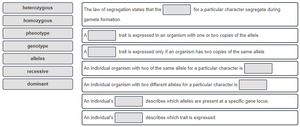
Key Terms:
Heterozygous: Having two different alleles for a gene.
Homozygous: Having two identical alleles for a gene.
Phenotype: The observable trait or characteristic.
Genotype: The genetic makeup (allele combination).
Allele: A variant form of a gene.
Dominant: An allele that masks the effect of another.
Recessive: An allele whose effect is masked by a dominant allele.
Step-by-Step Guidance
Read each definition and match it to the correct term.
Recall that dominant alleles are expressed with one or two copies, while recessive alleles require two copies.
Use context clues from the definitions to fill in the blanks.
Try solving on your own before revealing the answer!
Final Answer: Terms matched to definitions
Each definition is matched to the correct term, reinforcing your understanding of Mendelian vocabulary.
Q3. What makes alleles different from each other?
Background
Topic: Alleles and Genetic Variation
This question tests your understanding of what distinguishes one allele from another at the molecular level.
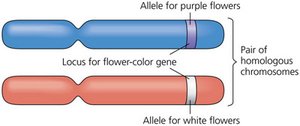
Key Terms:
Allele: Different versions of a gene.
Locus: The specific location of a gene on a chromosome.
DNA sequence: The order of nucleotides in a gene.
Step-by-Step Guidance
Recall that alleles are alternative forms of a gene found at the same locus on homologous chromosomes.
Consider that alleles differ in their DNA nucleotide sequences, which can lead to different traits.
Think about how these sequence differences can affect the function or expression of the gene product.
Try solving on your own before revealing the answer!
Final Answer: Alleles differ by their DNA nucleotide sequences
Alleles are distinguished by differences in their DNA sequences, which can result in different traits.
Q4. In pea plants, the purple allele is sufficient for making purple flowers, even if one of the homologous chromosomes carries the white allele. Which statements are true?
Background
Topic: Dominance and Expression of Alleles
This question tests your understanding of dominant and recessive alleles and how they affect phenotype.
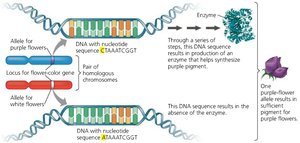
Key Terms:
Dominant allele: Expressed when present.
Recessive allele: Only expressed when two copies are present.
Enzyme: Protein that catalyzes biochemical reactions.
Step-by-Step Guidance
Review the concept that a dominant allele can mask the effect of a recessive allele.
Consider how the presence of one purple allele leads to enough enzyme production for purple pigment.
Evaluate each statement for accuracy based on your understanding of dominance and enzyme function.
Try solving on your own before revealing the answer!
Final Answer: The purple allele is dominant; one purple allele produces enough pigment
The statements about dominance and enzyme production are correct based on Mendelian genetics.
