 Back
Study Guide: Molecular Basis of Inheritance (DNA Structure, Replication, and Genetic Information)
Study Guide - Smart Notes
 Tailored notes based on your materials, expanded with key definitions, examples, and context.
Q1. What is the purpose of DNA replication?
Background
Topic: DNA Replication
This question tests your understanding of why cells need to copy their DNA before cell division and how this process is essential for inheritance and continuity of life.
Key Terms:
DNA replication: The process by which a cell copies its DNA before cell division.
Cell division: The process by which a parent cell divides into two daughter cells.
Genetic information: The instructions encoded in DNA that determine an organism's traits.
Step-by-Step Guidance
Consider why cells need to duplicate their DNA before dividing. What would happen if DNA was not copied?
Think about the role of DNA as the carrier of genetic information. How does replication ensure that each new cell receives the same genetic instructions?
Reflect on the importance of DNA replication in both growth (mitosis) and reproduction (meiosis).
Try solving on your own before revealing the answer!
Final Answer:
The purpose of DNA replication is to ensure that each daughter cell receives an exact copy of the genetic information from the parent cell. This is essential for growth, repair, and reproduction in all living organisms.
Without DNA replication, cells would not be able to pass on genetic information accurately, leading to loss of genetic continuity.
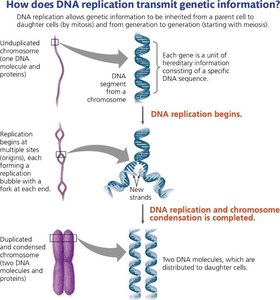
Q2. Describe how DNA replication transmits genetic information to the next generation in a species.
Background
Topic: DNA Replication and Heredity
This question focuses on the mechanism by which DNA replication ensures the faithful transmission of genetic information from parent to offspring, both in mitosis and meiosis.
Key Terms:
Genetic information: The sequence of nucleotides in DNA that encodes traits.
Replication: The process of copying DNA.
Meiosis: Cell division that produces gametes for sexual reproduction.
Mitosis: Cell division for growth and repair.
Step-by-Step Guidance
Recall that DNA replication produces two identical DNA molecules from one original molecule.
Think about how each daughter cell receives one copy of the replicated DNA during cell division.
Consider how this process works in both mitosis (for somatic cells) and meiosis (for gametes).
Reflect on how the accuracy of replication is crucial for maintaining genetic continuity across generations.
Try solving on your own before revealing the answer!
Final Answer:
DNA replication transmits genetic information by copying the DNA so that each new cell (or offspring) receives a complete set of genetic instructions. In mitosis, this ensures identical genetic material in daughter cells. In meiosis, replicated DNA is distributed to gametes, allowing genetic information to be passed to the next generation.
This process preserves the integrity of genetic information and enables inheritance of traits.
Q3. What are the two main types of nucleic acids, and what is the primary function of each?
Background
Topic: Nucleic Acids
This question tests your knowledge of the basic types of nucleic acids and their roles in cells.
Key Terms:
DNA (deoxyribonucleic acid): Stores genetic information.
RNA (ribonucleic acid): Transfers genetic information and helps in protein synthesis.
Step-by-Step Guidance
Identify the two main types of nucleic acids found in cells.
Think about the role of DNA in storing genetic information.
Consider the role of RNA in expressing and transferring genetic information.
Try solving on your own before revealing the answer!
Final Answer:
The two main types of nucleic acids are DNA and RNA. DNA's primary function is to store genetic information, while RNA's primary function is to transfer genetic information and assist in protein synthesis.
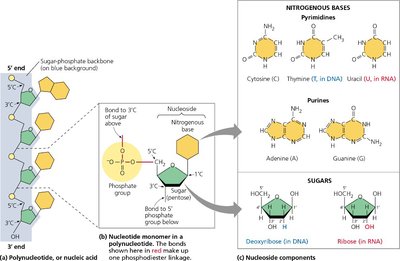
Q4. Using the picture to the right, describe the structure of nucleic acids. Be sure to include the phosphate, sugar, and nucleotide.
Background
Topic: Nucleic Acid Structure
This question asks you to describe the molecular structure of nucleic acids, focusing on their basic building blocks.
Key Terms and Formulas:
Nucleotide: The basic unit of nucleic acids, consisting of a phosphate group, a sugar (deoxyribose or ribose), and a nitrogenous base.
Phosphodiester bond: The linkage between nucleotides in a strand.
Step-by-Step Guidance
Examine the diagram and identify the three components of a nucleotide: phosphate, sugar, and nitrogenous base.
Describe how nucleotides are linked together by phosphodiester bonds to form a polynucleotide chain.
Note the orientation of the chain (5' to 3' direction).
Try solving on your own before revealing the answer!
Final Answer:
Nucleic acids are composed of nucleotides, each containing a phosphate group, a sugar (deoxyribose in DNA or ribose in RNA), and a nitrogenous base. Nucleotides are joined by phosphodiester bonds between the 5' phosphate and 3' hydroxyl groups of adjacent sugars, forming a sugar-phosphate backbone.
Q5. Using the figure to the right, what are the key differences between the structures of DNA and RNA?
Background
Topic: DNA vs. RNA Structure
This question tests your ability to distinguish between DNA and RNA based on their chemical and structural differences.
Key Terms:
Deoxyribose (DNA) vs. Ribose (RNA): Different sugars in the backbone.
Thymine (DNA) vs. Uracil (RNA): Different nitrogenous bases.
Double-stranded (DNA) vs. single-stranded (RNA): Structural difference.
Step-by-Step Guidance
Compare the sugar components in DNA and RNA.
Identify the nitrogenous bases unique to each molecule.
Note the strand structure (double vs. single).
Try solving on your own before revealing the answer!
Final Answer:
DNA contains deoxyribose sugar and thymine, is usually double-stranded, while RNA contains ribose sugar and uracil, and is usually single-stranded.
Q6. Using the figure above, describe which structure of the nucleotide is responsible for connecting the two nucleotides together.
Background
Topic: Nucleotide Linkage
This question focuses on the chemical bond that links nucleotides in a nucleic acid strand.
Key Terms:
Phosphodiester bond: The bond between the phosphate group of one nucleotide and the sugar of another.
5' and 3' ends: The directionality of the nucleic acid strand.
Step-by-Step Guidance
Identify the phosphate group and the sugar in the nucleotide structure.
Describe how the phosphate group of one nucleotide forms a bond with the 3' hydroxyl group of the sugar in the next nucleotide.
Explain how this linkage creates the sugar-phosphate backbone.
Try solving on your own before revealing the answer!
Final Answer:
The phosphate group of one nucleotide forms a phosphodiester bond with the 3' hydroxyl group of the sugar in the next nucleotide, connecting them together in a chain.
