 Back
Study Guide: Molecular Basis of Inheritance – DNA Structure & Replication
Study Guide - Smart Notes
 Tailored notes based on your materials, expanded with key definitions, examples, and context.
Q1. What is the purpose of DNA replication?
Background
Topic: DNA Replication
This question tests your understanding of why cells need to copy their DNA before cell division, and how this process is essential for inheritance and maintaining genetic continuity.
Key Terms:
DNA replication: The process by which a cell copies its DNA before cell division.
Genetic information: Instructions encoded in DNA that determine traits and functions.
Cell division: The process by which cells reproduce, either by mitosis (somatic cells) or meiosis (gametes).
Step-by-Step Guidance
Consider why cells need to duplicate their DNA before dividing. What would happen if DNA was not copied?
Think about the role of DNA as the carrier of genetic information. How does replication ensure that each new cell receives a complete set of instructions?
Reflect on the importance of DNA replication in both growth (mitosis) and reproduction (meiosis).
Try solving on your own before revealing the answer!
Final Answer:
The purpose of DNA replication is to ensure that each new cell formed during cell division receives an exact copy of the genetic information. This allows for the transmission of hereditary traits from parent to offspring and maintains genetic continuity across generations.
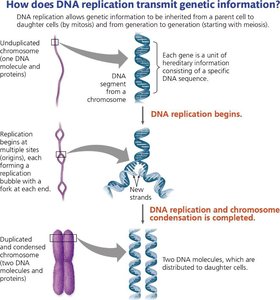
Q2. Describe how DNA replication transmits genetic information to the next generation in a species.
Background
Topic: DNA Replication and Heredity
This question focuses on the mechanism by which DNA replication enables the inheritance of genetic traits from one generation to the next.
Key Terms:
Genetic information: The sequence of nucleotides in DNA that encodes traits.
Replication: The process of copying DNA.
Inheritance: The passing of genetic traits from parents to offspring.
Step-by-Step Guidance
Recall that DNA replication produces two identical DNA molecules from one original molecule.
Think about how these identical DNA molecules are distributed to daughter cells during cell division.
Consider how this process ensures that offspring inherit the same genetic information as their parents.
Reflect on the role of DNA replication in both mitosis (for somatic cells) and meiosis (for gametes).
Try solving on your own before revealing the answer!
Final Answer:
DNA replication transmits genetic information by creating identical copies of DNA that are passed to daughter cells during cell division. In sexual reproduction, replicated DNA is distributed to gametes, ensuring offspring inherit genetic information from both parents. This process maintains genetic continuity and enables inheritance of traits.
Q3. What are the two main types of nucleic acids, and what is the primary function of each?
Background
Topic: Types of Nucleic Acids
This question tests your knowledge of the basic molecular types that store and transmit genetic information in cells.
Key Terms:
DNA (Deoxyribonucleic acid): Stores genetic information.
RNA (Ribonucleic acid): Transfers genetic information and is involved in protein synthesis.
Step-by-Step Guidance
Identify the two main nucleic acids found in cells.
Recall the primary function of DNA in storing hereditary information.
Think about the role of RNA in expressing and transferring genetic information for protein synthesis.
Try solving on your own before revealing the answer!
Final Answer:
The two main types of nucleic acids are DNA and RNA. DNA stores genetic information, while RNA transfers genetic information and helps synthesize proteins.
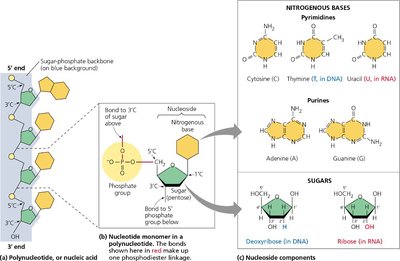
Q4. Using the picture to the right, describe the structure of nucleic acids. Be sure to include the phosphate, sugar, and nucleotide.
Background
Topic: Nucleic Acid Structure
This question asks you to identify the components of nucleic acids and how they are organized in a DNA or RNA strand.
Key Terms:
Nucleotide: The basic building block of nucleic acids, consisting of a phosphate group, a sugar, and a nitrogenous base.
Phosphate group: Links nucleotides together.
Sugar (deoxyribose in DNA, ribose in RNA): Forms the backbone of the molecule.
Nitrogenous base: Encodes genetic information.
Step-by-Step Guidance
Examine the diagram and identify the three main components of a nucleotide.
Describe how nucleotides are linked together to form a polynucleotide chain.
Explain the role of the sugar-phosphate backbone in providing structural stability.
Discuss how the nitrogenous bases are attached to the sugar and how they encode information.
Try solving on your own before revealing the answer!
Final Answer:
Nucleic acids are composed of nucleotides, each containing a phosphate group, a sugar (deoxyribose or ribose), and a nitrogenous base. Nucleotides are linked by phosphodiester bonds between the phosphate and sugar, forming a sugar-phosphate backbone. The nitrogenous bases project from the backbone and encode genetic information.
Q5. Using the figure to the right, what are the key differences between the structures of DNA and RNA?
Background
Topic: DNA vs. RNA Structure
This question tests your ability to distinguish between the molecular structures of DNA and RNA.
Key Terms:
Deoxyribose (DNA) vs. Ribose (RNA): Different sugars in the backbone.
Thymine (DNA) vs. Uracil (RNA): Different nitrogenous bases.
Double-stranded (DNA) vs. single-stranded (RNA): Structural differences.
Step-by-Step Guidance
Identify the sugar present in DNA and RNA from the diagram.
Note the nitrogenous bases unique to each molecule (thymine in DNA, uracil in RNA).
Compare the strand structure (double vs. single) as shown in the figure.
Try solving on your own before revealing the answer!
Final Answer:
DNA contains deoxyribose sugar and thymine, is usually double-stranded, while RNA contains ribose sugar and uracil, and is typically single-stranded.
Q6. Using the figure above, describe which structure of the nucleotide is responsible for connecting the two nucleotides together.
Background
Topic: Nucleotide Linkage
This question focuses on the chemical bonds that join nucleotides in a nucleic acid strand.
Key Terms:
Phosphodiester bond: The bond that links the phosphate group of one nucleotide to the sugar of another.
5' and 3' ends: Directionality of the nucleic acid strand.
Step-by-Step Guidance
Examine the diagram to locate the phosphate group and sugar in each nucleotide.
Identify the bond formed between the 5' phosphate and the 3' hydroxyl group of adjacent nucleotides.
Describe how this linkage creates the sugar-phosphate backbone.
Try solving on your own before revealing the answer!
Final Answer:
The phosphate group of one nucleotide forms a phosphodiester bond with the 3' hydroxyl group of the sugar in the next nucleotide, connecting them and creating the sugar-phosphate backbone.
