 Back
Study Guide: Molecular Basis of Inheritance (General Biology)
Study Guide - Smart Notes
 Tailored notes based on your materials, expanded with key definitions, examples, and context.
Q17. UV light from sunlight is a DNA damaging agent. Describe how this specifically damages the DNA and the repair mechanism to fix the problem.
Background
Topic: DNA Damage and Repair
This question tests your understanding of how environmental factors like UV light can cause mutations in DNA, and how cells repair such damage to maintain genetic integrity.
Key Terms and Concepts:
Thymine dimer: A covalent bond formed between two adjacent thymine bases in DNA due to UV exposure.
Nucleotide excision repair: A cellular mechanism that removes damaged DNA segments and replaces them with correct nucleotides.
Mutation: A change in the DNA sequence that can affect gene function.
Step-by-Step Guidance
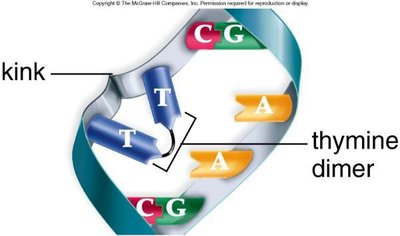
UV light can cause adjacent thymine bases in a DNA strand to bond together, forming a thymine dimer. This creates a kink in the DNA structure.
The thymine dimer distorts the DNA helix, interfering with normal DNA replication and transcription.
Cells recognize this abnormal structure and initiate a repair process called nucleotide excision repair.
During nucleotide excision repair, enzymes cut out the damaged section of DNA containing the thymine dimer.
The gap is then filled in with new, correct nucleotides using the undamaged strand as a template.
Try solving on your own before revealing the answer!
Final Answer:
UV light causes the formation of thymine dimers, which create a kink in the DNA and disrupt normal function. The cell uses nucleotide excision repair to remove the damaged section and replace it with correct nucleotides, restoring the DNA's integrity.
This mechanism is essential for preventing mutations that could lead to diseases like cancer.
Q22. What are telomeres and what role do they play in the chromosome?
Background
Topic: Chromosome Structure and Function
This question focuses on the protective function of telomeres at the ends of chromosomes and their importance in cell division and aging.
Key Terms:
Telomere: Repetitive DNA sequences at the ends of chromosomes that protect them from degradation.
Chromosome: A DNA molecule with associated proteins, carrying genetic information.
Cellular senescence: The process by which cells stop dividing after telomeres become too short.
Step-by-Step Guidance
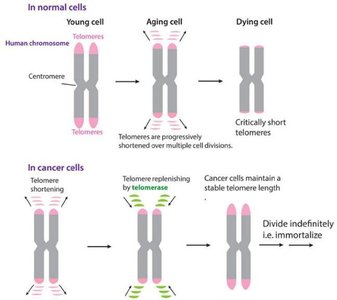
Telomeres are repetitive DNA sequences (often TTAGGG in humans) found at the ends of chromosomes.
They act as protective caps, preventing the loss of important genetic information during DNA replication.
Each time a cell divides, telomeres shorten because DNA polymerase cannot fully replicate the ends of linear chromosomes.
When telomeres become critically short, cells enter senescence and stop dividing, which is associated with aging.
Try solving on your own before revealing the answer!
Final Answer:
Telomeres are repetitive DNA sequences at chromosome ends that protect genetic material from degradation. They shorten with each cell division, eventually leading to cellular senescence when they become too short. This process is a key factor in aging and limits the number of times a cell can divide.
Q12. Describe the general mode of semiconservative DNA replication. Be sure to describe the template strand and the daughter strands.
Background
Topic: DNA Replication
This question tests your understanding of how DNA is copied during cell division, specifically the semiconservative model where each new DNA molecule contains one old and one new strand.
Key Terms and Concepts:
Semiconservative replication: Each daughter DNA molecule consists of one original (parental) strand and one newly synthesized strand.
Template strand: The original DNA strand used as a guide for synthesizing the new strand.
Daughter strand: The newly synthesized strand complementary to the template.
Step-by-Step Guidance
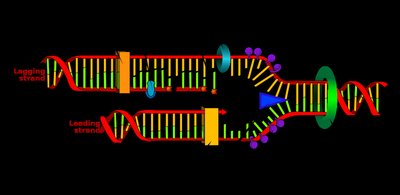
During DNA replication, the double helix unwinds, exposing two template strands.
Each template strand serves as a guide for synthesizing a new, complementary daughter strand.
DNA polymerase adds nucleotides to the new strand, matching them to the template strand according to base pairing rules.
After replication, each DNA molecule consists of one old (template) strand and one new (daughter) strand.
Try solving on your own before revealing the answer!
Final Answer:
Semiconservative DNA replication produces two DNA molecules, each with one original strand and one newly synthesized strand. This ensures genetic continuity and accuracy during cell division.
Q7. Describe the Griffith and Hershey and Chase experiments that led to the discovery that DNA could be hereditary information.
Background
Topic: Discovery of DNA as Genetic Material
This question explores classic experiments that demonstrated DNA's role in heredity.
Key Terms:
Transformation: The process by which genetic material from one organism can change another organism.
Bacteriophage: A virus that infects bacteria, used in the Hershey and Chase experiment.
Hereditary information: Material passed from one generation to the next.
Step-by-Step Guidance
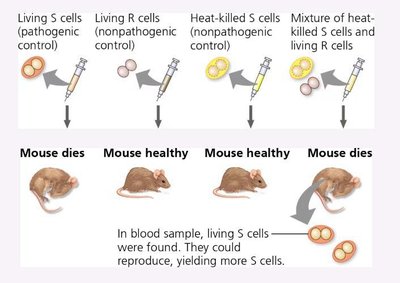
Griffith's experiment involved injecting mice with different combinations of pathogenic and non-pathogenic bacteria.
He observed that non-pathogenic bacteria could become pathogenic when mixed with heat-killed pathogenic bacteria, suggesting a "transforming principle."
Hershey and Chase used radioactive labeling to show that DNA, not protein, was the genetic material transferred by bacteriophages to bacteria.
These experiments provided strong evidence that DNA carries hereditary information.
Try solving on your own before revealing the answer!
Final Answer:
Griffith's experiment demonstrated transformation, while Hershey and Chase showed that DNA, not protein, is the hereditary material. Together, these experiments established DNA as the molecule responsible for inheritance.
