 Back
Study Guide: Origin and Diversification of Eukaryotes & Protist Biology
Study Guide - Smart Notes
 Tailored notes based on your materials, expanded with key definitions, examples, and context.
Q1. What features of domain Eukarya were seen in the fossil record during the initial diversification?
Background
Topic: Early Eukaryotic Evolution
This question explores the characteristics of early eukaryotes as observed in the fossil record, focusing on their initial diversification.
Key Terms:
Eukaryote: Organisms with cells containing a nucleus and membrane-bound organelles.
Fossil record: Physical evidence of ancient life preserved in rocks.
Diversification: The process by which species evolve and become more varied.
Step-by-Step Guidance
Review the timeline of Earth's history, focusing on the period around 1.8 billion years ago when eukaryotes first appeared.
Identify the cellular features that distinguish eukaryotes from prokaryotes, such as the presence of a nucleus and organelles.
Examine fossil evidence for these features, noting any structures that indicate compartmentalization or complexity.
Consider how these features might have contributed to the diversification of eukaryotes.
Try solving on your own before revealing the answer!
Q5. What is endosymbiosis?
Background
Topic: Endosymbiotic Theory
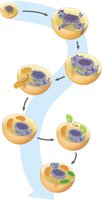
This question tests your understanding of the process by which eukaryotic cells acquired mitochondria and plastids through symbiotic relationships with prokaryotes.
Key Terms:
Endosymbiosis: A process where one organism lives inside another, forming a mutually beneficial relationship.
Mitochondria and plastids: Organelles believed to have originated from free-living bacteria.
Step-by-Step Guidance
Define endosymbiosis and explain its significance in the evolution of eukaryotic cells.
Describe how a prokaryotic cell could engulf another cell, leading to a symbiotic relationship.
Discuss the evidence supporting this theory, such as similarities between organelles and bacteria.
Consider the evolutionary advantages provided by endosymbiosis.
Try solving on your own before revealing the answer!
Q20. Number and explain eight steps in the Plasmodium life cycle.
Background
Topic: Parasitic Protist Life Cycle
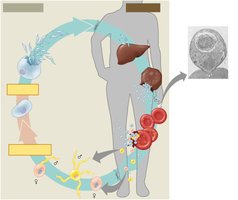
This question focuses on the complex life cycle of Plasmodium, the causative agent of malaria, which alternates between mosquito and human hosts.
Key Terms:
Plasmodium: A genus of parasitic protists responsible for malaria.
Life cycle: The series of stages an organism goes through from one generation to the next.
Host: The organism in which a parasite lives and reproduces.
Step-by-Step Guidance
Identify the two main hosts involved in the Plasmodium life cycle: humans and mosquitoes.
Describe the initial infection stage when a mosquito bites a human and injects Plasmodium sporozoites.
Explain how sporozoites travel to the liver and undergo development.
Discuss the release of merozoites from the liver into the bloodstream, where they infect red blood cells.
Outline the process of gametocyte formation in red blood cells, which are then taken up by another mosquito.
Try solving on your own before revealing the answer!
