 Back
Study Guide: Origin and Evolution of Vertebrates (Campbell Biology, Chapter 34)
Study Guide - Smart Notes
 Tailored notes based on your materials, expanded with key definitions, examples, and context.
Q1. Which trait is shared by all vertebrates except cyclostomes at some point in development?
Background
Topic: Vertebrate Characteristics
This question tests your understanding of the traits that define vertebrates and how cyclostomes (jawless vertebrates like lampreys and hagfish) differ from other vertebrates.
Key Terms:
Notochord: A flexible rod that supports the body in all embryonic and some adult chordates.
Vertebrae: Bones or cartilage forming the backbone.
Cartilaginous skeleton: Skeleton made of cartilage rather than bone.
Cranium (head): The skull, protecting the brain.
Mouth with jaws: Jaws are a major evolutionary innovation in vertebrates.
Step-by-Step Guidance
Review the key traits listed and recall which are present in all vertebrates except cyclostomes.
Think about the developmental stages of vertebrates and which trait is absent in cyclostomes but present in others.
Consider the evolutionary significance of jaws and vertebrae in vertebrate history.
Eliminate traits that are present in cyclostomes or not present in all other vertebrates.
Try solving on your own before revealing the answer!
Final Answer: Mouth with jaws
Cyclostomes lack jaws, while all other vertebrates develop jaws at some point. This is a key evolutionary trait distinguishing jawless from jawed vertebrates.
Q2. What suggests that bony skeletons came first, followed by cartilaginous ones?
Background
Topic: Evolution of Fish Skeletons
This question explores the evidence for the evolutionary sequence of bony and cartilaginous skeletons in fishes.
Key Terms:
Chondrichthyes: Cartilaginous fishes (sharks, rays).
Osteichthyes: Bony fishes.
Bone tissue: Hard tissue forming the skeleton.
Calcium impregnation: Cartilage with calcium deposits.
Step-by-Step Guidance
Review the evolutionary timeline and fossil evidence for fish skeletons.
Consider which group shows traces of bone tissue, even if their skeleton is mostly cartilage.
Think about the significance of finding bone tissue in both living and fossil cartilaginous fishes.
Eliminate options that do not directly address the sequence of skeletal evolution.
Try solving on your own before revealing the answer!
Final Answer: Traces of bone tissue are found in living and fossil Chondrichthyes.
This evidence suggests that bony skeletons evolved first, and cartilaginous skeletons are a derived condition.
Q3. Which correctly describes phylogenetic relationships among birds, mammals, and reptiles?
Background
Topic: Vertebrate Phylogeny
This question tests your understanding of evolutionary relationships and common ancestry among major vertebrate groups.
Key Terms:
Phylogeny: Evolutionary history and relationships.
Amniotes: Vertebrates with amniotic eggs (reptiles, birds, mammals).
Therapsids: Mammal-like reptiles.
Common ancestor: The most recent shared ancestor of two groups.
Step-by-Step Guidance
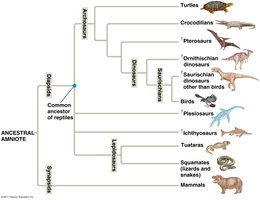
Review the evolutionary tree of vertebrates, focusing on birds, mammals, and reptiles.
Recall which groups are amniotes and their evolutionary origins.
Consider the relationship between birds and dinosaurs, and mammals and therapsids.
Eliminate statements that are inconsistent with current phylogenetic understanding.
Try solving on your own before revealing the answer!
Final Answer: Birds share the closest common ancestor with dinosaurs.
Birds are descended from theropod dinosaurs, making them closely related to dinosaurs within the reptile clade.
Q4. Which group soon outcompeted amphibians on land due to their watertight skin and eggs?
Background
Topic: Adaptations for Terrestrial Life
This question focuses on the evolutionary adaptations that allowed certain vertebrates to thrive on land.
Key Terms:
Watertight skin: Prevents desiccation.
Amniotic eggs: Eggs with protective membranes, allowing development on land.
Amphibians: Require moist environments for reproduction.
Step-by-Step Guidance
Recall which vertebrate groups have adaptations for dry land.
Think about the role of skin and eggs in preventing water loss.
Eliminate groups that do not have these adaptations.
Identify the group that became dominant on land after amphibians.
Try solving on your own before revealing the answer!
Final Answer: Reptiles
Reptiles have watertight skin and amniotic eggs, allowing them to outcompete amphibians in dry environments.
Q5. Which chordate group has all four key chordate characteristics as an adult, not just as an embryo?
Background
Topic: Chordate Characteristics
This question tests your knowledge of the four defining features of chordates and which group retains them throughout life.
Key Terms:
Notochord
Dorsal hollow nerve cord
Pharyngeal slits
Post-anal tail
Step-by-Step Guidance
List the four key chordate characteristics.
Recall which groups lose some of these features during development.
Identify the group that retains all four as adults.
Eliminate groups that only have these features as embryos.
Try solving on your own before revealing the answer!
Final Answer: Lancelets
Lancelets retain all four chordate characteristics throughout their adult life.
Q6. Which osteichthyan structure allows bony fishes to control their buoyancy using gases from their blood?
Background
Topic: Fish Adaptations
This question tests your understanding of the anatomical adaptations in bony fishes for buoyancy control.
Key Terms:
Osteichthyes: Bony fishes.
Swim bladder: Gas-filled organ for buoyancy.
Operculum: Gill cover.
Lateral line system: Sensory organ.
Cloaca: Common exit for digestive, urinary, and reproductive tracts.
Step-by-Step Guidance
Recall the function of each structure listed.
Identify which structure is responsible for buoyancy control.
Consider how gases from the blood are used in this process.
Eliminate structures not involved in buoyancy.
Try solving on your own before revealing the answer!
Final Answer: Swim bladder
The swim bladder allows bony fishes to regulate their buoyancy by adjusting gas levels.
Q7. Early vertebrate fossils called conodonts can be identified by all of the following features except _____.
Background
Topic: Fossil Identification
This question tests your knowledge of the features used to identify early vertebrate fossils, specifically conodonts.
Key Terms:
Conodonts: Extinct jawless vertebrates.
Cartilage skeleton
Large eyes
Barbed hooks
Slender, jawless bodies
Inner ear with semicircular canals
Step-by-Step Guidance
Review the features listed and recall which are characteristic of conodonts.
Identify the feature that is not found in conodonts.
Eliminate features that are present in conodont fossils.
Focus on anatomical features unique to conodonts.
Try solving on your own before revealing the answer!
Final Answer: An inner ear with two semicircular canals
Conodonts did not have an inner ear with two semicircular canals; this feature evolved later in vertebrates.
Q8. Which statement misdescribes the lateral line system?
Background
Topic: Sensory Systems in Aquatic Vertebrates
This question tests your understanding of the function and distribution of the lateral line system in aquatic vertebrates.
Key Terms:
Lateral line system: Sensory organ for detecting vibrations.
Gnathostomes: Jawed vertebrates.
Step-by-Step Guidance
Review the function of the lateral line system.
Identify which statement does not accurately describe its role or location.
Eliminate statements that are correct descriptions.
Focus on the statement that is inconsistent with the lateral line system's function.
Try solving on your own before revealing the answer!
Final Answer: It is used in digestion.
The lateral line system is not involved in digestion; it is a sensory system for detecting water movement and vibrations.
Q9. Archaeopteryx differed from modern birds in that it _____.
Background
Topic: Evolution of Birds
This question tests your knowledge of the differences between Archaeopteryx and modern birds.
Key Terms:
Archaeopteryx: Early bird-like dinosaur.
Feathered wings
Airfoil wings
Flight adaptations
Step-by-Step Guidance
Recall the features of Archaeopteryx and modern birds.
Identify which feature was present in Archaeopteryx but not in modern birds.
Eliminate features shared by both.
Focus on flight adaptations and ability to take off.
Try solving on your own before revealing the answer!
Final Answer: Could not take off from a standing position
Archaeopteryx lacked the adaptations for powered flight from a standing start, unlike modern birds.
Q10. Which is the closest living group to the primates?
Background
Topic: Vertebrate Relationships
This question tests your understanding of the evolutionary relationships between primates and other vertebrate groups.
Key Terms:
Primates: Mammalian order including humans, apes, monkeys.
Monotremes: Egg-laying mammals.
Phylogenetic proximity
Step-by-Step Guidance
Recall the major groups of mammals and their evolutionary relationships.
Identify which group shares the most recent common ancestor with primates.
Eliminate groups that are not mammals.
Focus on monotremes and their relationship to primates.
Try solving on your own before revealing the answer!
Final Answer: Monotremes
Monotremes are the closest living group to primates among the options, as both are mammals.
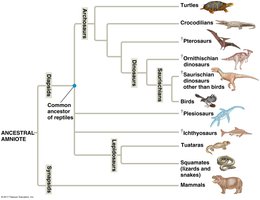
Q11. If you discovered a fossil that fit between the crocodilians and pterosaurs, what feature would it probably have?
Background
Topic: Fossil Identification and Evolutionary Relationships
This question tests your understanding of the features that would be present in a transitional fossil between crocodilians and pterosaurs.
Key Terms:
Amniote eggs
Wings
Feathers
Milk
Step-by-Step Guidance
Review the evolutionary tree and the features of crocodilians and pterosaurs.
Identify which feature would be transitional between these groups.
Eliminate features unique to birds or mammals.
Focus on features related to flight and reproduction.
Try solving on your own before revealing the answer!
Final Answer: Amniote eggs
A fossil between crocodilians and pterosaurs would likely have amniote eggs, a shared feature of these groups.
Q12. Which pair has convergent features?
Background
Topic: Convergent Evolution
This question tests your understanding of convergent evolution, where unrelated groups evolve similar traits.
Key Terms:
Convergent evolution: Independent evolution of similar traits.
Snake, caecilian: Both are limbless.
Lizard, marsupial: Different evolutionary lineages.
Step-by-Step Guidance
Review the pairs and recall which have similar features due to convergent evolution.
Identify the traits that are similar but evolved independently.
Eliminate pairs that are closely related or do not share convergent traits.
Focus on limblessness and other adaptations.
Try solving on your own before revealing the answer!
Final Answer: Snake, caecilian
Both snakes and caecilians are limbless, but this trait evolved independently in each lineage.
Q13. In which choice is the first group phylogenetically part of the second group?
Background
Topic: Phylogenetic Classification
This question tests your understanding of hierarchical classification and phylogenetic relationships.
Key Terms:
Phylogenetic group: A group that includes all descendants of a common ancestor.
Birds, reptiles; eutherians, mammals; cartilaginous fish, fish; hominins, primates
Step-by-Step Guidance
Review each pair and determine if the first is a subgroup of the second.
Recall the phylogenetic tree and classification of each group.
Eliminate pairs where the first is not part of the second.
Identify if all pairs fit the criteria.
Try solving on your own before revealing the answer!
Final Answer: All of the above
Each first group is phylogenetically part of the second group listed.
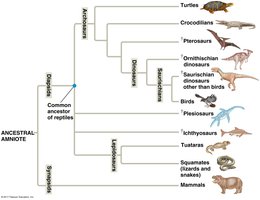
Q14. Which is the oldest amniote group?
Background
Topic: Amniote Evolution
This question tests your knowledge of the evolutionary history of amniotes.
Key Terms:
Amniotes: Vertebrates with amniotic eggs.
Turtles, crocodilians, pterosaurs, plesiosaurs, birds
Step-by-Step Guidance
Review the evolutionary tree of amniotes.
Identify which group appeared earliest in the fossil record.
Eliminate groups that evolved later.
Focus on the timeline of amniote evolution.
Try solving on your own before revealing the answer!
Final Answer: Turtles
Turtles are considered the oldest amniote group among the options listed.
Q15. If you introduced the following groups of vertebrates to a newly formed island with little surface water, which would probably become dominant?
Background
Topic: Adaptations for Dry Environments
This question tests your understanding of which vertebrate group is best adapted to dry environments.
Key Terms:
Amphibians: Require moist environments.
Reptiles: Adapted to dry environments.
Bony fish, coelacanths: Aquatic.
Step-by-Step Guidance
Review the adaptations of each group for dry environments.
Eliminate groups that require water for reproduction or survival.
Identify the group with watertight skin and amniotic eggs.
Focus on terrestrial adaptations.
Try solving on your own before revealing the answer!
Final Answer: Reptiles
Reptiles are best adapted to dry environments and would likely become dominant.
Q16. Which group does not belong?
Background
Topic: Vertebrate Classification
This question tests your ability to identify which group is not part of the others based on evolutionary relationships.
Key Terms:
Cartilaginous fish, amphibians, mammals, tuataras, pterosaurs
Step-by-Step Guidance
Review the evolutionary relationships among the groups listed.
Identify which group is not closely related to the others.
Eliminate groups that share common ancestry.
Focus on unique evolutionary traits.
Try solving on your own before revealing the answer!
Final Answer: Pterosaurs
Pterosaurs are extinct flying reptiles and do not belong with the other groups listed.
