 Back
Study Guide: Plant Diversity and Adaptations for Terrestrial Life
Study Guide - Smart Notes
 Tailored notes based on your materials, expanded with key definitions, examples, and context.
Q1. Identify key derived characters of plants.
Background
Topic: Plant Evolution and Adaptations
This question tests your understanding of the unique features that distinguish land plants from their aquatic ancestors, especially adaptations for terrestrial life.
Key Terms:
Derived characters: Traits that evolved in land plants and are not found in their algal ancestors.
Adaptations: Features that help plants survive on land, such as cuticle, stomata, and vascular tissue.
Step-by-Step Guidance
Review the five key traits that land plants share with green algae, focusing on those that are unique to land plants.
Consider adaptations such as multicellular, dependent embryos, walled spores produced in sporangia, and apical meristems.
Think about how each trait helps plants survive in a terrestrial environment (e.g., preventing water loss, supporting growth).
List these traits and briefly describe their function.
Try solving on your own before revealing the answer!
Final Answer:
Alternation of generations
Multicellular, dependent embryos
Walled spores produced in sporangia
Multicellular gametangia
Apical meristems
These traits are key adaptations that allowed plants to colonize land and thrive in terrestrial environments.
Q2. Characterize the life cycles of nonvascular plants.
Background
Topic: Alternation of Generations in Nonvascular Plants
This question focuses on the life cycle of mosses and other bryophytes, emphasizing the alternation between gametophyte and sporophyte generations.
Key Terms:
Gametophyte: The haploid generation that produces gametes.
Sporophyte: The diploid generation that produces spores.
Alternation of generations: The life cycle alternating between haploid and diploid stages.
Step-by-Step Guidance
Identify which generation is dominant in nonvascular plants (bryophytes).
Describe the role of the gametophyte and sporophyte in the life cycle.
Explain how gametes are produced and how fertilization occurs.
Discuss how spores are produced and dispersed.
Label the key stages in the moss life cycle diagram.
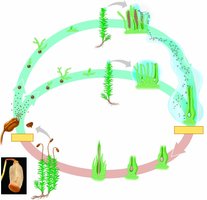
Try solving on your own before revealing the answer!
Final Answer:
In nonvascular plants, the gametophyte is the dominant, photosynthetic, and independent generation. The sporophyte is smaller and dependent on the gametophyte. Gametophytes produce gametes, which fuse to form a zygote. The zygote develops into a sporophyte, which produces spores by meiosis. Spores disperse and grow into new gametophytes.
Q3. Describe characteristics and reproductive processes of seedless vascular plants.
Background
Topic: Seedless Vascular Plant Life Cycles and Adaptations
This question examines the features and reproductive strategies of ferns and their relatives, focusing on their ability to grow tall and their dependence on water for reproduction.
Key Terms:
Vascular tissue: Xylem and phloem, which transport water and nutrients.
Seedless vascular plants: Plants like ferns, club mosses, and horsetails.
Sporophyte: The dominant generation in seedless vascular plants.
Step-by-Step Guidance
Identify the two types of vascular tissue and their functions.
Explain why seedless vascular plants can grow tall compared to nonvascular plants.
Describe the reproductive process, including the need for water for sperm to reach the egg.
Label the stages in the fern life cycle diagram, focusing on alternation of generations.
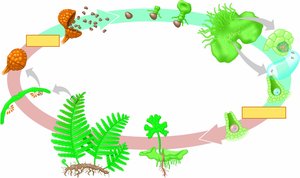
Try solving on your own before revealing the answer!
Final Answer:
Seedless vascular plants have xylem (transports water) and phloem (transports nutrients).
The sporophyte is the dominant generation and can grow tall due to lignified vascular tissue.
Reproduction requires water for sperm to swim to the egg; spores are produced and dispersed to grow new gametophytes.
Q4. Organize the plant groups using a concept map.
Background
Topic: Plant Classification and Grouping
This question tests your ability to classify plants into major groups based on their characteristics and reproductive strategies.
Key Terms:
Nonvascular plants: Bryophytes (mosses, liverworts, hornworts).
Vascular plants: Divided into seedless and seed plants.
Gymnosperms: Seed plants that produce seeds in cones.
Angiosperms: Flowering plants.
Step-by-Step Guidance
Start with the plant kingdom and divide it into nonvascular and vascular plants.
List the three types of nonvascular plants (bryophytes).
Divide vascular plants into seedless and seed plants.
Identify gymnosperms and angiosperms as subgroups of seed plants.
Revise the concept map to include the two groups of vascular plants that reproduce with spores.
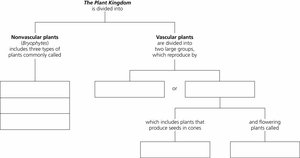
Try solving on your own before revealing the answer!
Final Answer:
Nonvascular plants include mosses, liverworts, and hornworts. Vascular plants are divided into seedless (ferns, club mosses) and seed plants (gymnosperms and angiosperms).
Q5. Label the stages in the moss life cycle diagram.
Background
Topic: Moss Life Cycle and Alternation of Generations
This question helps you understand the alternation of generations in mosses, including the roles of gametophyte and sporophyte.
Key Terms:
Antheridia: Male reproductive structures.
Archegonia: Female reproductive structures.
Sporangium: Structure where spores are produced.
Step-by-Step Guidance
Identify the male and female gametophytes in the diagram.
Label the antheridia and archegonia, and indicate where sperm and egg are produced.
Trace the path from fertilization to zygote, then to sporophyte.
Label the sporangium and indicate where spores are produced and released.
Try solving on your own before revealing the answer!
Final Answer:
Male gametophyte produces sperm in antheridia; female gametophyte produces eggs in archegonia. Fertilization forms a zygote, which develops into a sporophyte. The sporophyte produces spores in the sporangium, which are released to grow new gametophytes.
Q6. Label the stages in the fern life cycle diagram.
Background
Topic: Fern Life Cycle and Alternation of Generations
This question reinforces your understanding of alternation of generations in ferns, including the roles of gametophyte and sporophyte.
Key Terms:
Sporangium: Structure where spores are produced.
Gametophyte: Haploid stage producing gametes.
Sporophyte: Diploid stage producing spores.
Step-by-Step Guidance
Identify the sporangium and where meiosis occurs to produce spores.
Label the spore and trace its development into a gametophyte.
Locate the antheridium and archegonium on the gametophyte, and indicate where sperm and egg are produced.
Trace the path from fertilization to zygote, then to sporophyte.
Try solving on your own before revealing the answer!
Final Answer:
Sporangium produces spores by meiosis; spores grow into gametophytes. Gametophytes produce sperm (antheridium) and eggs (archegonium). Fertilization forms a zygote, which develops into a sporophyte.
