 Back
BackStudy Guide: Proteins & Gene Expression in Biology
Study Guide - Smart Notes
 Tailored notes based on your materials, expanded with key definitions, examples, and context.
Q1. Describe the roles of proteins in living systems.
Background
Topic: Protein Function
This question tests your understanding of the diverse functions that proteins perform in cells and organisms.
Key Terms:
Enzymes: Proteins that catalyze biochemical reactions.
Structural proteins: Provide support and shape to cells and tissues.
Transport proteins: Move substances across membranes or within the body.
Signaling proteins: Involved in communication within and between cells.
Defense proteins: Protect against disease (e.g., antibodies).
Step-by-Step Guidance
Think about the different types of proteins and their functions in the cell (e.g., enzymes, structural, transport, signaling, defense).
Consider examples of each type (e.g., actin for structure, hemoglobin for transport).
Reflect on how proteins are essential for nearly all cellular processes.
Try solving on your own before revealing the answer!
Final Answer:
Proteins serve as enzymes, structural components, transporters, signaling molecules, and defense agents in living systems. Each function is critical for maintaining life and cellular processes.
Q2. Proteins can have diverse structural features and functions in the cells. How do you get such variety of proteins in nature? What level of protein structure is responsible for these differences?
Background
Topic: Protein Structure and Diversity
This question is about how the sequence and structure of proteins lead to their diversity in function and form.
Key Terms:
Primary structure: Sequence of amino acids.
Secondary structure: Local folding (alpha helices, beta sheets).
Tertiary structure: Overall 3D shape.
Quaternary structure: Multiple polypeptide chains interacting.
Step-by-Step Guidance
Recall that the primary structure (amino acid sequence) determines how a protein folds.
Understand that folding leads to secondary, tertiary, and quaternary structures.
Recognize that the unique sequence and folding patterns create diverse protein functions.
Try solving on your own before revealing the answer!
Final Answer:
The primary structure (amino acid sequence) is responsible for the diversity of proteins, as it determines the folding and final shape, which in turn dictates function.
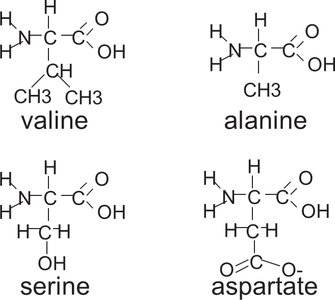
Q3. Describe the general structure of an amino acid shown below. Be sure to circle the R groups (side chains).
Background
Topic: Amino Acid Structure
This question tests your ability to identify the basic components of an amino acid and the importance of the R group.
Key Terms:
Amino group ()
Carboxyl group ()
Alpha carbon (central carbon)
R group (side chain, variable part)
Step-by-Step Guidance
Identify the central alpha carbon in each amino acid.
Locate the amino group () and carboxyl group () attached to the alpha carbon.
Find the R group (side chain) and note its position and variability among different amino acids.
Try solving on your own before revealing the answer!
Final Answer:
An amino acid consists of a central alpha carbon bonded to an amino group, a carboxyl group, a hydrogen atom, and an R group (side chain). The R group is what varies between amino acids and determines their properties.
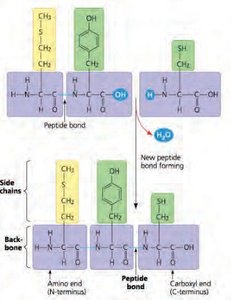
Q4. How are amino acids joined to form the primary structure? (Fig. 3.19)
Background
Topic: Peptide Bond Formation
This question is about the chemical process that links amino acids together to form proteins.
Key Terms and Formula:
Peptide bond: Covalent bond between amino acids.
Dehydration synthesis: Removal of water to form a bond.
Step-by-Step Guidance
Recognize that the carboxyl group of one amino acid reacts with the amino group of another.
Understand that this reaction releases a molecule of water (dehydration synthesis).
Identify the resulting peptide bond () that links the amino acids.
Try solving on your own before revealing the answer!
Final Answer:
Amino acids are joined by peptide bonds formed through dehydration synthesis, linking the carboxyl group of one amino acid to the amino group of another.
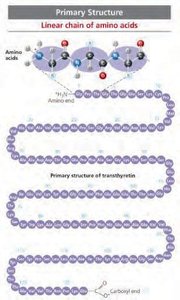
Q5. Using the figure to the left describe the primary structure of a protein.
Background
Topic: Primary Structure of Proteins
This question tests your understanding of what constitutes the primary structure of a protein.
Key Terms:
Primary structure: Linear sequence of amino acids.
Polypeptide chain: Long chain of amino acids.
Step-by-Step Guidance
Observe that the primary structure is a sequence of amino acids linked by peptide bonds.
Note that the sequence is unique for each protein and determines its final structure and function.
Recognize the directionality: amino end (N-terminus) to carboxyl end (C-terminus).
Try solving on your own before revealing the answer!
Final Answer:
The primary structure of a protein is its unique sequence of amino acids, forming a polypeptide chain from the N-terminus to the C-terminus.
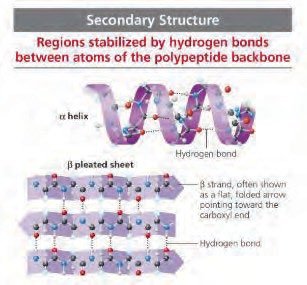
Q6. Now describe the secondary structure of a protein. What types of bonds hold them together? Which amino acid group forms these bonds? (Fig. 3.22)
Background
Topic: Secondary Structure of Proteins
This question is about the local folding patterns in proteins and the chemical bonds involved.
Key Terms:
Secondary structure: Alpha helix and beta pleated sheet.
Hydrogen bonds: Hold secondary structures together.
Backbone atoms: Atoms in the polypeptide backbone (not R groups).
Step-by-Step Guidance
Identify the two main types of secondary structure: alpha helix and beta sheet.
Understand that hydrogen bonds form between backbone atoms (not R groups).
Recognize that these bonds stabilize the local folding of the polypeptide chain.
Try solving on your own before revealing the answer!
Final Answer:
The secondary structure of a protein consists of alpha helices and beta sheets, stabilized by hydrogen bonds between backbone atoms (not R groups).
