 Back
Study Guide: Proteins, Energy, and Enzymes
Study Guide - Smart Notes
 Tailored notes based on your materials, expanded with key definitions, examples, and context.
Q4. Define the primary structure of a protein and identify and locate the peptide bonds that maintain primary structure.
Background
Topic: Protein Structure
This question tests your understanding of the primary structure of proteins, which is the sequence of amino acids in a polypeptide chain, and the peptide bonds that link them together.
Key Terms and Concepts:
Primary Structure: The unique sequence of amino acids in a protein.
Peptide Bond: A covalent bond formed between the carboxyl group of one amino acid and the amino group of another.
Step-by-Step Guidance
Recall that the primary structure of a protein is determined by the linear sequence of amino acids, which are linked together by peptide bonds.
Identify the peptide bond: It forms between the carboxyl group () of one amino acid and the amino group () of the next, releasing a molecule of water () in a condensation reaction.
Examine a polypeptide chain and locate the repeating pattern of backbone, where each peptide bond is between the carbon of the carboxyl group and the nitrogen of the amino group.
Look for the (carbonyl) and (amide) groups in the backbone, which are characteristic of peptide bonds.

Try solving on your own before revealing the answer!
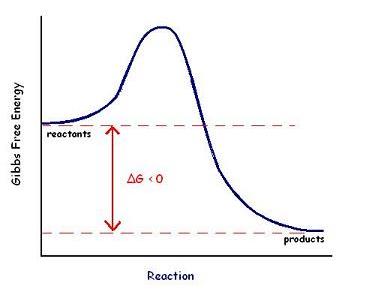
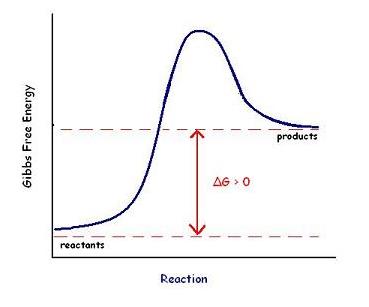
Q15. Identify whether a reaction is endergonic or exergonic using a graph of the free energy change of a reaction.
Background
Topic: Bioenergetics
This question tests your ability to interpret graphs of Gibbs free energy to determine if a reaction releases or requires energy.
Key Terms and Concepts:
Exergonic Reaction: A reaction that releases free energy ().
Endergonic Reaction: A reaction that requires an input of free energy ().
Gibbs Free Energy (): The energy associated with a chemical reaction that can be used to do work.
Step-by-Step Guidance
Examine the y-axis of the graph, which represents Gibbs free energy.
Compare the energy level of the reactants and products. If the products are lower in energy than the reactants, is negative (exergonic). If the products are higher, $\Delta G$ is positive (endergonic).
Look for the direction of the arrow or the value of indicated on the graph.
Use the sign of to classify the reaction as exergonic or endergonic.
Try solving on your own before revealing the answer!
