 Back
Study Guide: Proteins, Gene Expression, Mutations, and Protein Structure in General Biology
Study Guide - Smart Notes
 Tailored notes based on your materials, expanded with key definitions, examples, and context.
Q1. Describe the roles of proteins in living systems.
Background
Topic: Protein Function
This question tests your understanding of the diverse functions that proteins perform in cells and organisms, such as catalysis, structure, transport, signaling, and defense.
Key Terms:
Enzymes: Proteins that speed up chemical reactions.
Structural proteins: Provide support and shape (e.g., collagen, keratin).
Transport proteins: Move substances across membranes (e.g., hemoglobin).
Signaling proteins: Relay messages within and between cells (e.g., hormones).
Defensive proteins: Protect against disease (e.g., antibodies).
Step-by-Step Guidance
List several major functions that proteins carry out in living systems.
Think about examples of proteins for each function (e.g., enzymes, structural proteins).
Consider how the structure of a protein relates to its function.
Reflect on why proteins are essential for life and how their roles differ from other biomolecules.
Try solving on your own before revealing the answer!
Final Answer:
Proteins serve as enzymes, structural components, transporters, signaling molecules, and defensive agents. Their unique three-dimensional structures allow them to perform these diverse functions efficiently in living systems.
Q2. Proteins can have diverse structural features and functions in the cells. How do you get such variety of proteins in nature? What level of protein structure is responsible for these differences?
Background
Topic: Protein Structure and Diversity
This question explores how the sequence and structure of proteins lead to their functional diversity, focusing on the levels of protein structure.
Key Terms:
Primary structure: Sequence of amino acids.
Secondary structure: Local folding (α-helix, β-sheet).
Tertiary structure: Overall 3D shape.
Quaternary structure: Multiple polypeptide chains.
R group (side chain): Variable part of amino acid that determines properties.
Step-by-Step Guidance
Recall the four levels of protein structure and what each represents.
Think about how the sequence of amino acids (primary structure) leads to different folding patterns.
Consider how the chemical properties of the R groups affect folding and function.
Identify which level of structure is most directly responsible for the diversity of protein shapes and functions.
Try solving on your own before revealing the answer!
Final Answer:
The primary structure (amino acid sequence) is responsible for the diversity of proteins, as it determines how the protein folds and what functions it can perform. The variety of R groups in amino acids leads to different interactions and shapes.
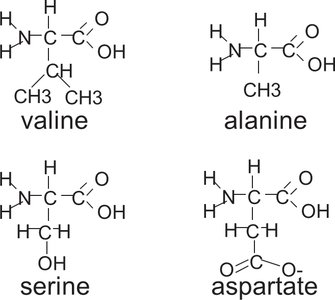
Q3. Describe the general structure of an amino acid shown below. Be sure to circle the R groups (side chains).
Background
Topic: Amino Acid Structure
This question tests your ability to identify the basic components of an amino acid and recognize the importance of the R group.
Key Terms:
Amino group ()
Carboxyl group ()
Alpha carbon (central carbon)
R group (side chain): Variable part that distinguishes amino acids
Step-by-Step Guidance
Identify the four main parts of an amino acid: amino group, carboxyl group, hydrogen atom, and R group.
Locate the R group in each structure and note how it varies between amino acids.
Understand that the R group determines the chemical properties of each amino acid.
Circle the R group in each diagram to highlight its importance.
Try solving on your own before revealing the answer!
Final Answer:
An amino acid consists of a central carbon bonded to an amino group, a carboxyl group, a hydrogen atom, and an R group (side chain). The R group is what makes each amino acid unique.
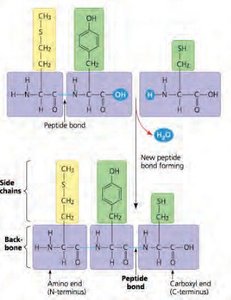
Q4. How are amino acids joined to form the primary structure? (Fig. 3.19)
Background
Topic: Peptide Bond Formation
This question tests your understanding of how amino acids are linked together to form polypeptides, which make up the primary structure of proteins.
Key Terms and Formula:
Peptide bond: Covalent bond between amino acids.
Dehydration synthesis: Reaction that removes water to form a bond.
Step-by-Step Guidance
Identify the amino and carboxyl groups of two adjacent amino acids.
Describe how a peptide bond forms between the carboxyl group of one amino acid and the amino group of another.
Explain that this process releases a molecule of water (dehydration synthesis).
Recognize that repeating this process creates a polypeptide chain (primary structure).
Try solving on your own before revealing the answer!
Final Answer:
Amino acids are joined by peptide bonds formed through dehydration synthesis, linking the carboxyl group of one amino acid to the amino group of another, creating a polypeptide chain.
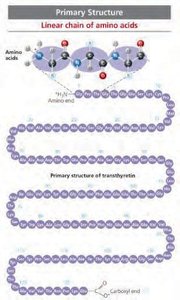
Q5. Using the figure to the left describe the primary structure of a protein.
Background
Topic: Primary Structure of Proteins
This question asks you to describe the linear sequence of amino acids in a protein, which is the primary structure.
Key Terms:
Primary structure: Sequence of amino acids in a polypeptide.
Polypeptide: Chain of amino acids.
Step-by-Step Guidance
Observe the linear arrangement of amino acids in the figure.
Note that each circle represents an amino acid in the chain.
Understand that the sequence is determined by the order of amino acids.
Recognize that this sequence is unique for each protein and dictates higher levels of structure.
Try solving on your own before revealing the answer!
Final Answer:
The primary structure of a protein is a linear chain of amino acids, connected by peptide bonds, with a specific sequence that determines the protein's properties and function.
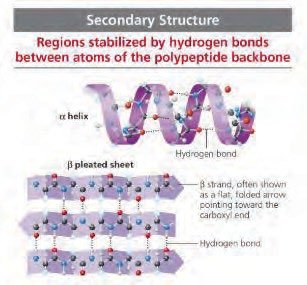
Q6. Now describe the secondary structure of a protein. What types of bonds hold them together? Which amino acid group forms these bonds? (Fig. 3.22)
Background
Topic: Secondary Structure of Proteins
This question tests your understanding of how proteins fold locally into structures like α-helices and β-sheets, stabilized by hydrogen bonds.
Key Terms:
Secondary structure: α-helix and β-sheet.
Hydrogen bonds: Form between backbone atoms (not R groups).
Polypeptide backbone: Atoms involved in secondary structure bonding.
Step-by-Step Guidance
Identify the two main types of secondary structure: α-helix and β-sheet.
Describe how hydrogen bonds form between the carbonyl oxygen and amide hydrogen of the backbone.
Note that these bonds are between atoms in the backbone, not the R groups.
Explain how these structures contribute to the overall shape and stability of the protein.
Try solving on your own before revealing the answer!
Final Answer:
The secondary structure of a protein consists of α-helices and β-sheets, held together by hydrogen bonds between atoms of the polypeptide backbone. These bonds do not involve the R groups.
