 Back
Study Guide: Regulation of Gene Expression in Prokaryotes and Eukaryotes
Study Guide - Smart Notes
 Tailored notes based on your materials, expanded with key definitions, examples, and context.
Q1. List at least three advantages of controlling gene expression. Alternatively, list three disadvantages of not controlling gene expression.
Background
Topic: Gene Regulation
This question tests your understanding of why cells regulate gene expression and the consequences of failing to do so. It relates to cellular efficiency, safety, and adaptability.
Key Terms:
Gene expression: The process by which information from a gene is used to synthesize a functional gene product (usually a protein).
Regulation: Control of when, where, and how much a gene is expressed.
Step-by-Step Guidance
Think about situations where producing unnecessary proteins could be harmful or wasteful for a cell.
Consider how uncontrolled gene expression might affect cellular energy usage and resource allocation.
Reflect on how the lack of regulation could disrupt cellular functions or lead to dangerous conditions (e.g., production of digestive enzymes at the wrong time).
Try to come up with your own examples or scenarios where gene regulation is crucial for normal cell function.
Try solving on your own before revealing the answer!
Final Answer:
Controlling gene expression prevents the production of unnecessary or harmful proteins, ensuring cellular safety.
It conserves energy and resources by only making proteins when needed.
It allows cells to adapt to changing environmental conditions and maintain proper function.
Without regulation, cells could waste energy, produce toxic proteins, or fail to respond appropriately to signals.
Q2. List at least three occasions/scenarios in which gene expression in your own body has important effects.
Background
Topic: Gene Expression in Physiology
This question asks you to connect gene regulation to real-life physiological events, such as hormone production, development, and healing.
Key Terms:
Hormone: A signaling molecule produced by glands that regulates physiology and behavior.
Growth factors: Proteins that stimulate cell growth and division.
Step-by-Step Guidance
Recall situations where your body responds to changes (e.g., blood sugar levels, injury, development).
Think about how gene expression is involved in producing hormones or proteins in these scenarios.
Consider examples like insulin production, wound healing, or developmental processes.
Try to identify at least three distinct occasions where gene expression plays a critical role.
Try solving on your own before revealing the answer!
Final Answer:
Insulin production in response to high blood sugar.
Expression of growth factors during development (e.g., formation of fingers).
Production of proteins for cell division during wound healing.
These examples show how gene expression is essential for normal physiological responses.
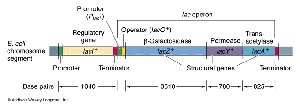
Q3. What protein does lacZ encode? What is the function of this protein?
Background
Topic: Prokaryotic Gene Regulation (Lac Operon)
This question tests your knowledge of the lac operon and the specific function of the lacZ gene product in E. coli.
Key Terms:
lacZ: A gene in the lac operon encoding an enzyme involved in lactose metabolism.
Beta-galactosidase: The enzyme produced by lacZ.
Step-by-Step Guidance
Identify the lacZ gene within the lac operon diagram.
Recall the enzyme produced by lacZ and its role in breaking down lactose.
Think about how this enzyme helps the cell utilize lactose as an energy source.
Try solving on your own before revealing the answer!
Final Answer:
The lacZ gene encodes beta-galactosidase, an enzyme that breaks down lactose into glucose and galactose for energy.
Q4. For each combination of sugars below, determine: 1) if the lac repressor is active, 2) if cAMP levels are high or low, 3) if CRP is active, and 4) if lac operon expression will occur. Is the operon on (high expression) or off (low/no expression)?
Background
Topic: Regulation of the Lac Operon
This question tests your understanding of how environmental conditions (presence of glucose and/or lactose) affect the activity of the lac operon through regulatory proteins and signaling molecules.
Key Terms:
Lac repressor: Protein that inhibits lac operon expression when active.
cAMP: Cyclic AMP, a signaling molecule whose levels are inversely related to glucose concentration.
CRP: cAMP receptor protein, activates transcription when bound to cAMP.
Step-by-Step Guidance
For each sugar scenario, determine if the lac repressor is active (bound to operator) or inactive.
Assess cAMP levels based on glucose presence (high glucose = low cAMP).
Decide if CRP is active (requires high cAMP).
Predict whether the lac operon will be expressed (high or low levels).
Set up a table or list for each scenario, but stop before filling in the final answers.
Try solving on your own before revealing the answer!
Final Answer:
Glucose only: Repressor ON, low cAMP, CRP inactive, no expression.
Lactose only: Repressor OFF, high cAMP, CRP active, high expression.
Glucose and lactose: Repressor OFF, low cAMP, CRP inactive, low expression.
The lac operon is highly expressed only when lactose is present and glucose is absent.
Q5. When is lacI expressed? What protein does it encode?
Background
Topic: Lac Operon Regulation
This question focuses on the regulatory gene lacI and its role in controlling the lac operon.
Key Terms:
lacI: Regulatory gene encoding the lac repressor protein.
Repressor: Protein that binds to the operator to inhibit transcription.
Step-by-Step Guidance
Locate the lacI gene in the operon diagram.
Recall the function of the protein encoded by lacI.
Think about when lacI is expressed (constitutively or regulated).
Try solving on your own before revealing the answer!
Final Answer:
lacI is expressed continuously and encodes the lac repressor protein, which is active unless lactose is present.
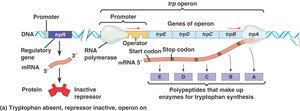
Q6. Does the repressor bind to the operator in the presence or absence of tryptophan?
Background
Topic: Tryptophan (trp) Operon Regulation
This question tests your understanding of repressible operons and how the presence of a corepressor (tryptophan) affects repressor binding.
Key Terms:
Repressor: Protein that can bind to the operator to inhibit transcription.
Corepressor: Molecule (tryptophan) that activates the repressor.
Step-by-Step Guidance
Identify the role of tryptophan in regulating the trp operon.
Recall whether the repressor is active or inactive in the presence of tryptophan.
Determine if the repressor binds to the operator when tryptophan is present or absent.
Try solving on your own before revealing the answer!
Final Answer:
The repressor binds to the operator in the presence of tryptophan, shutting off the operon.
Q7. What is the final function of the proteins encoded by the genes of the trp operon?
Background
Topic: trp Operon Function
This question asks about the collective role of the enzymes produced by the trp operon genes.
Key Terms:
trp operon: Cluster of genes encoding enzymes for tryptophan biosynthesis.
Amino acid synthesis: The process of making amino acids from simpler molecules.
Step-by-Step Guidance
Identify the genes within the trp operon.
Recall the pathway these enzymes are involved in.
Think about the end product of this pathway and its importance to the cell.
Try solving on your own before revealing the answer!
Final Answer:
The proteins encoded by the trp operon synthesize the amino acid tryptophan, which is essential for protein production.
Q8. What type of regulation is represented by the trp operon system, and why?
Background
Topic: Negative Regulation and Repressible Operons
This question tests your understanding of regulatory mechanisms in prokaryotes, specifically negative regulation and repressible operons.
Key Terms:
Negative regulation: Regulation by inhibition (e.g., repressor binding).
Repressible operon: Operon that is usually ON but can be turned OFF by a repressor.
Step-by-Step Guidance
Recall the default state of the trp operon (ON or OFF).
Think about how the repressor is activated and what effect this has on transcription.
Consider why this is called negative regulation and a repressible operon.
Try solving on your own before revealing the answer!
Final Answer:
This is negative regulation because the repressor inhibits transcription. It is a repressible operon, as it is ON by default and can be turned OFF when tryptophan is present.
Q9. Explain why the lac operon is turned ON in the presence of lactose, while the trp operon is turned OFF in the presence of tryptophan. How do the protein products of these operons differ?
Background
Topic: Inducible vs. Repressible Operons
This question compares the regulatory logic of the lac and trp operons and the functional differences in their protein products.
Key Terms:
Inducible operon: Operon turned ON by the presence of a substrate (e.g., lactose).
Repressible operon: Operon turned OFF by the presence of a product (e.g., tryptophan).
Step-by-Step Guidance
Recall the conditions that activate the lac operon (presence of lactose).
Recall the conditions that repress the trp operon (presence of tryptophan).
Compare the functions of the protein products: enzymes for lactose metabolism vs. enzymes for tryptophan synthesis.
Set up a comparison table or summary, but stop before completing the final explanation.
Try solving on your own before revealing the answer!
Final Answer:
The lac operon is inducible and turns ON in the presence of lactose to metabolize it, while the trp operon is repressible and turns OFF in the presence of tryptophan to stop its synthesis. Their protein products differ: lac operon enzymes break down lactose, trp operon enzymes synthesize tryptophan.
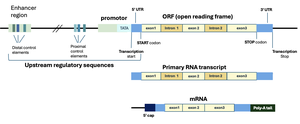
Q10. Draw a simple diagram of a eukaryotic gene with all the control elements (promoter and enhancer), and the gene with start, stop, introns and exons. Mark the 5’ and 3’ in each strand and the coding and template strands.
Background
Topic: Eukaryotic Gene Structure
This question tests your ability to visualize and label the components of a eukaryotic gene, including regulatory and coding regions.
Key Terms:
Promoter: DNA sequence where transcription begins.
Enhancer: Regulatory DNA sequence that increases transcription.
Exons: Coding regions of a gene.
Introns: Non-coding regions removed during RNA processing.
5’ and 3’: Ends of DNA/RNA strands.
Step-by-Step Guidance
Sketch or visualize the gene with upstream regulatory sequences, promoter, and enhancer.
Label the start and stop codons, exons, and introns.
Mark the 5’ and 3’ ends of both coding and template strands.
Identify which strand is coding and which is template.
Try solving on your own before revealing the answer!
Final Answer:
A eukaryotic gene diagram should include enhancer, promoter, exons, introns, start/stop codons, and 5’/3’ ends labeled for both strands. Coding strand runs 5’ to 3’, template strand runs 3’ to 5’.
Q11. In your drawing above, draw a circle to represent where General Transcription Factors (GTF) and Specific Transcription Factors (STF) would bind. Label each.
Background
Topic: Transcription Factor Binding
This question tests your understanding of where transcription factors bind in relation to gene regulatory elements.
Key Terms:
General Transcription Factors (GTF): Proteins that bind to the promoter to initiate transcription.
Specific Transcription Factors (STF): Proteins that bind to enhancers or other control elements to regulate transcription.
Step-by-Step Guidance
Identify the promoter region for GTF binding.
Locate enhancer or distal control elements for STF binding.
Label these regions on your diagram.
Try solving on your own before revealing the answer!
Final Answer:
GTFs bind at the promoter, while STFs bind at enhancer or distal control elements. Both are labeled on the gene diagram.
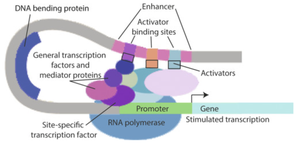
Q12. Explain what is necessary, at the transcription level, for a eukaryotic cell to achieve a high level of transcription for a particular gene.
Background
Topic: Transcription Regulation in Eukaryotes
This question tests your understanding of how transcription factors and regulatory elements influence gene expression levels.
Key Terms:
General Transcription Factors: Required for basic transcription initiation.
Specific Transcription Factors: Enhance transcription by binding to control elements.
Step-by-Step Guidance
Recall the role of general transcription factors at the promoter.
Consider how specific transcription factors interact with enhancers or other control elements.
Think about how these factors together increase transcription levels.
Try solving on your own before revealing the answer!
Final Answer:
High transcription levels require both general transcription factors at the promoter and specific transcription factors at control elements, which together stabilize RNA polymerase and enhance transcription.
Q13. Explain how an enhancer region can affect gene regulation for a gene that is far away – even thousands of bases upstream or downstream from the gene.
Background
Topic: Enhancer Function in Eukaryotic Gene Regulation
This question tests your understanding of how enhancers and DNA bending facilitate gene regulation at a distance.
Key Terms:
Enhancer: DNA sequence that increases transcription, even when far from the gene.
DNA bending: Allows distant regulatory elements to interact with promoter region.
Step-by-Step Guidance
Recall how specific transcription factors bind to enhancer regions.
Think about how DNA bends to bring enhancers close to the promoter.
Consider how this interaction stabilizes RNA polymerase and increases transcription.
Try solving on your own before revealing the answer!
Final Answer:
Enhancer regions can affect gene regulation from a distance by binding transcription factors, causing DNA to bend and bringing these factors into contact with the promoter, thus enhancing transcription.
Q14. Discuss two differences between a skin cell making melanin and a pancreas cell making insulin that allow them to make different proteins.
Background
Topic: Cell Specialization and Differential Gene Expression
This question tests your understanding of how different cell types express different genes and produce different proteins.
Key Terms:
Differential gene expression: Cells express different sets of genes based on their function.
Transcription factors: Proteins that regulate which genes are expressed.
Step-by-Step Guidance
Consider how chromatin structure and transcription factors differ between cell types.
Think about how regulatory sequences and cell-specific factors influence gene expression.
Identify two distinct mechanisms that allow these cells to produce different proteins.
Try solving on your own before revealing the answer!
Final Answer:
Skin and pancreas cells have different transcription factors and regulatory sequences, leading to expression of melanin or insulin genes, respectively.
Chromatin structure and cell-specific signaling pathways also contribute to differential gene expression.
Q15. What is the mechanism behind coordinated gene expression in eukaryotes, such as when one hormone elicits production of several different proteins simultaneously?
Background
Topic: Coordinated Gene Expression in Eukaryotes
This question tests your understanding of how hormones and transcription factors coordinate the expression of multiple genes.
Key Terms:
Hormone: Signaling molecule that can affect gene expression in multiple cell types.
Transcription factors: Proteins activated by hormone signaling that regulate gene expression.
Step-by-Step Guidance
Recall how hormones signal through relay proteins to activate transcription factors.
Think about how these transcription factors can bind to control elements in multiple genes.
Consider how this leads to simultaneous expression of different proteins in response to a single signal.
Try solving on your own before revealing the answer!
Final Answer:
Coordinated gene expression occurs when a hormone activates specific transcription factors in target cells, leading to simultaneous up-regulation of multiple genes with shared control elements.
Q16. Brainstorm ways a eukaryotic cell can control which proteins are present and functional at any given time. Categorize these into levels: Chromatin Structure, Transcription Level, Post-transcriptional, and Post-translational.
Background
Topic: Levels of Gene Regulation
This question tests your ability to categorize mechanisms of gene regulation in eukaryotes.
Key Terms:
Chromatin structure: DNA packaging affects accessibility.
Transcriptional regulation: Control of mRNA synthesis.
Post-transcriptional regulation: mRNA processing and stability.
Post-translational regulation: Protein modification and activation.
Step-by-Step Guidance
List mechanisms for each level (e.g., DNA methylation, transcription factors, mRNA splicing, phosphorylation).
Organize these mechanisms into the four categories.
Stop before listing all possible examples; encourage brainstorming.
Try solving on your own before revealing the answer!
Final Answer:
Chromatin structure: DNA methylation, histone modification.
Transcription level: Promoter/enhancer binding, transcription factors.
Post-transcriptional: mRNA splicing, stability, transport.
Post-translational: Protein folding, modification, degradation.
Q17. What level of gene regulation occurs under the following conditions? Is it a long-term or short-term response?
Background
Topic: Types and Duration of Gene Regulation
This question tests your ability to identify the level and duration of gene regulation in various scenarios.
Key Terms:
Long-term regulation: Permanent or sustained changes (e.g., chromatin structure).
Short-term regulation: Temporary changes (e.g., post-translational modification).
Step-by-Step Guidance
For each scenario, identify the level of regulation (chromatin, transcriptional, post-transcriptional, post-translational).
Determine if the response is long-term (persistent) or short-term (temporary).
Set up a table or list for each scenario, but stop before filling in the final answers.
Try solving on your own before revealing the answer!
Final Answer:
Gene expressed only in flowers: Chromatin/transcriptional, long-term.
Proteins made only when light is available: Transcriptional, short-term.
DNA deleted for antibody production: Chromatin, long-term.
Unstable mRNA: Post-transcriptional, short-term.
Hormone-induced enzyme activation: Post-translational, short-term.
Q18. Draw a simple diagram of a eukaryotic gene and a prokaryotic operon to explain the difference between transcription start and start codon.
Background
Topic: Gene Structure and Transcription Initiation
This question tests your understanding of the distinction between transcription start sites and translation start codons in eukaryotes and prokaryotes.
Key Terms:
Transcription start site: Where RNA polymerase begins synthesizing RNA.
Start codon: The first codon translated into protein (usually AUG).
Step-by-Step Guidance
Sketch or visualize a eukaryotic gene with transcription start and start codon labeled.
Do the same for a prokaryotic operon, noting differences.
Label the relevant features, but stop before completing the diagram.
Try solving on your own before revealing the answer!
Final Answer:
A eukaryotic gene diagram shows separate transcription start and start codon, while a prokaryotic operon diagram shows multiple genes with their own start codons but a single transcription start site.
