 Back
BackStudy Guide: Respiration and Photosynthesis (BIOL101)
Study Guide - Smart Notes
 Tailored notes based on your materials, expanded with key definitions, examples, and context.
Respiration and Photosynthesis: Core Concepts
Introduction
This study guide covers the essential concepts of cellular respiration and photosynthesis, focusing on their biochemical pathways, cellular locations, and integration within the cell. Mastery of these topics is fundamental for understanding energy flow and matter cycling in biological systems.
Catabolism vs. Anabolism
Definitions and Classification
Catabolism: The breakdown of complex molecules into simpler ones, releasing energy. Example: Cellular respiration.
Anabolism: The synthesis of complex molecules from simpler ones, requiring energy input. Example: Photosynthesis.
Respiration is a catabolic process; photosynthesis is an anabolic process.
Types of Respiration
Aerobic respiration: Uses oxygen as the final electron acceptor.
Anaerobic respiration: Uses other molecules (not O2) as final electron acceptors.
Fermentation: Partial degradation of sugars without the use of an electron transport chain.
Cellular respiration: Includes both aerobic and anaerobic processes, but is often used to refer specifically to aerobic respiration.
Balanced Equation for Glucose Breakdown
In words: Glucose + Oxygen → Carbon dioxide + Water + Energy
Chemical formula:
Integration of Biomolecules and Cellular Structure
Key Concepts to Revise
Free energy changes in exergonic and endergonic reactions
Role of ATP in metabolism
Structure of fats and carbohydrates
Potential energy of electrons
Electronegativity and polarity of covalent bonds
Structure and function of mitochondria and chloroplasts
Stages of Cellular Respiration
Overview
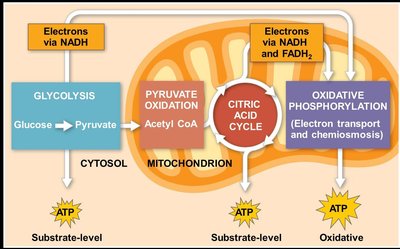
Cellular respiration occurs in three main stages, each with distinct cellular locations and functions:
Glycolysis (cytosol): Splits glucose into two pyruvate molecules.
Pyruvate oxidation & Citric Acid Cycle (mitochondrial matrix): Oxidizes pyruvate to CO2 and generates NADH and FADH2.
Oxidative phosphorylation (inner mitochondrial membrane): Uses electron transport and chemiosmosis to produce ATP.
Glycolysis
Location: Cytosol
Phases: Energy investment phase and energy payoff phase
Substrate: Glucose
Products: 2 Pyruvate, 2 ATP (net), 2 NADH
Pyruvate Oxidation & Citric Acid Cycle
Location: Mitochondrial matrix
Pyruvate oxidation: Converts pyruvate to Acetyl CoA, producing NADH and CO2
Citric Acid Cycle: Acetyl CoA is oxidized to CO2; produces NADH, FADH2, and ATP
Oxidative Phosphorylation
Location: Inner mitochondrial membrane
Stages: Electron transport chain (ETC) and chemiosmosis
Purpose of ETC: Transfer electrons to oxygen, pumping protons to create a gradient
ATP Synthase: Harnesses proton gradient to synthesize ATP
Fermentation and Anaerobic Respiration
ATP Production Without Oxygen
Fermentation allows ATP production via glycolysis when oxygen is absent.
NADH produced in glycolysis is reoxidized to NAD+ by transferring electrons to organic acceptors (e.g., pyruvate or acetaldehyde).
Redox balance is maintained without the electron transport chain.
Versatility of Catabolism
Integration of Food Molecules
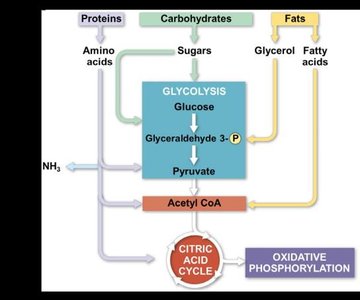
Proteins, carbohydrates, and fats can all be catabolized and enter cellular respiration at various points.
Amino acids, sugars, glycerol, and fatty acids are converted to intermediates of glycolysis or the citric acid cycle.
Photosynthesis
Chloroplast Structure and Function
Chloroplasts are the organelles where photosynthesis occurs, containing thylakoids (site of light reactions) and stroma (site of Calvin cycle).
Autotrophs vs. Heterotrophs
Autotrophs: Organisms that produce their own organic molecules from CO2 (e.g., plants).
Heterotrophs: Organisms that obtain organic molecules by consuming other organisms.
Stages of Photosynthesis
Light reactions (thylakoid membranes): Convert solar energy to chemical energy (ATP, NADPH).
Calvin cycle (stroma): Uses ATP and NADPH to fix CO2 into sugars.
Light Reactions
Photosystems and Electron Flow
Photosystems are complexes of proteins and pigments that capture light energy.
Photosystem II (PSII) and Photosystem I (PSI) differ in their light absorption and electron acceptors.
Linear electron flow involves eight steps, resulting in the production of ATP and NADPH.
Electron transport and chemiosmosis in photosynthesis are analogous to those in respiration, but use different electron donors and acceptors.
Calvin Cycle
Phases and Enzymes
The Calvin cycle has three phases: carbon fixation, reduction, and regeneration of RuBP.
RuBP (ribulose bisphosphate) and RuBisCO (enzyme) are essential for carbon fixation.
Photorespiration occurs when RuBisCO fixes O2 instead of CO2, reducing efficiency.
C4 and CAM plants have adaptations to minimize photorespiration under dry or hot conditions.
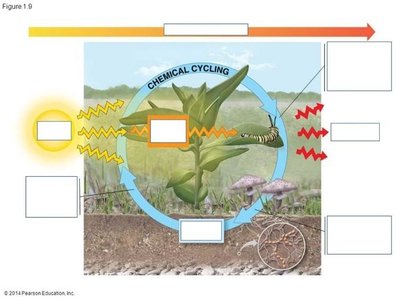
Energy Flow and Chemical Cycling
Integration of Respiration and Photosynthesis
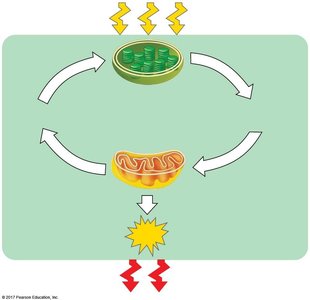
Photosynthesis captures light energy to build organic molecules; respiration breaks them down to release energy.
Both processes are interconnected in the cycling of carbon and energy in ecosystems.
Summary Table: Comparison of Respiration and Photosynthesis
Process | Location | Inputs | Outputs | Energy Conversion |
|---|---|---|---|---|
Cellular Respiration | Cytosol & Mitochondria | Glucose, O2 | CO2, H2O, ATP | Chemical → Chemical (ATP) |
Photosynthesis | Chloroplasts | CO2, H2O, Light | Glucose, O2 | Light → Chemical |
Additional info: Students are encouraged to use animations and videos referenced in the guide for dynamic visualization of these processes. Practice self-assessment using concept checks and "what if" questions to deepen understanding.
