 Back
Study Guide: Speciation and Reproductive Isolation Mechanisms
Study Guide - Smart Notes
 Tailored notes based on your materials, expanded with key definitions, examples, and context.
Q1. Define speciation.
Background
Topic: Speciation
This question is testing your understanding of what speciation means in evolutionary biology.
Key Terms:
Speciation: The process by which one species splits into two or more distinct species.
Step-by-Step Guidance
Think about what happens when populations of a single species become genetically distinct.
Consider the role of reproductive isolation in preventing gene flow between populations.
Recall that speciation involves the accumulation of genetic differences that lead to the formation of new species.
Try solving on your own before revealing the answer!
Q2. Distinguish between microevolution and macroevolution.
Background
Topic: Evolutionary Processes
This question asks you to compare two scales of evolutionary change.
Key Terms:
Microevolution: Small-scale changes in allele frequencies within a population over time.
Macroevolution: Large-scale evolutionary changes that result in the formation of new species or groups above the species level.
Step-by-Step Guidance
Define microevolution and give an example (e.g., changes in coloration in a population of beetles).
Define macroevolution and consider examples such as the origin of mammals or flowering plants.
Think about the time scales and processes involved in each.
Try solving on your own before revealing the answer!
Q3. Use the biological species concept to define species.
Background
Topic: Species Concepts
This question is about understanding how biologists define a species using the biological species concept.
Key Terms:
Biological Species Concept: Defines a species as a group of populations whose members can interbreed and produce viable, fertile offspring, but are reproductively isolated from other such groups.
Step-by-Step Guidance
Recall the main criteria for the biological species concept: interbreeding and reproductive isolation.
Think about why reproductive isolation is important for maintaining species boundaries.
Consider examples where this concept might be difficult to apply (e.g., asexual organisms, fossils).
Try solving on your own before revealing the answer!
Q4. What is required for the formation of new species?
Background
Topic: Speciation Mechanisms
This question is about the conditions necessary for speciation to occur.
Key Terms:
Reproductive Isolation: The existence of biological factors that impede members of two species from interbreeding and producing viable, fertile offspring.
Step-by-Step Guidance
Think about the role of gene flow in maintaining species integrity.
Consider what must happen to gene flow for speciation to occur.
Recall the importance of reproductive barriers in the process of speciation.
Try solving on your own before revealing the answer!
Q5. What are hybrids?
Background
Topic: Hybridization
This question is about understanding what hybrids are in the context of speciation and reproductive isolation.
Key Terms:
Hybrid: The offspring resulting from the mating of individuals from two different species or genetically distinct populations.
Step-by-Step Guidance
Recall what happens when two different species or populations interbreed.
Think about the viability and fertility of hybrids compared to their parent species.
Consider examples of hybrids in nature (e.g., mule, liger).
Try solving on your own before revealing the answer!
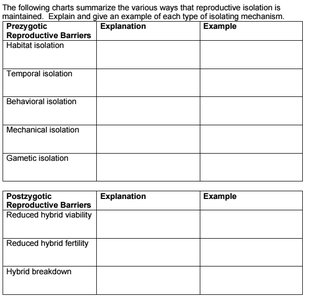
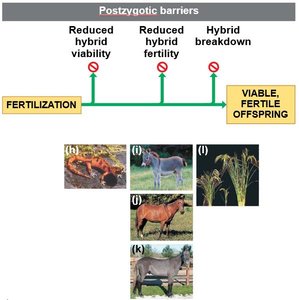
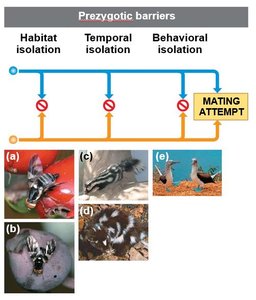
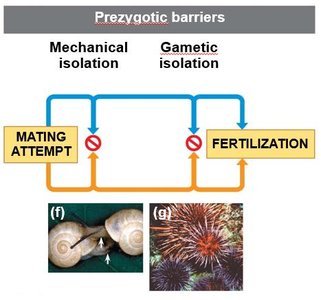
Q6. Explain the two overall types of barriers that maintain reproductive isolation. Give examples of specific barriers within each major type.
Background
Topic: Reproductive Isolation Mechanisms
This question is about the mechanisms that prevent gene flow between species, maintaining species boundaries.
Key Terms and Types:
Prezygotic Barriers: Prevent mating or fertilization between species.
Postzygotic Barriers: Prevent the hybrid offspring from developing into a viable, fertile adult.
Step-by-Step Guidance
List the two main types: prezygotic and postzygotic barriers.
For prezygotic barriers, identify examples such as habitat isolation, temporal isolation, behavioral isolation, mechanical isolation, and gametic isolation.
For postzygotic barriers, identify examples such as reduced hybrid viability, reduced hybrid fertility, and hybrid breakdown.
Explain how each barrier works to prevent gene flow.
Try solving on your own before revealing the answer!
Q9. Gene flow can be interpreted in two main ways. Use Figure 22.5, which shows an ancestral species of fish and then the two modes of speciation, to explain each type.
Background
Topic: Modes of Speciation
This question is about understanding how gene flow relates to allopatric and sympatric speciation.
Key Terms:
Gene Flow: The transfer of alleles or genes from one population to another.
Allopatric Speciation: Speciation that occurs when populations are geographically separated.
Sympatric Speciation: Speciation that occurs in populations that live in the same geographic area.
Step-by-Step Guidance
Look at Figure 22.5 to identify the ancestral population and how it splits.
Describe how gene flow is interrupted in allopatric speciation (physical barrier).
Describe how gene flow is reduced or eliminated in sympatric speciation (without physical separation).
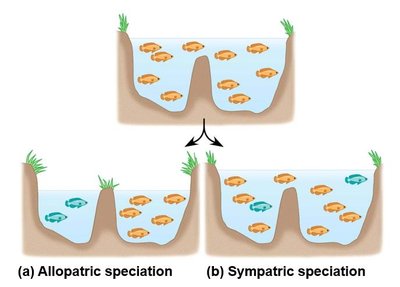
Try solving on your own before revealing the answer!
Q10. What type of speciation is caused by a barrier such as the Grand Canyon?
Background
Topic: Allopatric Speciation
This question is about identifying the mode of speciation that results from geographic barriers.
Key Terms:
Allopatric Speciation: Speciation that occurs when populations are separated by a physical barrier.
Step-by-Step Guidance
Think about what happens when a population is split by a geographic feature like the Grand Canyon.
Recall which mode of speciation involves geographic isolation.
Connect the concept of gene flow interruption to the formation of new species.
Try solving on your own before revealing the answer!
Q11. Sympatric speciation occurs in populations that live in the same geographic area. How is this possible?
Background
Topic: Sympatric Speciation
This question is about understanding the mechanisms that allow speciation without geographic separation.
Key Terms:
Sympatric Speciation: Speciation that occurs in populations that occupy the same geographic area.
Polyploidy, habitat differentiation, sexual selection: Mechanisms that can drive sympatric speciation.
Step-by-Step Guidance
Consider how reproductive isolation can arise without physical barriers.
Think about genetic changes (e.g., polyploidy in plants) or behavioral changes that can lead to reproductive isolation.
Recall examples where sympatric speciation has been observed.
Try solving on your own before revealing the answer!
