 Back
BackStudy Guide: Structure and Function of Large Biological Molecules
Study Guide - Smart Notes
 Tailored notes based on your materials, expanded with key definitions, examples, and context.
Large Biological Molecules: Structure and Function
Overview
Large biological molecules, also known as macromolecules, are essential for life and include carbohydrates, lipids, proteins, and nucleic acids. These molecules are built from smaller units called monomers, which are joined to form polymers through specific chemical reactions. Understanding their structure and function is fundamental to biology.
Monomers and Polymers
Definitions and Formation
Monomers are small, repeating units that serve as the building blocks for polymers, which are long chains of monomers linked together. Three of the four classes of biological molecules—carbohydrates, proteins, and nucleic acids—are true polymers.
Polymer: A long molecule consisting of many similar or identical monomers linked by covalent bonds.
Monomer: The repeating unit that makes up polymers.
Synthesis and Breakdown of Polymers
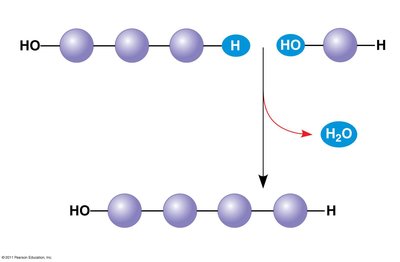
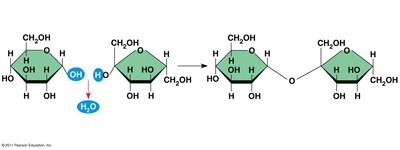
Dehydration Reaction: Joins two monomers by removing a water molecule, forming a covalent bond. This process adds units to a polymer chain.
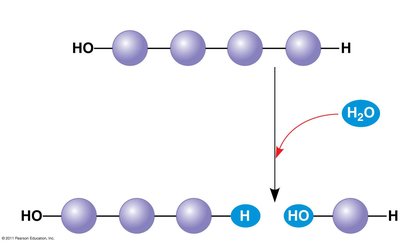
Hydrolysis: Breaks polymers into monomers by adding a water molecule, essentially the reverse of dehydration.
Example: Digestion involves hydrolysis to break down food polymers into monomers.
Categories of Large Biological Molecules
Carbohydrates
Carbohydrates are sugars and their polymers, serving as energy sources and structural materials. They are composed of carbon, hydrogen, and oxygen, and are found in foods like bread, grains, fruits, and vegetables.
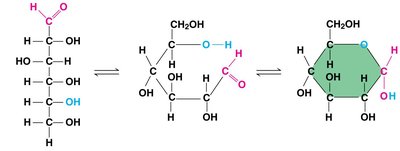
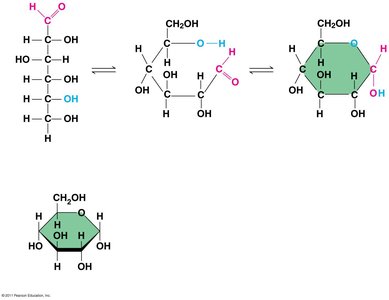
Monosaccharides: Simple sugars (e.g., glucose) that often form rings in aqueous solutions.
Disaccharides: Two monosaccharides joined by a dehydration reaction, forming a glycosidic linkage (e.g., sucrose).
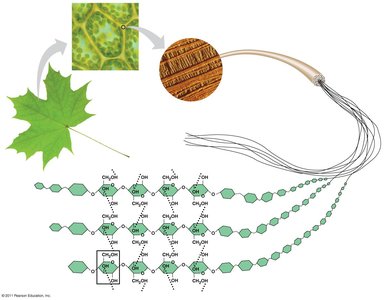
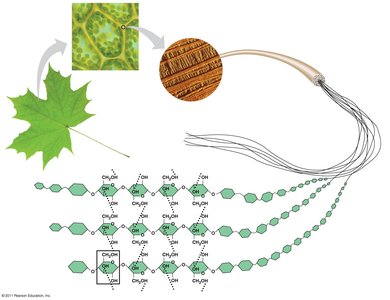
Polysaccharides: Large macromolecules with hundreds to thousands of monosaccharides. Functions include energy storage (starch, glycogen) and structural support (cellulose, chitin).

Lipids
Lipids are hydrophobic molecules that include fats, phospholipids, and steroids. They are not true polymers but are vital for energy storage, membrane structure, and signaling.
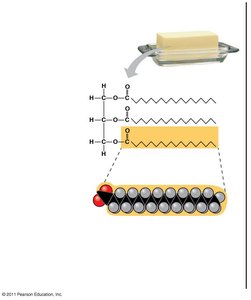
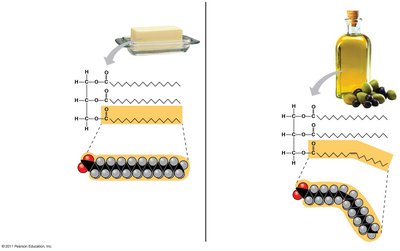
Fats: Composed of glycerol and three fatty acid tails. Used for energy storage, insulation, and cushioning.
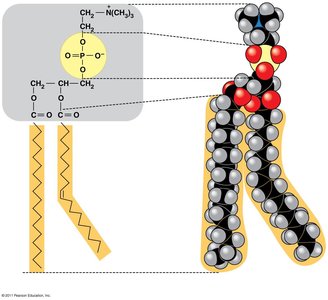
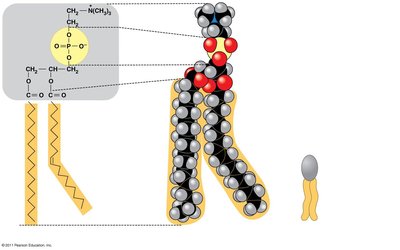
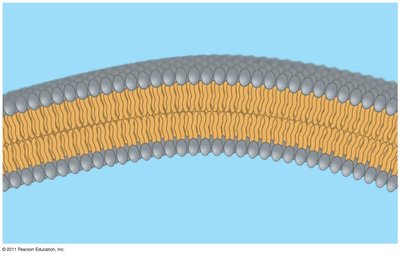
Phospholipids: Composed of glycerol, two fatty acid tails, and a phosphate group. They form the bilayer structure of cell membranes.
Steroids: Characterized by four fused rings; includes cholesterol and hormones.
Saturated vs. Unsaturated Fats:
Saturated: No double bonds, solid at room temperature (e.g., animal fats).
Unsaturated: One or more double bonds, liquid at room temperature (e.g., plant oils).

Proteins
Structure and Function
Proteins are polymers of amino acids and perform a vast array of functions, including structural support, transport, signaling, movement, defense, and catalysis. They are composed of carbon, hydrogen, oxygen, nitrogen, and sometimes sulfur.
Amino Acids: Building blocks of proteins, each with a unique side chain (R group) determining its properties.
Polypeptide: A chain of amino acids linked by peptide bonds.
Protein: One or more polypeptides folded into a functional shape.
Levels of Protein Structure
Primary: Sequence of amino acids.
Secondary: Coils and folds (α helix, β pleated sheet) stabilized by hydrogen bonds.
Tertiary: Overall 3D shape due to interactions among side chains.
Quaternary: Association of multiple polypeptide chains.
Protein Functions
Structural: Keratin in hair, collagen in connective tissue.
Transport: Hemoglobin transports oxygen.
Signaling: Hormones like insulin.
Movement: Actin and myosin in muscles.
Defense: Antibodies in the immune system.
Enzymatic: Catalysis of biochemical reactions.
Nucleic Acids
Structure and Function
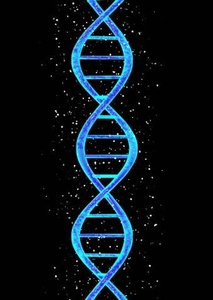
Nucleic acids, including DNA and RNA, store and transmit genetic information. They are composed of nucleotides, each containing a phosphate group, a pentose sugar, and a nitrogenous base.
DNA: Double-stranded helix; stores genetic information.
RNA: Single-stranded; involved in protein synthesis.
Nucleotide Structure: Each nucleotide consists of a phosphate group, a sugar (deoxyribose or ribose), and a nitrogenous base (A, T, C, G, U).
Base Pairing: In DNA, adenine pairs with thymine, and guanine pairs with cytosine. In RNA, uracil replaces thymine.
Genetic Code: The sequence of bases encodes information for protein synthesis.
Summary Table: Biological Macromolecules
Category | Monomer | Polymer | Main Functions |
|---|---|---|---|
Carbohydrates | Monosaccharide | Polysaccharide | Energy, structure |
Lipids | Fatty acid, glycerol | Not true polymers | Energy, membranes, signaling |
Proteins | Amino acid | Polypeptide | Structure, transport, catalysis |
Nucleic Acids | Nucleotide | DNA/RNA | Information storage, transmission |
Key Equations
Dehydration Reaction:
Hydrolysis:
Review Questions
What are the molecular components of fats?
What is the primary function of phospholipids?
Why are human hormones considered lipids?
Why are lipids not considered to be polymers or macromolecules?
List several protein functions.
Additional info: Academic context was added to clarify definitions, functions, and examples for each macromolecule category, and to ensure completeness for exam preparation.
