 Back
Study Guide: The Chemical Context of Life (General Biology)
Study Guide - Smart Notes
 Tailored notes based on your materials, expanded with key definitions, examples, and context.
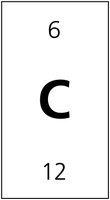
Q6. What is the atomic mass? What is the atomic number? How many electrons does carbon have? How many neutrons?
Background
Topic: Atomic Structure and Periodic Table
This question tests your understanding of how to interpret information from the periodic table and relate it to the structure of an atom, specifically carbon.
Key Terms and Formulas:
Atomic number: The number of protons in the nucleus of an atom.
Atomic mass: The total number of protons and neutrons in the atom.
Electrons: In a neutral atom, the number of electrons equals the atomic number.
Neutrons: Calculated as atomic mass minus atomic number.
Formula for neutrons:
Step-by-Step Guidance
Identify the atomic number for carbon from the periodic table entry (the top number).
Identify the atomic mass for carbon from the periodic table entry (the bottom number).
Recall that the atomic number also tells you the number of protons in the atom.
For a neutral atom, the number of electrons equals the atomic number.
Set up the calculation for the number of neutrons using the formula above, but do not solve it yet.
Try solving on your own before revealing the answer!
Final Answer:
Atomic number: 6
Atomic mass: 12
Number of electrons: 6 (in a neutral atom)
Number of neutrons: 6 (12 - 6 = 6)
The atomic number tells us both the number of protons and electrons (for a neutral atom), and the atomic mass minus atomic number gives the number of neutrons.
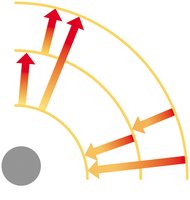
Q12. Label the diagram as shown in Figure 2.5. The cellular processes of photosynthesis and cellular respiration center on the movement of electrons. How is the movement of electrons shown in the diagram related to photosynthesis?
Background
Topic: Electron Movement in Biological Processes
This question focuses on the role of electron movement in photosynthesis and cellular respiration, which are fundamental processes in biology.
Key Terms and Concepts:
Electron shells: Energy levels where electrons reside around the nucleus.
Photosynthesis: The process by which plants convert light energy into chemical energy, involving electron transfer.
Cellular respiration: The process by which cells extract energy from glucose, also involving electron transfer.
Step-by-Step Guidance
Observe the diagram and note the arrows indicating electron movement between shells.
Recall that in photosynthesis, electrons are excited to higher energy levels by light energy.
Understand that the movement of electrons to higher shells represents energy absorption, while movement to lower shells represents energy release.
Think about how these electron movements are central to the energy transformations in photosynthesis.
Prepare to label the diagram with terms like 'energy absorption' and 'energy release', but do not complete the labeling yet.
Try solving on your own before revealing the answer!
Final Answer:
The diagram shows electrons moving between energy levels (shells). In photosynthesis, electrons absorb energy and move to higher shells, representing energy capture from sunlight. The arrows pointing outward indicate energy absorption, while arrows pointing inward indicate energy release. This movement is fundamental to the conversion of light energy to chemical energy in photosynthesis.
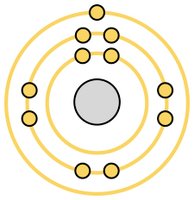
Q15. Here is an electron distribution diagram for sodium:
Background
Topic: Electron Configuration and Atomic Structure
This question tests your ability to interpret electron distribution diagrams and understand the concept of valence electrons and atomic structure.
Key Terms and Concepts:
Valence electrons: Electrons in the outermost shell, important for chemical bonding.
Protons: Positively charged particles in the nucleus; their number equals the atomic number.
Step-by-Step Guidance
Count the electrons in each shell of the diagram.
Identify the outermost shell and count the valence electrons present.
Recall that sodium's atomic number is 11, which tells you the number of protons.
Circle the valence electron(s) in the outermost shell (but do not mark them yet).
Set up your answer for the number of protons and valence electrons, but do not state the final values yet.
Try solving on your own before revealing the answer!
Final Answer:
Valence electrons: 1 (in the outermost shell)
Protons: 11 (atomic number of sodium)
The diagram shows one electron in the outermost shell, which is the valence electron. Sodium has 11 protons, as indicated by its atomic number.
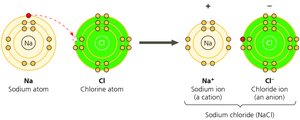
Q23. Another bond type is the ionic bond. Explain what is happening in the following figure.
Background
Topic: Ionic Bonding
This question tests your understanding of how ionic bonds form between atoms, specifically sodium and chlorine.
Key Terms and Concepts:
Ionic bond: A chemical bond formed when one atom transfers an electron to another atom.
Cation: A positively charged ion (e.g., sodium ion).
Anion: A negatively charged ion (e.g., chloride ion).
Step-by-Step Guidance
Observe the electron distribution diagrams for sodium and chlorine atoms.
Note the transfer of an electron from sodium to chlorine, as indicated by the arrow.
Recognize that sodium becomes a cation (Na+) and chlorine becomes an anion (Cl-).
Understand that the resulting ions are attracted to each other due to opposite charges.
Prepare to explain the process in your own words, but do not write the full explanation yet.
Try solving on your own before revealing the answer!
Final Answer:
The figure shows sodium transferring its one valence electron to chlorine. Sodium becomes a positively charged cation (Na+), and chlorine becomes a negatively charged anion (Cl-). The electrostatic attraction between these ions forms an ionic bond, resulting in sodium chloride (NaCl).
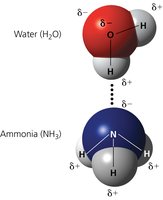
Q25. What is a hydrogen bond? Indicate where the hydrogen bond occurs in the following figure.
Background
Topic: Hydrogen Bonding
This question tests your understanding of hydrogen bonds, which are important for the structure and properties of water and other molecules.
Key Terms and Concepts:
Hydrogen bond: A weak bond between a hydrogen atom (with partial positive charge) and an electronegative atom (like oxygen or nitrogen).
Electronegativity: The tendency of an atom to attract electrons.
Step-by-Step Guidance
Identify the partial charges (δ+ and δ-) on the atoms in the diagram.
Look for the dotted line between the hydrogen atom of water and the nitrogen atom of ammonia, which represents the hydrogen bond.
Recall that hydrogen bonds occur between a hydrogen atom attached to an electronegative atom and another electronegative atom.
Prepare to indicate the location of the hydrogen bond in the diagram, but do not mark it yet.
Try solving on your own before revealing the answer!
Final Answer:
A hydrogen bond is shown as the dotted line between the hydrogen atom (δ+) of water and the nitrogen atom (δ-) of ammonia. Hydrogen bonds occur between molecules where hydrogen is bonded to highly electronegative atoms, such as oxygen or nitrogen.
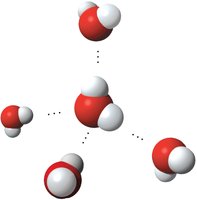
Q29. Study the water molecules below. On the central molecule, label oxygen (O) and hydrogen (H). Now, add + and − signs to indicate the charged regions of each molecule. Then, indicate the hydrogen bonds.
Background
Topic: Water Structure and Hydrogen Bonding
This question tests your ability to identify the atoms in a water molecule, recognize the partial charges, and locate hydrogen bonds.
Key Terms and Concepts:
Polar molecule: A molecule with uneven distribution of charge.
Hydrogen bond: A weak bond between the hydrogen atom of one molecule and the electronegative atom of another.
Step-by-Step Guidance
Identify the central oxygen atom (larger, red sphere) and the hydrogen atoms (smaller, white spheres) in the diagram.
Add δ- to the oxygen atom and δ+ to the hydrogen atoms to indicate partial charges.
Look for the dotted lines between hydrogen and oxygen atoms of adjacent molecules, which represent hydrogen bonds.
Prepare to label the diagram with these features, but do not complete the labeling yet.
Try solving on your own before revealing the answer!
Final Answer:
On the central water molecule, the oxygen atom is labeled 'O' and the hydrogen atoms are labeled 'H'. The oxygen atom has a partial negative charge (δ-), and the hydrogen atoms have partial positive charges (δ+). The dotted lines between molecules indicate hydrogen bonds.
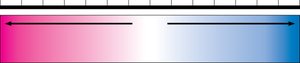
Q44. On the pH scale below, label pH 1–14. Label neutral, acid, and base.
Background
Topic: pH Scale and Acidity
This question tests your understanding of the pH scale, which measures the concentration of hydrogen ions in a solution.
Key Terms and Concepts:
pH scale: Ranges from 1 (most acidic) to 14 (most basic), with 7 being neutral.
Acid: Substance with pH less than 7.
Base: Substance with pH greater than 7.
Neutral: pH of 7.
Step-by-Step Guidance
Observe the pH scale diagram, which ranges from red (acidic) to blue (basic).
Label the scale from pH 1 to pH 14.
Identify the neutral point at pH 7 (white region in the center).
Label the left side (red) as acidic and the right side (blue) as basic.
Prepare to mark these labels on the diagram, but do not complete the labeling yet.
Try solving on your own before revealing the answer!
Final Answer:
pH 1–6: Acidic (red region)
pH 7: Neutral (white region)
pH 8–14: Basic (blue region)
The pH scale ranges from 1 (acidic) to 14 (basic), with 7 as neutral.
