 Back
Study Guide: The Chemical Context of Life (General Biology)
Study Guide - Smart Notes
 Tailored notes based on your materials, expanded with key definitions, examples, and context.
Q1. Complete the following table: Element, Definition, Example
Background
Topic: Chemical Elements
This question is testing your understanding of what a chemical element is, how to define it, and examples of elements relevant to biology.
Key Terms:
Element: A substance that cannot be broken down into other substances by chemical means.
Example: Carbon (C), Oxygen (O), Hydrogen (H), etc.
Step-by-Step Guidance
Think about the definition of a chemical element and how it differs from compounds or mixtures.
Recall examples of elements commonly found in living organisms.
Write the definition in your own words and provide at least one example.
Try solving on your own before revealing the answer!
Final Answer:
Element: A pure substance consisting of only one type of atom, cannot be broken down by chemical means.
Example: Carbon (C), Oxygen (O), Hydrogen (H).
Q2. What four elements make up 96% of all living matter?
Background
Topic: Essential Elements in Biology
This question is testing your knowledge of the most abundant elements in living organisms.
Key Terms:
Element Symbol: The one- or two-letter abbreviation for each element.
Step-by-Step Guidance
Recall the four main elements that are most common in biological molecules.
Write their names and corresponding symbols.
Think about why these elements are so important for life.
Try solving on your own before revealing the answer!
Final Answer:
The four elements are Carbon (C), Oxygen (O), Hydrogen (H), and Nitrogen (N).
Q3. What is the difference between an essential element and a trace element?
Background
Topic: Element Classification
This question is testing your understanding of how elements are categorized based on their necessity and abundance in living organisms.
Key Terms:
Essential Element: Required for an organism to survive, grow, and reproduce.
Trace Element: Required in only minute quantities.
Step-by-Step Guidance
Define what makes an element 'essential' for life.
Contrast this with the definition of a 'trace' element.
Think of examples for each category.
Try solving on your own before revealing the answer!
Final Answer:
Essential elements are needed in large amounts for life, while trace elements are needed in very small amounts.
Example: Iron (Fe) is a trace element; Carbon (C) is an essential element.
Q4. Complete the table: Subatomic particles (Proton, Neutron, Electron), Charge, Location within the atom
Background
Topic: Atomic Structure
This question is testing your knowledge of the basic components of atoms and their properties.
Key Terms:
Proton: Positively charged particle in the nucleus.
Neutron: Neutral particle in the nucleus.
Electron: Negatively charged particle in the electron cloud.
Step-by-Step Guidance
Recall the three main subatomic particles and their charges.
Identify where each particle is located within the atom.
Fill in the table with this information.
Try solving on your own before revealing the answer!
Final Answer:
Proton: +1 charge, located in the nucleus.
Neutron: 0 charge, located in the nucleus.
Electron: -1 charge, located in the electron cloud/orbitals.
Q5. Draw and label an atom showing the electrons, protons, neutrons, and atomic nucleus
Background
Topic: Atomic Structure Visualization
This question is testing your ability to visually represent the structure of an atom and label its parts.
Key Terms:
Nucleus: Center of the atom containing protons and neutrons.
Electron cloud: Area surrounding the nucleus where electrons are found.
Step-by-Step Guidance
Draw a central circle to represent the nucleus.
Label protons and neutrons inside the nucleus.
Draw rings or clouds around the nucleus to represent electron orbitals.
Label electrons in these orbitals.
Try solving on your own before revealing the answer!
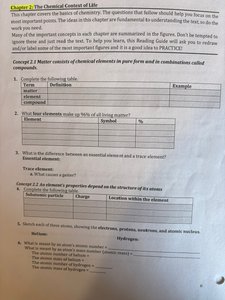
Final Answer:
The nucleus contains protons and neutrons, while electrons are found in orbitals surrounding the nucleus.
Q6. Define each term: atom, atomic number, electron, proton, neutron, electron shell, isotope
Background
Topic: Atomic Terminology
This question is testing your understanding of key terms related to atomic structure and chemistry.
Key Terms:
Atom: The smallest unit of matter that retains the properties of an element.
Atomic number: Number of protons in the nucleus.
Electron: Negatively charged subatomic particle.
Proton: Positively charged subatomic particle.
Neutron: Neutral subatomic particle.
Electron shell: Energy levels where electrons are found.
Isotope: Atoms of the same element with different numbers of neutrons.
Step-by-Step Guidance
Write a brief definition for each term listed.
Think about how each term relates to atomic structure.
Consider examples for isotope (e.g., Carbon-12 vs Carbon-14).
Try solving on your own before revealing the answer!
Final Answer:
Atom: Smallest unit of an element.
Atomic number: Number of protons.
Electron: Negative charge.
Proton: Positive charge.
Neutron: No charge.
Electron shell: Energy level for electrons.
Isotope: Same element, different neutrons.
Q7. Representation of carbon in the periodic table: What is the atomic mass and atomic number? How many protons, neutrons, electrons?
Background
Topic: Periodic Table and Atomic Structure
This question is testing your ability to interpret information from the periodic table and apply it to atomic structure.
Key Terms:
Atomic number: Number of protons.
Atomic mass: Sum of protons and neutrons.
Step-by-Step Guidance
Find carbon on the periodic table (symbol C).
Identify its atomic number and atomic mass.
Use atomic number to determine protons and electrons.
Subtract atomic number from atomic mass to estimate neutrons.
Try solving on your own before revealing the answer!
Final Answer:
Carbon (C): Atomic number = 6, Atomic mass ≈ 12.
Protons = 6, Electrons = 6, Neutrons ≈ 6.
Q8. Atoms can hold more neutrons, when this occurs, these atoms form isotopes. What are unstable isotopes called?
Background
Topic: Isotopes and Radioactivity
This question is testing your understanding of stable vs unstable isotopes and their biological significance.
Key Terms:
Isotope: Variant of an element with different neutron number.
Radioactive isotope: Unstable, emits radiation.
Step-by-Step Guidance
Recall what happens when an atom has too many or too few neutrons.
Think about the term used for isotopes that decay and emit energy.
Try solving on your own before revealing the answer!
Final Answer:
Unstable isotopes are called radioactive isotopes.
Q9. What is potential energy?
Background
Topic: Energy in Atoms
This question is testing your understanding of the concept of potential energy, especially in the context of electrons in atoms.
Key Terms:
Potential energy: Stored energy due to position or arrangement.
Step-by-Step Guidance
Think about how electrons have potential energy based on their location in electron shells.
Recall the definition of potential energy in physics and chemistry.
Try solving on your own before revealing the answer!
Final Answer:
Potential energy is the energy stored due to an object's position or arrangement, such as electrons in higher energy shells.
Q10. How does potential energy relate to electron shells?
Background
Topic: Electron Shells and Energy
This question is testing your understanding of how electrons in different shells have different amounts of potential energy.
Key Terms:
Electron shell: Energy level for electrons.
Potential energy: Higher in shells farther from the nucleus.
Step-by-Step Guidance
Recall that electrons in shells farther from the nucleus have more potential energy.
Think about how energy changes when electrons move between shells.
Try solving on your own before revealing the answer!
Final Answer:
Electrons in shells farther from the nucleus have higher potential energy than those closer to the nucleus.
Q11. How is the chemical behavior of an atom determined?
Background
Topic: Chemical Properties of Atoms
This question is testing your understanding of what determines how atoms interact and form bonds.
Key Terms:
Valence electrons: Electrons in the outermost shell.
Step-by-Step Guidance
Recall that the outermost electrons (valence electrons) are most important for chemical reactions.
Think about how the number and arrangement of these electrons affect bonding.
Try solving on your own before revealing the answer!
Final Answer:
The chemical behavior of an atom is determined by the number and arrangement of its valence electrons.
Q12. What are valence electrons?
Background
Topic: Valence Electrons
This question is testing your understanding of the electrons involved in chemical bonding.
Key Terms:
Valence electrons: Electrons in the outermost shell.
Step-by-Step Guidance
Recall the definition of valence electrons.
Think about their role in forming chemical bonds.
Try solving on your own before revealing the answer!
Final Answer:
Valence electrons are the electrons in the outermost shell of an atom, involved in chemical bonding.
Q13. What is the valence of the following elements: hydrogen, oxygen, nitrogen, carbon?
Background
Topic: Valence and Bonding
This question is testing your knowledge of how many bonds each element can form based on its valence electrons.
Key Terms:
Valence: Number of bonds an atom can form.
Step-by-Step Guidance
Recall the number of valence electrons for each element.
Determine how many bonds each can form to fill its outer shell.
Try solving on your own before revealing the answer!
Final Answer:
Hydrogen: 1
Oxygen: 2
Nitrogen: 3
Carbon: 4
Q14. Complete the following: Chemical bonds between atoms form...
Background
Topic: Chemical Bonding
This question is testing your understanding of how atoms interact to form molecules.
Key Terms:
Chemical bond: Attraction between atoms that enables the formation of chemical compounds.
Step-by-Step Guidance
Recall the types of chemical bonds (ionic, covalent, hydrogen).
Think about how these bonds form between atoms.
Try solving on your own before revealing the answer!
Final Answer:
Chemical bonds form when atoms share or transfer electrons to achieve stable electron configurations.
Q15. Three major types of chemical bonds: covalent, ionic, hydrogen
Background
Topic: Types of Chemical Bonds
This question is testing your knowledge of the three main types of bonds found in biological molecules.
Key Terms:
Covalent bond: Sharing of electrons.
Ionic bond: Transfer of electrons.
Hydrogen bond: Attraction between partial charges.
Step-by-Step Guidance
Recall the definition and characteristics of each bond type.
Think about examples of each bond in biological molecules.
Fill in the table with the correct information.
Try solving on your own before revealing the answer!
Final Answer:
Covalent: Electrons shared.
Ionic: Electrons transferred.
Hydrogen: Attraction between partial charges.
Q16. What is meant by electronegativity?
Background
Topic: Electronegativity
This question is testing your understanding of how atoms attract electrons in bonds.
Key Terms:
Electronegativity: Ability of an atom to attract electrons.
Step-by-Step Guidance
Recall the definition of electronegativity.
Think about how it affects bond polarity.
Try solving on your own before revealing the answer!
Final Answer:
Electronegativity is the tendency of an atom to attract electrons toward itself in a chemical bond.
Q17. In the space below, sketch one water molecule and label the regions that are more positive or more negative.
Background
Topic: Polarity of Water Molecules
This question is testing your understanding of the distribution of charge in a water molecule.
Key Terms:
Polarity: Uneven distribution of charge.
Water molecule: H2O, oxygen is more negative, hydrogens are more positive.
Step-by-Step Guidance
Draw a water molecule with one oxygen and two hydrogens.
Label the oxygen region as more negative and the hydrogen regions as more positive.
Think about how this polarity affects water's properties.
Try solving on your own before revealing the answer!
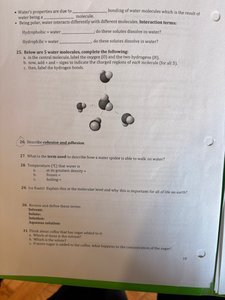
Final Answer:
Oxygen is more negative, hydrogens are more positive due to electronegativity differences.
Q18. What are hydrogen bonds and how are they represented in diagrams?
Background
Topic: Hydrogen Bonding
This question is testing your understanding of hydrogen bonds and their representation in molecular diagrams.
Key Terms:
Hydrogen bond: Weak attraction between a hydrogen atom and an electronegative atom.
Step-by-Step Guidance
Recall the definition of a hydrogen bond.
Think about how hydrogen bonds are shown in diagrams (often as dashed lines).
Try solving on your own before revealing the answer!
Final Answer:
Hydrogen bonds are represented as dashed lines between the hydrogen of one molecule and the electronegative atom of another.
Q19. What is a chemical reaction?
Background
Topic: Chemical Reactions
This question is testing your understanding of what constitutes a chemical reaction.
Key Terms:
Chemical reaction: Process where substances are transformed into new substances.
Step-by-Step Guidance
Recall the definition of a chemical reaction.
Think about examples of chemical reactions in biology.
Try solving on your own before revealing the answer!
Final Answer:
A chemical reaction is a process in which reactants are converted into products, involving the breaking and forming of chemical bonds.
Q20. What is the term used to describe how a water spider is able to walk on water?
Background
Topic: Surface Tension
This question is testing your understanding of the property of water that allows certain organisms to walk on its surface.
Key Terms:
Surface tension: Cohesive forces at the surface of a liquid.
Step-by-Step Guidance
Recall the property of water that results from hydrogen bonding.
Think about how this property allows insects to walk on water.
Try solving on your own before revealing the answer!
Final Answer:
Surface tension is the property that allows a water spider to walk on water.
Q21. What is a pH scale and what does it measure?
Background
Topic: Acids, Bases, and pH
This question is testing your understanding of the pH scale and its significance in biology.
Key Terms:
pH scale: Measures the concentration of hydrogen ions (H+) in a solution.
Step-by-Step Guidance
Recall what the pH scale represents.
Think about how pH relates to acidity and alkalinity.
Try solving on your own before revealing the answer!
Final Answer:
The pH scale measures the concentration of hydrogen ions (H+) in a solution, indicating its acidity or basicity.
