 Back
Exam 3 Ch. 24 Vertebrate Evolution
Study Guide - Smart Notes
 Tailored notes based on your materials, expanded with key definitions, examples, and context.
Phylum Chordata: Overview and Evolutionary Significance
Defining Characteristics of Chordates
Chordates are a diverse phylum distinguished by several key anatomical features present at some stage in their life cycle. These features are critical for understanding the evolutionary relationships within the group.
Notochord: A flexible, rod-shaped structure that provides support.
Dorsal, hollow nerve cord: Runs along the back and develops into the central nervous system.
Pharyngeal slits or clefts: Openings in the pharynx that function in filter-feeding or gas exchange.
Post-anal tail: An extension of the body past the anal opening.
Segmented muscles: Arranged along the body for movement.
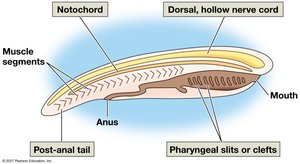
Major Groups within Chordata
Chordata is divided into three main subphyla: Cephalochordata, Urochordata, and Vertebrata. Each group exhibits unique derived features and evolutionary significance.
Cephalochordata: Lancelets, retain all chordate features throughout life.
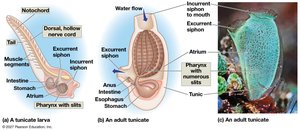
Urochordata: Tunicates, exhibit chordate features mainly in the larval stage.
Vertebrata: Possess a backbone and complex nervous system.
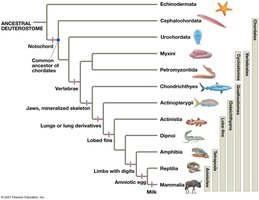
Phylogenetic Relationships and Evolutionary Trends
Chordate Phylogeny
The evolutionary tree of chordates illustrates the relationships among major groups and highlights key innovations such as jaws, limbs, and amniotic eggs.
Jawless vertebrates (Cyclostomes): Myxini (hagfishes) and Petromyzontida (lampreys).
Jawed vertebrates: Chondrichthyes (cartilaginous fishes), Osteichthyes (bony fishes), and tetrapods.
Tetrapods: Amphibia, Reptilia, Mammalia.
Summary Table: Major Chordate Groups
Group | Key Features |
|---|---|
Cephalochordata | All chordate features retained |
Urochordata | Chordate features in larval stage |
Myxini | Jawless, slime glands |
Petromyzontida | Jawless, circular mouth |
Chondrichthyes | Cartilaginous skeleton, jaws |
Actinopterygii | Ray-finned fishes, bony skeleton |
Actinistia | Lobe-finned fishes |
Dipnoi | Lungfishes |
Amphibia | Limbs with digits, life in water and land |
Reptilia | Amniotic egg, scales |
Mammalia | Milk, hair, differentiated teeth |
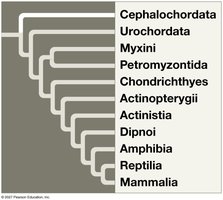
Cephalochordata: Lancelets
Structure and Function
Lancelets (genus Branchiostoma) are small, fish-like marine animals that retain all chordate features throughout their lives. They are important for understanding the ancestral chordate condition.
Notochord: Provides structural support.
Pharyngeal slits: Used for filter feeding.
Dorsal, hollow nerve cord: Central nervous system precursor.
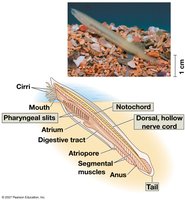
Urochordata: Tunicates
Life Cycle and Adaptations
Tunicates are marine animals with a distinct larval stage that exhibits chordate features. Adults are sessile and lose most chordate traits except pharyngeal slits.
Larval stage: Motile, with notochord and tail.
Adult stage: Sessile, filter-feeding, pharyngeal slits retained.
Vertebrata: Key Innovations
Neural Crest and Vertebrate Traits
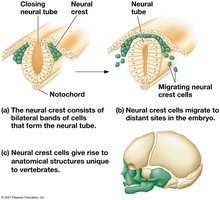
Vertebrates are defined by the presence of a backbone and a neural crest, a group of cells unique to this clade that gives rise to many anatomical structures.
Neural crest: Migrates during development to form diverse tissues.
Backbone: Protects the nerve cord and supports the body.
Cyclostomes: Jawless Vertebrates
Myxini (Hagfishes) and Petromyzontida (Lampreys)
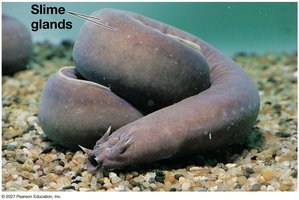
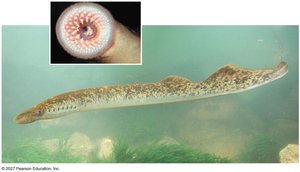
Cyclostomes are primitive vertebrates lacking jaws. They are important for understanding early vertebrate evolution.
Myxini: Possess slime glands for defense.
Petromyzontida: Parasitic, circular mouth adapted for feeding.
Gnathostomes: Jawed Vertebrates
Evolution of Jaws
Gnathostomes are vertebrates with jaws, a major evolutionary innovation that allowed for new feeding strategies and ecological roles.
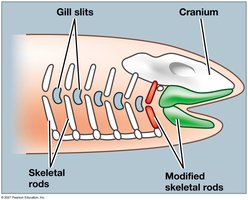
Jaws: Derived from modified skeletal rods supporting gill slits.
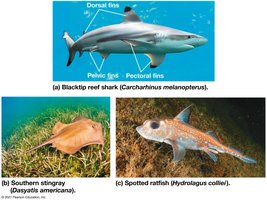
Chondrichthyes: Cartilaginous fishes (sharks, rays, chimaeras).
Osteichthyes: Bony fishes, including ray-finned and lobe-finned fishes.
Actinopterygii: Ray-Finned Fishes
Diversity and Adaptations
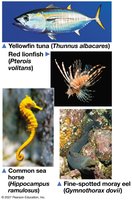
Ray-finned fishes are the most diverse group of vertebrates, characterized by fins supported by bony rays.
Ray-finned structure: Allows for efficient swimming and maneuverability.
Diversity: Over 27,000 species, including tuna, seahorses, and eels.
Sarcopterygii: Lobe-Finned Fishes and Tetrapods
Evolutionary Significance
Lobe-finned fishes possess fleshy, lobed fins and are ancestral to tetrapods. The transition from aquatic to terrestrial life is a major evolutionary event.
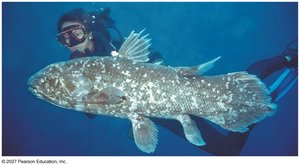
Actinistia: Coelacanths, rare deep-sea fishes.
Dipnoi: Lungfishes, capable of breathing air.
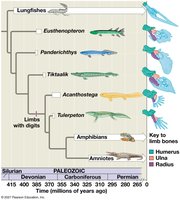
Tetrapods: Vertebrates with limbs and digits.
Tetrapods: Limbs and Digits
Origin of Limbs
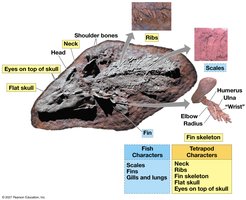
The evolution of limbs with digits enabled vertebrates to colonize land. Transitional fossils like Tiktaalik illustrate this process.
Tiktaalik: Exhibits both fish and tetrapod characteristics.
Key adaptations: Limbs with digits, neck, ribs, and flat skull.
Amphibia: Life in Water and Land
Adaptations and Diversity
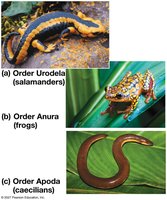
Amphibians are tetrapods that typically require water for reproduction. They exhibit a range of adaptations for both aquatic and terrestrial environments.
Orders: Urodela (salamanders), Anura (frogs), Apoda (caecilians).
Monophyly: Amphibia is not strictly monophyletic; reorganization may be needed for phylogenetic accuracy.
Amniotes: Adaptations for Terrestrial Life
Amniotic Egg and Evolutionary Significance
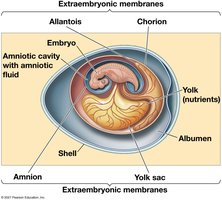
Amniotes are vertebrates with an amniotic egg, which allows reproduction away from water. This adaptation was crucial for the colonization of terrestrial habitats.
Amniotic egg: Contains extraembryonic membranes for protection and nourishment.
Groups: Reptilia and Mammalia.
Reptilia: Derived Traits and Diversity
Key Features
Reptiles are amniotes with scales and shelled eggs. They include turtles, crocodilians, lizards, snakes, and birds.
Scales: Protect against desiccation.
Shelled eggs: Allow for terrestrial reproduction.
Aves: Birds and Their Evolution
Derived Traits and Phylogeny
Birds are derived from theropod dinosaurs and exhibit unique adaptations for flight.
Wings with feathers: Enable flight.
Loss of teeth, reduced gonads, loss of urinary bladder: Adaptations for weight reduction.
Mammalia: Unique Features and Diversity
Derived Characters
Mammals are amniotes that produce milk, have hair, and possess differentiated teeth. These features are key to their evolutionary success.
Milk: Provides nutrients for young.
Hair and subcutaneous fat: Insulation and energy storage.
Differentiated teeth: Specialized for various diets.
Jaw structure: Dentary bone becomes dominant; evolution of ear bones.
Summary of Key Concepts: Clade Descriptions
Chordate Evolutionary Trends
Major evolutionary trends in chordates include the development of jaws, limbs, amniotic eggs, and reduced dependence on water. These innovations enabled the diversification and success of vertebrates in a variety of environments.
Reduced dependence on water: Amniotic egg and internal fertilization.
Increased complexity: Nervous system, skeletal structure, and reproductive adaptations.
Summary Table: Evolutionary Innovations
Innovation | Group |
|---|---|
Jaws | Gnathostomes |
Limbs with digits | Tetrapods |
Amniotic egg | Amniotes |
Milk, hair, differentiated teeth | Mammalia |
Additional info: These notes expand on brief points from the original materials, providing academic context and examples for each major group and evolutionary innovation within Phylum Chordata.
