 Back
Study Notes: Biomolecules, Elements, and Atomic Structure in Biology
Study Guide - Smart Notes
 Tailored notes based on your materials, expanded with key definitions, examples, and context.
Biomolecules and Chemistry Foundations
Introduction to Matter and Elements
Matter is defined as anything that occupies space and has mass. In biological systems, matter is composed of elements, which are pure substances that cannot be broken down into simpler substances by chemical reactions.
Element: A fundamental substance with unique properties, made up of atoms.
Atom: The smallest unit of an element that retains its chemical properties.
Compound: A substance formed when two or more elements combine in a fixed ratio.
Atomic Structure
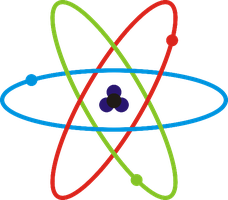
Atoms consist of three main subatomic particles: protons, neutrons, and electrons. The arrangement and number of these particles determine the properties of each element.
Protons: Positively charged, located in the nucleus, mass ≈ 1 Dalton.
Neutrons: No charge, located in the nucleus, mass ≈ 1 Dalton.
Electrons: Negatively charged, orbit the nucleus, negligible mass.
Atomic Number: Number of protons in the nucleus; identifies the element.
Atomic Mass Number: Sum of protons and neutrons in the nucleus.
Periodic Table and Element Notation
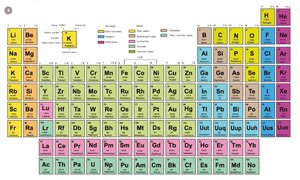
The periodic table organizes elements based on their atomic number and properties. Each element is represented by a unique symbol, atomic number, and atomic mass.
Element Symbol: One or two letters representing the element.
Atomic Number: Shown above the symbol; equals the number of protons.
Atomic Mass: Shown below the symbol; approximates the sum of protons and neutrons.
Compounds in Biology
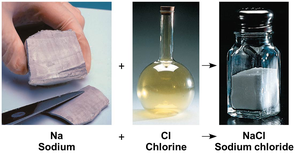
Compounds are formed when elements combine chemically. Biological compounds, such as water and sodium chloride, are essential for life.
Water (H2O): Formed from hydrogen and oxygen.
Sodium Chloride (NaCl): Formed from sodium and chlorine.
Essential Elements for Life
Elements Required for Human Biology
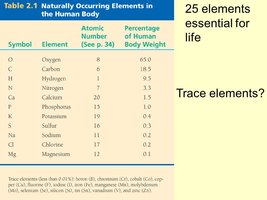
Living organisms require a specific set of elements for structure and function. The most abundant elements in the human body include oxygen, carbon, hydrogen, nitrogen, calcium, and phosphorus.
Major Elements: Oxygen, carbon, hydrogen, nitrogen, calcium, phosphorus.
Trace Elements: Required in small amounts (e.g., iron, zinc, copper).
Atomic Properties and Isotopes
Atomic Number and Mass
Atoms of different elements are distinguished by their atomic number (number of protons). The atomic mass number is the sum of protons and neutrons. Electrons are not included in mass calculations due to their negligible mass.
Atomic Number (Z):
Atomic Mass Number (A):
Isotopes
Isotopes are variants of an element with the same number of protons but different numbers of neutrons. Some isotopes are stable, while others are radioactive and decay over time, releasing energy.
Stable Isotopes: Do not change over time.
Radioactive Isotopes: Decay spontaneously, used in radiometric dating.
Half-life: The time required for half of the isotope to decay.
Practice: Identifying Elements
Element Identification Using Atomic Number and Mass
Students are often asked to identify elements based on their atomic number, number of protons, or atomic mass. For example:
Atomic number 7: Nitrogen (7 protons)
Atomic number 20: Calcium (20 protons)
15 protons: Phosphorus (atomic number 15)
2 protons: Helium (atomic number 2)
Argon: Atomic number 18, 18 protons
Sulfur: Atomic number 16, 16 protons
Summary Table: Essential Elements in the Human Body
The following table summarizes the main elements required for life, their atomic numbers, and their percentage of human body weight:
Symbol | Element | Atomic Number | Percentage of Human Body Weight |
|---|---|---|---|
O | Oxygen | 8 | 65.0 |
C | Carbon | 6 | 18.5 |
H | Hydrogen | 1 | 9.5 |
N | Nitrogen | 7 | 3.3 |
Ca | Calcium | 20 | 1.5 |
P | Phosphorus | 15 | 1.0 |
K | Potassium | 19 | 0.4 |
S | Sulfur | 16 | 0.3 |
Na | Sodium | 11 | 0.2 |
Cl | Chlorine | 17 | 0.2 |
Mg | Magnesium | 12 | 0.1 |
Additional info:
Dalton is the unit of measurement for atomic mass, approximately equal to the mass of a proton or neutron.
Electrons are much lighter than protons and neutrons and are not included in atomic mass calculations.
Radioactive isotopes are used in biological research and medical imaging.
