 Back
BackStudy Notes: Chemical Reactions in Aqueous Solutions and Redox Chemistry
Study Guide - Smart Notes
 Tailored notes based on your materials, expanded with key definitions, examples, and context.
Chemical Reactions in Aqueous Solutions
Solutions and Electrolytes
A solution is a homogeneous mixture of a solute dissolved in a solvent. In aqueous solutions, water acts as the solvent. Substances dissolved in water can behave as electrolytes or nonelectrolytes, depending on their ability to produce ions in solution.
Electrolytes: Substances that dissociate into ions in water, conducting electricity.
Strong electrolytes: Completely ionize in solution (e.g., strong acids, strong bases, most salts).
Weak electrolytes: Partially ionize in solution (e.g., weak acids and bases).
Nonelectrolytes: Do not produce ions in solution (e.g., sugar, alcohols).
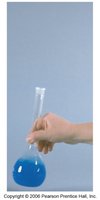
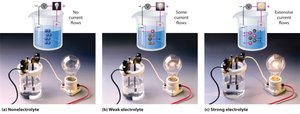
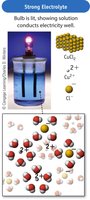
Classification of Solutes in Aqueous Solution
Solutes can be classified based on their chemical nature and behavior in water:
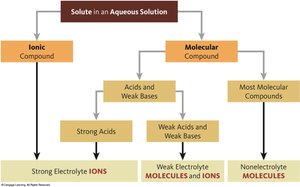
Precipitation Reactions
Precipitation reactions occur when two solutions are mixed and an insoluble solid (precipitate) forms. The formation of a precipitate is governed by solubility rules for ionic compounds.
Solubility: The maximum amount of solute that can dissolve in a solvent at a specific temperature.
Exchange (double displacement) reactions: The anions and cations of two different compounds exchange places, possibly forming a precipitate.
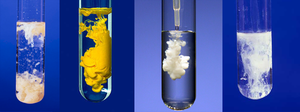
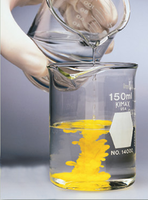
Solubility Guidelines for Ionic Compounds
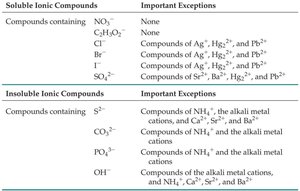
Solubility rules help predict whether an ionic compound will dissolve in water or form a precipitate.
Soluble Ionic Compounds | Important Exceptions |
|---|---|
NO3-, C2H3O2- | None |
Cl-, Br-, I- | Ag+, Hg22+, Pb2+ |
SO42- | Sr2+, Ba2+, Hg22+, Pb2+ |
Insoluble Ionic Compounds | Important Exceptions |
S2-, CO32-, PO43-, OH- | NH4+, alkali metal cations, Ca2+, Sr2+, Ba2+ |
Writing Ionic and Net Ionic Equations
To represent reactions in aqueous solution, write:
Molecular equation: Shows all reactants and products as compounds.
Total ionic equation: Shows all strong electrolytes as ions.
Net ionic equation: Shows only the species that actually change during the reaction (removing spectator ions).
Acid-Base Reactions
Acids and Bases: Definitions and Properties
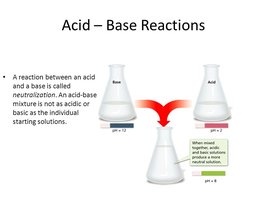
Acids increase the concentration of H+ (or H3O+) in solution, while bases increase the concentration of OH-. Acid-base reactions often result in the formation of water and a salt (neutralization).
Strong acids: Ionize completely in water (e.g., HCl, HNO3, H2SO4).
Weak acids: Ionize partially (e.g., CH3COOH, H3PO4).
Strong bases: Ionize completely (e.g., NaOH, KOH).
Weak bases: Ionize partially (e.g., NH3).
pH and pOH Calculations
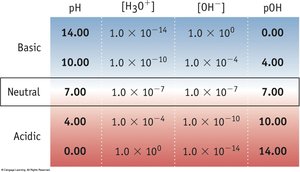
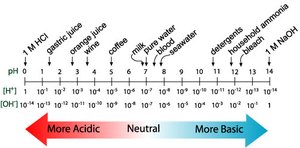
The pH scale quantifies the acidity or basicity of a solution. It is related to the concentration of hydrogen ions:
pH = -log10[H+]
pOH = -log10[OH-]
pH + pOH = 14 (at 25°C)
[H+][OH-] = 1 \times 10^{-14}
![pH, [H3O+], [OH-], and pOH relationships](https://static.studychannel.pearsonprd.tech/study_guide_files/biology/sub_images/d705cecc_image_15.png)
Gas-Forming Reactions
Types of Gas-Forming Reactions
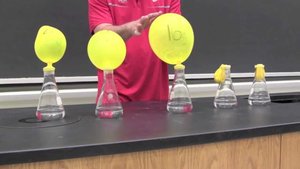
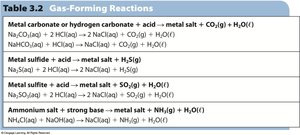
Some reactions in aqueous solution produce a gas as one of the products. Common types include:
Metal carbonate + acid → metal salt + CO2(g) + H2O(l)
Metal sulfide + acid → metal salt + H2S(g)
Metal sulfite + acid → metal salt + SO2(g) + H2O(l)
Ammonium salt + strong base → metal salt + NH3(g) + H2O(l)
Concentration of Solutions
Molarity and Dilution
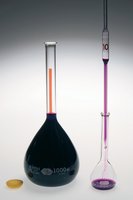
Molarity (M) is the number of moles of solute per liter of solution. Dilution involves adding solvent to decrease the concentration of a solution, following the equation:
M1V1 = M2V2
Serial dilution is the stepwise dilution of a solution, often used to achieve very low concentrations.
Redox (Reduction-Oxidation) Reactions
Oxidation and Reduction
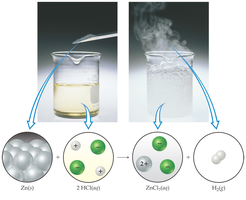
Redox reactions involve the transfer of electrons between substances. Oxidation is the loss of electrons, while reduction is the gain of electrons.
Oxidizing agent: Causes oxidation, is itself reduced.
Reducing agent: Causes reduction, is itself oxidized.
Assigning Oxidation Numbers
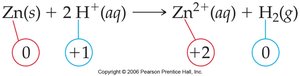
Oxidation numbers are assigned to elements in compounds to track electron transfer. Key rules include:
Elements in their natural state: 0
Monatomic ions: equal to their charge
Oxygen: usually -2 (except in peroxides: -1)
Hydrogen: +1 (with nonmetals), -1 (with metals)
Sum of oxidation numbers in a neutral compound: 0
Sum in a polyatomic ion: equals the ion's charge
Balancing Redox Reactions
Redox reactions are balanced using the half-reaction method, especially in acidic or basic solutions. Steps include:
Write separate half-reactions for oxidation and reduction.
Balance all elements except H and O.
Balance O by adding H2O; balance H by adding H+ (or OH- in base).
Balance charge by adding electrons.
Multiply half-reactions to equalize electrons, then add and simplify.
Summary Table: Types of Chemical Reactions in Aqueous Solution
Type of Reaction | General Equation | Key Feature |
|---|---|---|
Precipitation | AB(aq) + CD(aq) → AD(aq) + CB(s) | Formation of insoluble solid |
Acid-Base (Neutralization) | Acid + Base → Salt + H2O | Formation of water |
Gas-Forming | Metal carbonate + Acid → Salt + CO2 + H2O | Formation of gas |
Redox | Electron transfer between species | Change in oxidation numbers |
