 Back
Study Notes: Chromosomal Basis of Inheritance
Study Guide - Smart Notes
 Tailored notes based on your materials, expanded with key definitions, examples, and context.
Chromosomal Basis of Inheritance
Relationship Between Inheritance and Meiosis
The process of meiosis is fundamental to inheritance, as it ensures the transmission of genetic material from parents to offspring. Meiosis produces gametes (sperm and egg cells) with half the number of chromosomes, allowing for genetic variation through recombination and independent assortment.
Meiosis: A type of cell division that reduces chromosome number by half, producing four genetically distinct gametes.
Inheritance: The passing of genetic traits from parents to offspring, governed by the arrangement and segregation of chromosomes during meiosis.
Genetic Variation: Arises from crossing over and independent assortment during meiosis.
Example: Mendel’s laws of segregation and independent assortment are explained by the behavior of chromosomes during meiosis.
Gene Arrangement on Chromosomes and Its Effect on Inheritance
The physical arrangement of genes on chromosomes affects how traits are inherited. Genes located close together on the same chromosome tend to be inherited together, a phenomenon known as genetic linkage.
Linked Genes: Genes located near each other on the same chromosome; they do not assort independently.
Independent Assortment: Genes on different chromosomes assort independently during meiosis.
Example: If genes R and Y are on different chromosomes, a heterozygote (RrYy) produces four types of gametes: RY, Ry, rY, ry.
Example: If genes A and B are linked, a heterozygote (AaBb) produces only two types of gametes: AB and ab.
Sex-Linked Traits and Sex Determination
Sex-linked traits are determined by genes located on sex chromosomes (X and Y). The inheritance of these traits differs between males and females due to their different sex chromosome compositions.
Autosomes: Chromosomes not involved in sex determination.
Sex Chromosomes: X and Y chromosomes are associated with sex development.
Model Organism: Drosophila melanogaster (fruit fly) is commonly used to study sex-linked traits due to its short life cycle and ease of breeding.
Sex Chromosome Composition:
Diploid male somatic: XY
Diploid female somatic: XX
Human sperm cells: X or Y
Human egg cells: X
Morgan’s Discovery of X-Linked Inheritance
Thomas Hunt Morgan’s experiments with fruit flies revealed that certain traits, such as eye color, are linked to the X chromosome. This discovery provided evidence for the chromosomal theory of inheritance.
Parental Generation: Typically red-eyed flies.
F1 Generation: All red-eyed flies.
F2 Generation: Both red-eyed and white-eyed flies, with white eyes appearing only in males.
Surprise: The appearance of white-eyed males in the F2 generation.
Conclusion: Eye color is linked to the X chromosome.
Sex-Linked Human Genetics
Human X and Y chromosomes carry different sets of genes. The X chromosome contains many genes unrelated to sex determination, while the Y chromosome carries the SRY gene, which triggers male development.
X Chromosome: Contains many genes, including those for blood clotting and color vision.
Y Chromosome: Contains the SRY gene, which initiates male development.
SRY Gene: If absent in XY individuals, they develop as females; if present in XX individuals, they develop as males.
Practice Problems: X-Linked Inheritance of Hemophilia
Hemophilia is a recessive X-linked disorder. The inheritance pattern can be analyzed using Punnett squares and allele keys.
Allele Key: H = normal clotting, h = hemophilia
Genotype-Phenotype Key:
XHXH: normal female
XHXh: carrier female
XhXh: affected female
XHY: normal male
XhY: affected male
Example Problem 1: Carrier female (XHXh) × unaffected male (XHY)
Children with hemophilia: 25%
Children who are carriers: 25%
Female carriers: 50%
Example Problem 2: Affected male (XhY) × homozygous normal female (XHXH)
Children with hemophilia: 0%
Children who are carriers: 50%
Female carriers: 100%
X-Inactivation
X-inactivation is a process in female mammals where one X chromosome in each somatic cell is randomly inactivated, forming a Barr body. This ensures dosage compensation between males and females.
Purpose: Equalizes gene expression from X chromosomes in males and females.
Occurs in: Female somatic cells.
Barr Body: The inactivated X chromosome.
Example: Calico cats display patches of color due to X-inactivation.
Linked Genes
Linked genes are located close together on the same chromosome and tend to be inherited together. The opposite concept is independent assortment, where genes on different chromosomes assort independently.
Location: Linked genes are physically close on the same chromosome.
Effect: Reduces the number of possible gamete combinations.
Example: RrYy (independent assortment) produces RY, Ry, rY, ry; AaBb (linked) produces AB, ab.
Chromosomal Abnormalities
Chromosomal abnormalities can result from errors during meiosis, such as nondisjunction, leading to aneuploidy. These abnormalities affect the number or structure of chromosomes.
Aneuploidy: An abnormal number of chromosomes.
Nondisjunction: Failure of chromosomes to separate properly during meiosis.
Trisomy: Presence of an extra chromosome (e.g., Down syndrome, trisomy 21).
Monosomy: Missing a chromosome (e.g., Turner syndrome, monosomy X).
Alterations of Chromosome Structure
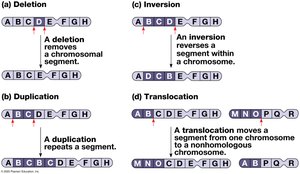
Chromosome structure can be altered by deletion, duplication, inversion, or translocation. These changes can have significant effects on gene expression and phenotype.
Deletion: Removes a chromosomal segment.
Duplication: Repeats a segment.
Inversion: Reverses a segment within a chromosome.
Translocation: Moves a segment from one chromosome to a nonhomologous chromosome.
Exceptions to Chromosomal Inheritance
Some organelles, such as mitochondria and chloroplasts, contain their own DNA and are inherited in a non-Mendelian fashion, typically from the mother.
Organelles with DNA: Mitochondria and chloroplasts.
Inheritance Pattern: Maternal inheritance; organelle DNA is passed from mother to offspring.
