 Back
Survey of the Animal Kingdom: Porifera, Cnidaria, Platyhelminthes, and Mollusca
Study Guide - Smart Notes
 Tailored notes based on your materials, expanded with key definitions, examples, and context.
Survey of the Animal Kingdom
Introduction
This section provides an overview of several major animal phyla, focusing on their structure, function, and evolutionary significance. The phyla covered include Porifera (sponges), Cnidaria (coelenterates), Platyhelminthes (flatworms), and Mollusca (mollusks). Understanding these groups is fundamental to the study of animal diversity and evolutionary biology.
Phylum Porifera (Sponges)
General Characteristics
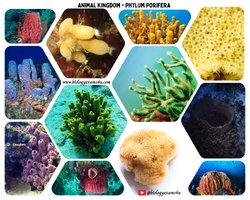
Sponges are simple, multicellular animals lacking true tissues and organs.
They are typically asymmetrical and are sessile (attached to a substrate).
Sponges are filter-feeding heterotrophs and do not possess photosynthetic pigments.
Examples include Granita, which may appear plantlike due to its sessile nature.
Structure of Sponges
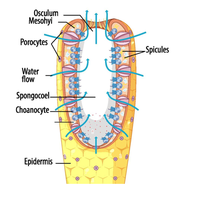
The sponge wall filters seawater to remove food particles.
The outer surface is lined by an epithelial layer of cells.
Inside is the spongocoel, a central cavity lined by flagellated cells called choanocytes (collar cells).
Water enters through pores (porocytes), flows into the spongocoel, and exits via the osculum.
Granita: A Representative Sponge
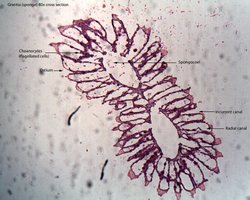
Granita has a wall with folds forming incurrent and flagellated canals.
Digestion is intracellular (occurs inside cells).
The wall is reinforced by spongin fibers and spicules (crystalline structures).
Contains amoebocytes: motile cells with various functions (e.g., digestion, structure, reproduction).
Reproduction in Sponges
Sponges reproduce both sexually and asexually.
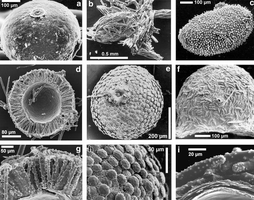
Asexual methods include budding and formation of gemmules (stress-resistant cell aggregates).
Sexual reproduction involves differentiation of choanocytes and amoebocytes into gametes.
Eggs remain in the mesenchyme; sperm are released into water and captured by other sponges.
Phylum Cnidaria (Coelenterates)
General Characteristics and Classification
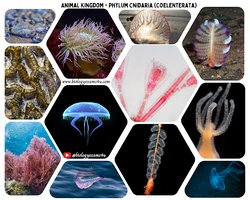
Includes Hydrozoa (hydras), Scyphozoa (sea jellies), Cubozoa (box jellies), and Anthozoa (corals, anemones).
Mostly marine carnivores with radial symmetry.
More complex than sponges, possessing true tissues.
Body Structure and Forms
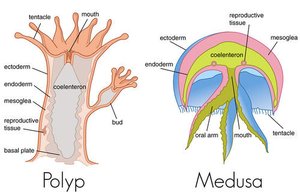
Body wall has two layers: ectoderm (outer) and endoderm (inner), separated by mesoglea (gelatinous layer).
Two main body plans:
Polyp: Cylindrical, mouth and tentacles facing upward.
Medusa: Umbrella-shaped, mouth and tentacles facing downward.
Some cnidarians exhibit polymorphism, alternating between polyp and medusa forms.
Feeding and Defense
All cnidarians are carnivores, capturing prey with tentacles around the mouth.
Prey is ingested into the gastrovascular cavity (GVC) for digestion (both intracellular and extracellular).
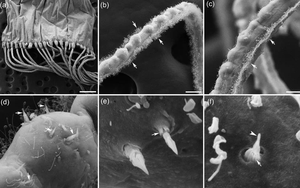
Tentacles contain cnidocytes (stinging cells) with nematocysts (barbed harpoons for prey capture and defense).
Phyla Platyhelminthes and Mollusca
General Features
Both phyla are more complex than sponges and cnidarians, with three embryonic layers (triploblastic): ectoderm, mesoderm, endoderm.
They possess organs made of interdependent tissues.
Phylum Platyhelminthes (Flatworms)
Flatworms are the most ancient animals with bilateral symmetry (distinct anterior and posterior ends).
They are acoelomate: lacking a body cavity (coelom) surrounded by mesoderm; their mesoderm is a solid mass.
Subphylum Turbellaria
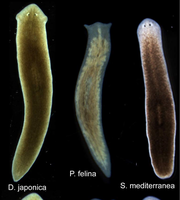
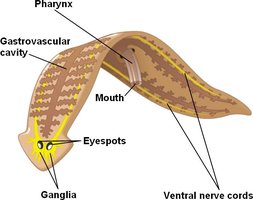
Free-living flatworms found in aquatic and moist terrestrial environments.
Hermaphroditic (possess both male and female sex organs).
Have lateral lobes and eyespots for sensory input.
Feed by sucking food through a mouth into a pharynx leading to an incomplete gastrovascular cavity.
Subphylum Neodermata
All parasitic flatworms belong here; their surface is called the neodermis.
Two main subgroups:
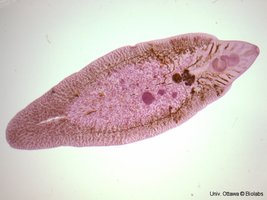
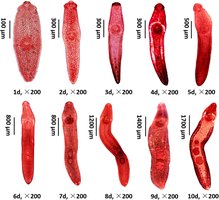
Trematoda (flukes): Endoparasites and ectoparasites of vertebrates, covered by an epicuticle.
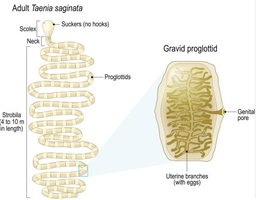
Cercomeromorpha (tapeworms): Endoparasites of vertebrate guts, lack a digestive tract, absorb nutrients through their cuticle.
Tapeworm Structure
Anterior end (scolex) attaches to host's intestine with hooks or suckers.
Body consists of a neck and a series of segments called proglottids.
Gravid proglottids (containing eggs) break off and exit with host feces.
Phylum Mollusca (Mollusks)
Soft-bodied animals (e.g., snails, clams, octopuses, squids) with a specialized mantle that secretes a shell.
Coelomate, but coelom is often reduced to a small chamber around the heart.
Most have an open circulatory system (except cephalopods), where blood bathes organs directly.
Possess a complete digestive tract (mouth and anus).
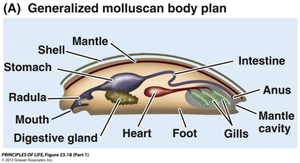
Basic Molluscan Body Plan
Key features include:
Visceral mass (organ systems)
Sensory structures
Ventral, muscular foot (locomotion)
Calcium-based shell (sometimes absent)
Mantle (secretes shell)
Differentiated head (in some groups)
Classification of Mollusks
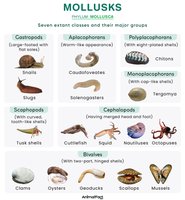
Class | Examples | Key Features |
|---|---|---|
Gastropoda | Snails, slugs | Single, often coiled shell; distinct head |
Bivalvia | Clams, oysters, mussels | Two-part hinged shell; no head |
Cephalopoda | Squid, octopus | Well-developed head, tentacles, closed circulatory system |
Polyplacophora | Chitons | Eight-plated shell |
Scaphopoda | Tusk shells | Tubular, tusk-shaped shell |
Monoplacophora | Neopilina | Single, cap-like shell |
Aplacophora | Solenogasters | No shell, worm-like |
Additional info: The above notes expand on the original content by providing definitions, examples, and a classification table for mollusks, as well as clarifying the structure and function of key anatomical features in each phylum.
