 Back
Systematics, Classification, and the Diversity of Life
Study Guide - Smart Notes
 Tailored notes based on your materials, expanded with key definitions, examples, and context.
Systematics and Classification
Introduction to Systematics
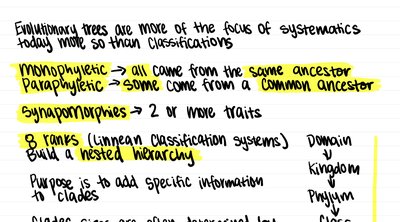
Systematics is the scientific study of the diversity of organisms and their evolutionary relationships. Modern systematics focuses more on evolutionary trees (phylogenies) than on simple classifications, aiming to reflect evolutionary history in the organization of life.
Evolutionary trees (phylogenies) depict hypotheses about the evolutionary relationships among species.
Classification organizes organisms into groups based on similarities and differences.
Monophyletic and Paraphyletic Groups
Monophyletic group: All members share a single common ancestor and include all descendants of that ancestor.
Paraphyletic group: Includes some, but not all, descendants of a common ancestor.
Synapomorphies: Shared derived traits present in two or more groups, used to determine evolutionary relationships.
Hierarchical Classification: The 8 Ranks
Biological classification uses a nested hierarchy of ranks to organize life. The main ranks are:
Domain
Kingdom
Phylum
Class
Order
Family
Genus
Species
This system adds specific information to clades (groups of organisms with a common ancestor). Clade sizes are often determined by evolutionary trees.
From Classification to Evolutionary History
Modern technology has shifted the focus from simple classification to understanding evolutionary history. This helps explain where a specific species came from and how it relates to others.
Finding similarities is often difficult without evolutionary context.
Classification systems are subject to revision as new information emerges.
The Three Domains of Life
Kingdoms and Domains
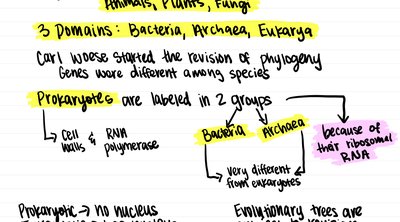
Traditional kingdoms (Animals, Plants, Fungi) are now divided into three domains based on genetic and cellular differences:
Bacteria
Archaea
Eukarya
Carl Woese proposed this system after discovering significant genetic differences among species, especially in ribosomal RNA.
Prokaryotes and Eukaryotes
Prokaryotes: Organisms without a nucleus (Bacteria and Archaea). Their cell walls and RNA polymerase differ significantly from those of eukaryotes.
Eukaryotes: Organisms with a nucleus, where DNA and chromosomes are present (Eukarya).
Prokaryotes are divided into two groups: Bacteria and Archaea, which are very different from each other, especially in their ribosomal RNA.
Current Classification and Challenges
Classification Based on Reproduction
Current classifications often use reproductive methods (e.g., asexual vs. sexual reproduction) as a basis for grouping organisms.
The phylogenetic species concept groups organisms by species with common ancestors.
Challenges in Studying Prokaryotes
Prokaryotes are often microscopic, making many species difficult to discover and study.
Many prokaryotic species remain undiscovered.
Conservation and Extinction
Human activities are destroying environments, causing some species to go extinct before they are even discovered.
Additional info: The rapid loss of biodiversity highlights the importance of systematics and conservation biology in cataloging and preserving Earth's species.
