 Back
BackTaxonomy and Systematics: Phylogenetic Analysis and Classification
Study Guide - Smart Notes
 Tailored notes based on your materials, expanded with key definitions, examples, and context.
Taxonomy and Systematics (Phân loại học và Hệ thống học)
Introduction to Taxonomy and Systematics
Taxonomy and systematics are branches of biology that focus on the classification and evolutionary relationships of organisms. Taxonomy involves naming and organizing species into groups, while systematics seeks to understand the evolutionary history and relationships among these groups.
Taxonomy: The science of naming, describing, and classifying organisms.
Systematics: The study of evolutionary relationships among organisms.
Phylogenetic Trees: Diagrams that depict ( mô tả) hypotheses about evolutionary relationships.
Cladistics: A method of classification based on common ancestry and evolutionary relationships.
Molecular Clocks: Techniques that use mutation rates in DNA to estimate (Ước tính) evolutionary divergence times.
Horizontal Gene Transfer: The movement of genetic material between organisms other than by descent.(không phải theo dòng dõi)
Imagine two bacteria sharing DNA like friends sharing notes, instead of inheriting from their parents. HGT can quickly spread traits (like antibiotic resistance) across populations. Tip: HGT makes evolution more complex, because genes can "jump" between species!
This is different from vertical gene transfer , which is the usual way genes are passed (from parent to child).
Clades and Monophyly (Nhóm nhánh tiến hóa và tính đơn ngành)
Understanding Clades and Nodes
Clades are groups of organisms that include an ancestor and all its descendants. In phylogenetic trees, branch points are called nodes, and two lineages that share a node are termed sister clades. Clades can be rotated at nodes without altering the evolutionary relationships depicted. (No matter how you rotate, the evolutionary relationships (who shares a common ancestor) stay the same. Tip: The order of branches doesn’t matter—what matters is how they connect at the nodes!)
Clade: A monophyletic group (also called a clade) consisting of an ancestor and all its descendants.
Node: A branch point representing a common ancestor.
Sister Clades: Two clades that emerge from the same node.

Monophyletic, Polyphyletic, and Paraphyletic Taxa (Các đơn vị phân loại đơn ngành, đa ngành và phi ngành)
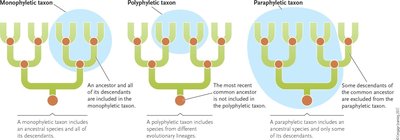
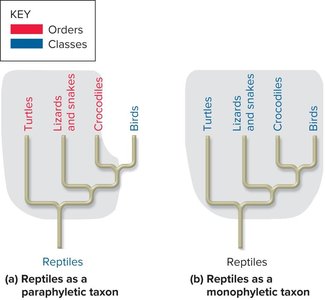
Systematics aims to classify organisms into monophyletic groups, which include an ancestor and all its descendants. Polyphyletic groups contain species from different evolutionary lineages, while paraphyletic groups include an ancestor and some, but not all, of its descendants.
Monophyletic Taxa: Include a common ancestor and all its descendants.
Polyphyletic Taxa: Include species from separate lineages (dòng dõi), not sharing a recent common ancestor.
Paraphyletic Taxa: Include an ancestor and some, but not all, descendants.
Defining Taxa in Classification (Xác định các đơn vị phân loại trong hệ thống phân loại)
Evolutionary Relationships and Classification
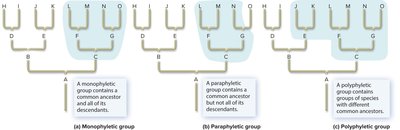
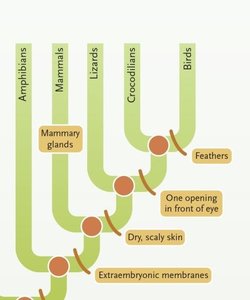
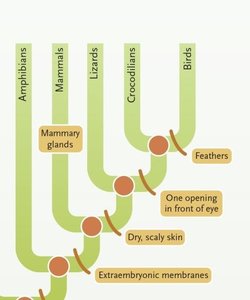
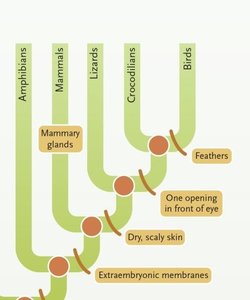
Taxonomic groups should reflect evolutionary relationships, ideally forming monophyletic groups. Traditional classifications sometimes result in paraphyletic groups, such as the traditional class Reptilia, which excludes birds despite their descent from reptilian ancestors.
Sources of Data for Phylogenetic Analysis (Nguồn dữ liệu cho phân tích phát sinh chủng loại)
Types of Characters Used
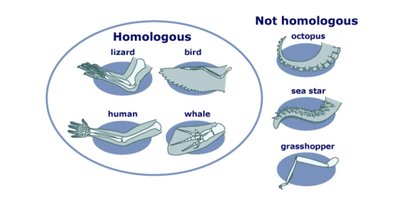
Phylogenetic analysis (phân tích) relies on various types (Các loại khác nhau) of data to infer (suy ra) evolutionary relationships. These include morphological, behavioral, and molecular characters. Homologous characters, which arise from common ancestry, are particularly informative, while analogous (homoplasious) characters result from convergent evolution (Tiến hóa hội tụ) and do not reflect shared ancestry.
Morphological Characters: Physical traits, such as bone structure, used to infer relationships.
Behavioral Characters: Behaviors that may distinguish species when morphology is similar.
Molecular Sequences: DNA, RNA, or protein sequences used to assess genetic similarities and differences.
Homology: Similarity due to shared ancestry.
Homoplasy (Analogy): Similarity due to convergent evolution, not common ancestry.
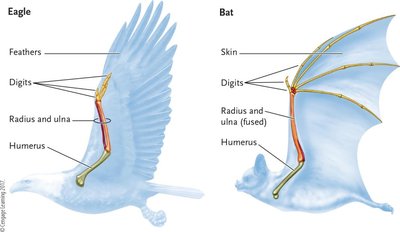
Homoplasy means a similarity between organisms that is not due to shared ancestry. Instead, it happens because of convergent evolution —different species evolve similar traits independently. This is also called analogy . Example: Wings in bats and birds. Both have wings, but their ancestors did not have wings—each evolved wings separately.
Convergent Evolution
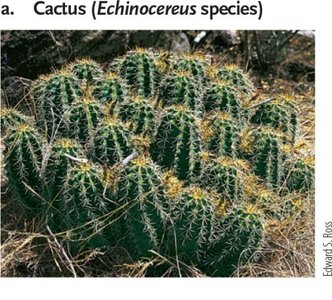
Convergent evolution occurs when unrelated organisms independently evolve similar adaptations in response to similar environmental pressures. This leads to homoplasy, where phenotypic similarities do not reflect common ancestry.
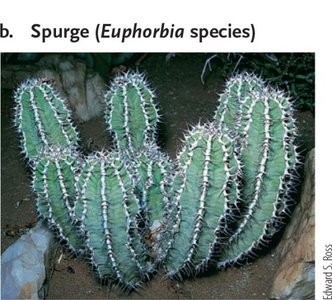
Example: Cacti (Echinocereus) and spurges (Euphorbia) have similar forms but evolved independently.
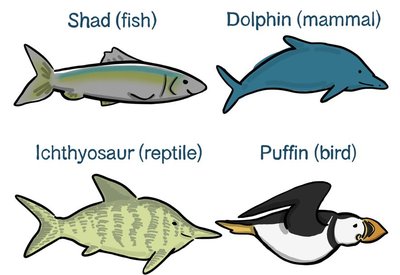
Example: Streamlined body shapes in fish, mammals, reptiles, and birds are a result of convergent evolution.
Assessing Homology (Đánh giá tính đồng dạng)
Determining whether a trait is homologous or homoplasious is crucial for accurate phylogenetic analysis. Morphological analysis often requires examining multiple traits, and molecular data can provide additional evidence for homology.
Homologous traits are inherited from a common ancestor . Homoplasious traits (homoplasy) look similar but evolved independently (not from a common ancestor). It's important to tell the difference because: Homologous traits show true evolutionary relationships . Homoplasious traits can mislead phylogenetic trees if mistaken for homology. Scientists use morphological analysis (comparing physical traits) and molecular data (like DNA sequences) to help decide if a trait is truly homologous.
Behavioral Characters (Các đặc điểm hành vi)
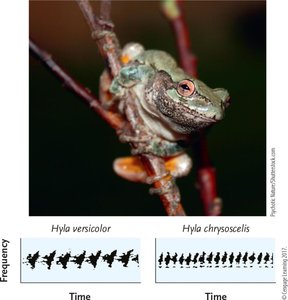
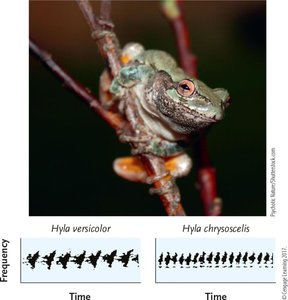
Behavioral traits can be used to distinguish species, especially when morphological differences are minimal. For example, differences in mating calls or courtship behaviors may indicate evolutionary divergence (Sự phân tách).
Molecular Sequences
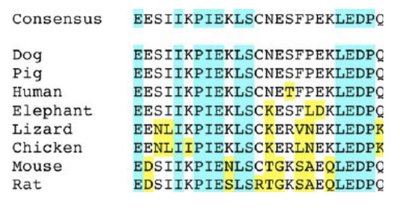
Molecular data, such as DNA and protein sequences, are widely used in modern systematics. Shared changes in molecular sequences, including insertions, deletions, or substitutions, provide evidence for evolutionary relationships. Amino acid sequence homology is a common method for comparing genetic similarities among species.
Traditional vs. Cladistic Classification (Phân loại truyền thống và phân loại theo nhánh tiến hóa)
Traditional Classification (Phân loại truyền thống)
Traditional classification systems are based on phenotypic similarities and differences, often grouping organisms by body plan or lifestyle. However, these systems may not always reflect evolutionary history, sometimes resulting in paraphyletic groups.
Cladistic Revolution (phân loại theo nhánh tiến hóa)
Cladistics focuses on recently evolved character states (synapomorphies) to reconstruct evolutionary history and classify organisms. Systematists use various techniques to identify the most parsimonious phylogenetic tree, which best explains the observed data with the fewest evolutionary changes. Cladistics is a method used to classify organisms based on shared, recently evolved traits called synapomorphies . Synapomorphies are traits that a group of organisms share because they inherited them from their most recent common ancestor. Cladistics helps scientists build phylogenetic trees that show how species are related through evolution.
Character States (Trạng thái tính cách): Traits can exist in ancestral (plesiomorphic) or derived (apomorphic) forms.
Character states are the different forms a trait can take in organisms. Ancestral (plesiomorphic) state: This is the original form of the trait, inherited from a distant ancestor. Example: Having five fingers is ancestral for mammals. Derived (apomorphic) state: This is a new, changed form of the trait that evolved later. Example: Having wings (in bats) is a derived state compared to other mammals.
Ancestral = old/original; Derived = new/changed.
Synapomorphies: Shared derived characters that are informative for determining evolutionary relationships. Synapomorphies = shared, new traits that show close evolutionary relationships! They are new traits that a group of organisms have, which their common ancestor also had.
Symplesiomorphies: Shared ancestral traits, less useful for resolving relationships within a group.
Symplesiomorphies : These are shared ancestral traits . They are old traits that many organisms have because they inherited them from a distant ancestor. Example: Having a backbone is a symplesiomorphy for all vertebrates. They are not very helpful for figuring out close relationships within a group, because so many organisms share them.
Autapomorphies: Unique derived traits, not useful for determining relationships among groups.
Autapomorphies:
These are unique derived traits.
They are new traits found in only one group or species.
Example: The long neck of a giraffe is an autapomorphy for giraffes.
They don’t help show relationships between groups, because only one group has them.
Outgroup Comparison (So sánh với nhóm ngoài): Used to determine the polarity (ancestral vs. derived) of character states.
Outgroup comparison is a method used in cladistics to figure out if a trait is ancestral or derived . An outgroup is a species or group that is related to the group you’re studying, but not part of it . By comparing the traits of the outgroup and the group you’re studying (the ingroup ), you can see which traits are older (ancestral) and which are newer (derived) .
Character State Polarity (Hướng của trạng thái đặc điểm)
The polarity of character states (Phân cực của các trạng thái tính cách) (ancestral vs. derived) is often determined using fossil evidence or by comparing the group of interest to an outgroup. Outgroups are species or groups known to have diverged before the lineage containing the groups being studied.
Plesiomorphies: Do not help resolve relationships within the group.
Plesiomorphies : These are ancestral traits shared by many members of a group. Because so many organisms have them, they don’t help distinguish which members are more closely related within the group. Example: All mammals have a backbone, but this trait is also found in other vertebrates, so it doesn’t help tell mammals apart.
Autapomorphies: Unique to a single lineage, not informative for group relationships.
Autapomorphies : These are unique derived traits found in only one lineage (species or group). Since only one group has the trait, it doesn’t show relationships between different groups. Example: The long neck of a giraffe is unique to giraffes, so it doesn’t help connect giraffes to other animals.
Synapomorphies: Shared derived traits, crucial for reconstructing phylogenies.
Additional info: This guide covers the foundational concepts of taxonomy and systematics, focusing on phylogenetic analysis, types of taxa, sources of data, and the principles of cladistics. Understanding these concepts is essential for interpreting evolutionary relationships and the classification of life.
