 Back
Lecture 2 slides: The Basics of Chemistry for Biology: Atoms, Bonds, and Chemical Reactions
Study Guide - Smart Notes
 Tailored notes based on your materials, expanded with key definitions, examples, and context.
Chemistry and Life
The Role of Chemistry in Biology
All living organisms are composed of chemical substances, and the processes of life are fundamentally chemical reactions. Understanding the basics of chemistry is essential for studying biology, as it explains how matter is organized and transformed in living systems.
Biological molecules are assembled from chemical elements through specific types of bonds.
Life depends on the arrangement and behavior of atoms and molecules.
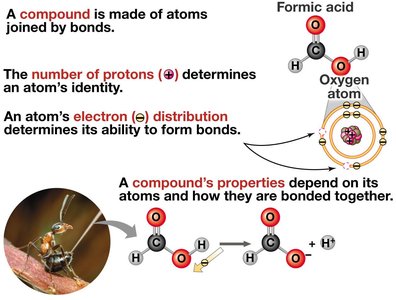
Examples include defensive chemicals like formic acid produced by ants.

Atoms: Structure and Properties
Atomic Structure
Atoms are the fundamental units of matter, consisting of a nucleus (protons and neutrons) surrounded by electrons. The arrangement of these subatomic particles determines the chemical properties of each element.
Protons (positively charged) and neutrons (neutral) are found in the nucleus.
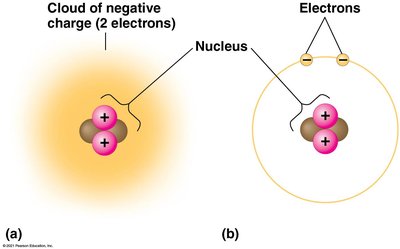
Electrons (negatively charged) orbit the nucleus in specific energy levels or shells.
The number of protons defines the element (atomic number).
The distribution of electrons determines how atoms interact and bond with each other.
Electron Energy Levels
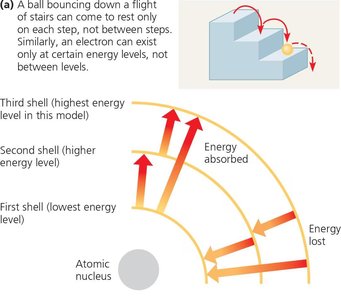
Electrons occupy energy levels (shells) around the nucleus. The energy of an electron depends on its distance from the nucleus; electrons further away have higher potential energy.
Electrons can move between energy levels by absorbing or releasing energy.
Matter tends to move toward the lowest possible state of potential energy.
Valence Electrons and Chemical Behavior
Valence Shells
The chemical behavior of an atom is largely determined by the number of electrons in its outermost shell, known as the valence shell.
Atoms with a full valence shell are chemically inert (unreactive).
Atoms with incomplete valence shells tend to form bonds to achieve stability.
Chemical Bonds
Covalent Bonds
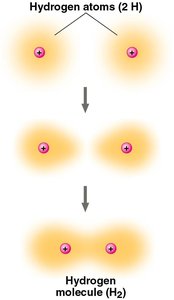
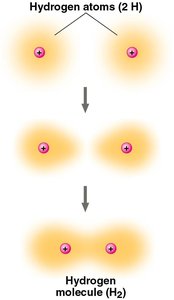
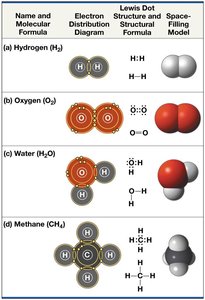
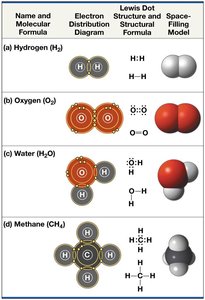
Covalent bonds form when two atoms share pairs of valence electrons. These bonds are strong and are the basis for most biological molecules.
Nonpolar covalent bonds: Electrons are shared equally between atoms (e.g., H2).
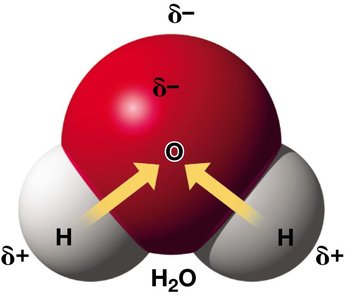
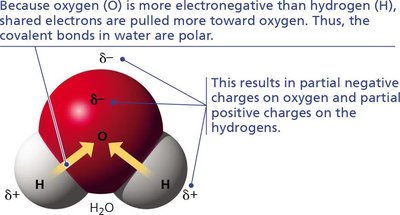
Polar covalent bonds: Electrons are shared unequally, resulting in partial charges (e.g., H2O).
Electronegativity is the tendency of an atom to attract electrons in a bond.
Ionic Bonds
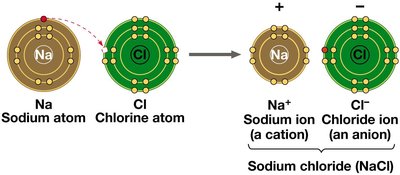
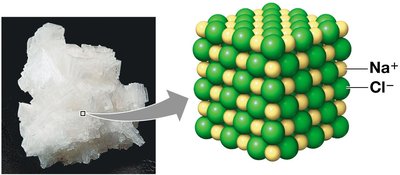
Ionic bonds form when one atom transfers an electron to another, resulting in oppositely charged ions that attract each other. These bonds are generally weaker in aqueous environments.
Cation: Positively charged ion (e.g., Na+).
Anion: Negatively charged ion (e.g., Cl-).
Example: Sodium chloride (NaCl) forms from the transfer of an electron from sodium to chlorine.
Hydrogen Bonds
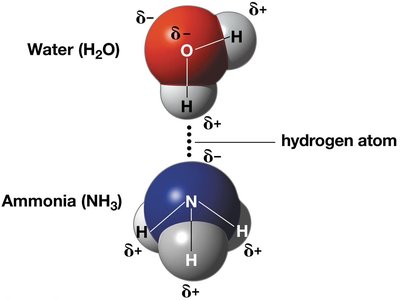
Hydrogen bonds are weak attractions between a hydrogen atom with a partial positive charge and an electronegative atom (such as oxygen or nitrogen). These bonds are crucial for the structure and function of biological molecules like DNA and proteins.
Hydrogen bonds are responsible for many of water's unique properties.
They are weaker than covalent and ionic bonds but are essential for molecular interactions in cells.
Relative Strengths of Bonds
Covalent bonds are the strongest, followed by ionic bonds (especially in dry environments), and then hydrogen bonds. Weak, reversible bonds are important for dynamic biological processes.
Weak bonds allow for temporary interactions, such as enzyme-substrate binding.
Chemical Reactions
Rearrangement of Electrons
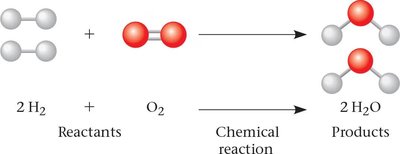
Chemical reactions involve the making and breaking of bonds, leading to the rearrangement of atoms and the transformation of substances. These reactions are the foundation of all biological processes.
Reactants are the starting materials; products are the resulting substances.
Example: The reaction of hydrogen and oxygen to form water.
Summary Table: Types of Chemical Bonds
Bond Type | How Formed | Relative Strength | Example |
|---|---|---|---|
Covalent | Sharing of electron pairs | Strongest | H2O, CH4 |
Ionic | Transfer of electrons | Intermediate | NaCl |
Hydrogen | Attraction between partial charges | Weakest | Between water molecules |
Key Terms and Concepts
Atom: The smallest unit of an element, composed of protons, neutrons, and electrons.
Element: A substance that cannot be broken down into other substances by chemical means.
Compound: A substance formed by the chemical combination of two or more elements in fixed proportions.
Valence electrons: Electrons in the outermost shell, important for chemical bonding.
Electronegativity: The ability of an atom to attract electrons in a covalent bond.
Chemical reaction: The process of making and breaking chemical bonds, leading to changes in the composition of matter.
