 Back
BackLec 28
Study Guide - Smart Notes
 Tailored notes based on your materials, expanded with key definitions, examples, and context.
The Biology of Sex
Introduction to Sexual Selection
Sexual selection is a form of natural selection that arises from differences in reproductive success due to variation in the ability to obtain mates. It often leads to the evolution of traits that improve mating success, even if these traits do not necessarily enhance survival.
Variation: Phenotypic and genetic variation exists within populations.
Inheritance: Genetic information is transmitted from parent to offspring.
Selective Pressure: Environmental and social factors influence which traits are advantageous.
Differential Reproduction: Only some individuals produce successful offspring, leading to changes in trait frequencies over generations.
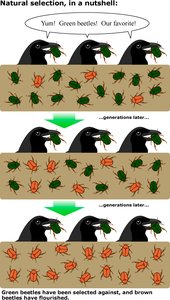
Natural Selection and Fitness
Darwinian Fitness
Darwinian fitness is defined as the number of offspring an individual produces during its lifetime. Fitness is a measure of reproductive success, not just survival.
Key Point: Traits that increase reproductive output are favored by natural selection.
Example: In a population, individuals with traits that attract more mates or produce more viable offspring will have higher fitness.
Sexual Dimorphism
Definition and Examples
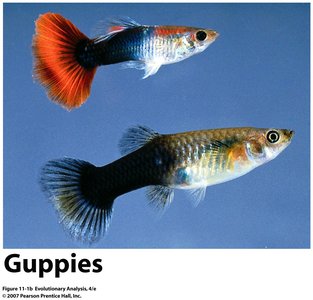
Sexual dimorphism refers to phenotypic differences between males and females of the same species. These differences often arise due to sexual selection and can include size, coloration, morphology, and behavior.
Examples: Male birds often have brighter plumage than females; male mammals may be larger or have specialized structures for combat.
Mechanisms of Sexual Selection
Darwin's Theory of Sexual Selection
Charles Darwin proposed that intraspecific competition for mates can lead to selection on secondary sexual characteristics, which enhance reproductive success regardless of their effect on survival.
Intrasexual Selection: Competition among members of the same sex (usually males) for access to mates.
Intersexual Selection: Mate choice, often by females, based on specific traits in males.
Case Studies in Sexual Dimorphism and Selection
Sexual Dimorphism in Elephant Seals
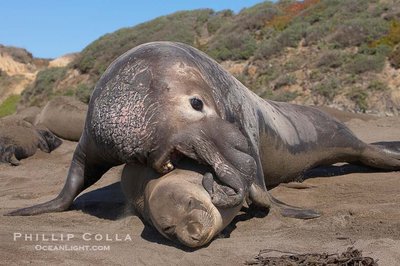
Elephant seals exhibit extreme sexual dimorphism, with males being much larger than females. This size difference is driven by intense male-male competition for access to females.
Male Competition in Marine Iguanas
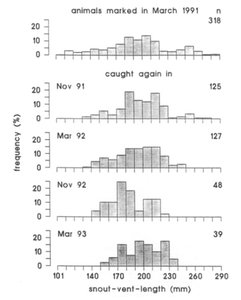
In marine iguanas, males compete for access to females, but only contribute sperm and do not provide parental care. Females invest heavily in egg production and nest guarding. Stabilizing selection favors medium-sized males, as they have the highest fitness.
Stabilizing Selection: Selection favors intermediate phenotypes over extremes.
Social Mating Systems
Types of Mating Systems
Species exhibit a variety of social mating systems, which influence patterns of sexual selection and parental investment.
Mating System | Description |
|---|---|
Monogamy | 1 male, 1 female; exclusive mating with prolonged pair bonding (but cheating may occur) |
Promiscuity | Multiple partners for at least one sex; no prolonged pair bonding |
Polygyny | 1 male, >1 female; prolonged pair bonds and exclusive mating |
Polyandry | >1 male, 1 female; prolonged pair bonds with exclusive mating |
Patterns in Mammals and Birds
Most mammals are polygynous or promiscuous; only about 5% are monogamous.
Birds are more likely to form pair bonds and be monogamous.
These differences are influenced by the relative investment of each sex in offspring.
Evolutionary Theory of Parental Investment
Parental Investment and Sexual Selection
Evolutionary theory predicts that the sex investing more in offspring (usually females) becomes a limiting resource for the other sex (usually males), which then competes for access to mates. Male parental care evolves when it increases reproductive success, as seen in many bird species.
Females: Invest resources in eggs or parenting; reproductive success depends on access to resources and ability to convert resources into offspring.
Males: Invest in gaining access to mating opportunities; reproductive success depends on number of mates.
Reproductive Strategies
Variation in Reproductive Success
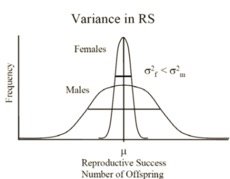
There is often greater variance in reproductive success among males than females, leading to stronger sexual selection on males. This can result in the evolution of elaborate traits or behaviors used to attract mates or compete with rivals.
Summary Table: Mating Systems and Parental Investment
Mating System | Parental Investment | Sexual Selection Intensity |
|---|---|---|
Monogamy | Both sexes | Low |
Polygyny | Females | High (on males) |
Polyandry | Males | High (on females) |
Promiscuity | Varies | Variable |
Additional info: These notes integrate foundational concepts from evolutionary biology, including natural selection, sexual selection, and reproductive strategies, as outlined in standard college biology curricula.
