 Back
The Cell Cycle and Cell Division: Study Notes for General Biology
Study Guide - Smart Notes
 Tailored notes based on your materials, expanded with key definitions, examples, and context.
The Cell Cycle and Cell Division
Overview: The Key Roles of Cell Division
Cell division is a fundamental process that distinguishes living organisms from nonliving matter. It is essential for the continuity of life, enabling organisms to reproduce and maintain their populations.
Reproduction: The ability of organisms to produce more of their own kind is a key feature of life.
Cell Division: The continuity of life is based on the reproduction of cells through cell division.
The Functions of Cell Division
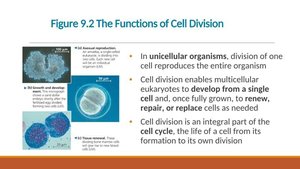
Cell division serves multiple functions in both unicellular and multicellular organisms. It is integral to growth, development, repair, and reproduction.
Unicellular organisms: Division of one cell reproduces the entire organism.
Multicellular eukaryotes: Enables development from a single cell, and allows for renewal, repair, or replacement of cells.
Cell cycle: The life of a cell from its formation to its own division.
Cellular Organization of Genetic Material
Chromatin, Chromosomes, and Cell Types
Genetic material in eukaryotic cells is organized as chromatin, a complex of DNA and protein. Chromosomes are the distinct units of genetic material, and their number varies by species.
Chromatin: DNA-protein complex forming chromosomes.
Somatic cells: Nonreproductive cells; humans have 46 chromosomes (2 sets of 23).
Gametes: Reproductive cells (sperm and eggs); humans have 23 chromosomes in gametes.
The Cell Cycle
Phases of the Cell Cycle
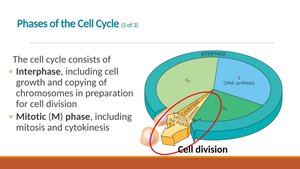
The cell cycle is the series of events that cells go through as they grow and divide. It consists of interphase and the mitotic (M) phase.
Interphase: Cell growth and chromosome copying in preparation for division.
Mitotic (M) phase: Includes mitosis (division of chromosomes) and cytokinesis (division of the cell).
Subphases of Interphase
Interphase is divided into three subphases, during which the cell grows and prepares for division.
G1 phase: "First gap" – cell growth.
S phase: "Synthesis" – DNA replication.
G2 phase: "Second gap" – further growth and preparation.
Cell Cycle Summary
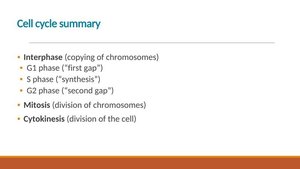
The cell cycle includes interphase (chromosome copying), mitosis (chromosome division), and cytokinesis (cell division).
Interphase: G1, S, G2 phases.
Mitosis: Division of chromosomes.
Cytokinesis: Division of the cell.
Mitosis
Phases of Mitosis
Mitosis is conventionally divided into five phases, remembered by the acronym P-P-M-A-T.
Prophase
Prometaphase
Metaphase
Anaphase
Telophase
Stages of Mitosis
Each phase of mitosis is characterized by specific events involving chromosomes and the mitotic spindle.
Prophase: Chromosomes condense, spindle forms.
Pro metaphase: Nuclear envelope fragments, spindle fibers attach to chromosomes.
Metaphase: Chromosomes align at the metaphase plate.
Anaphase: Sister chromatids separate and move to opposite poles.
Telophase: Nuclear envelope reforms, chromosomes decondense.
Chromosome Duplication and Distribution
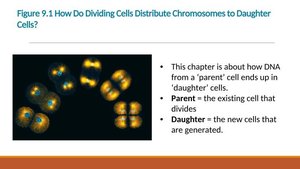
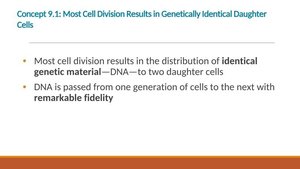
During cell division, chromosomes are duplicated and distributed to daughter cells, ensuring genetic continuity.
Chromosome duplication: DNA is replicated, forming two sister chromatids.
Distribution: Sister chromatids separate and move into two nuclei.
Exploring Mitosis in Animal Cells
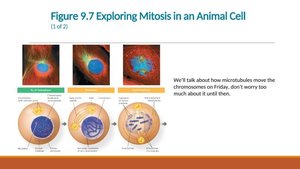
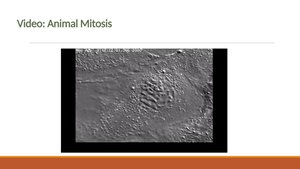
Animal cells undergo mitosis through a series of coordinated steps involving the mitotic spindle and chromosome movement.
Spindle formation: Microtubules organize and attach to chromosomes.
Chromosome movement: Chromosomes are moved by spindle fibers to ensure proper segregation.
The Mitotic Spindle
The mitotic spindle is a structure made of microtubules and associated proteins, controlling chromosome movement during mitosis.
Centrosome: Microtubule organizing center in animal cells.
Metaphase plate: Imaginary structure at the cell's equator where chromosomes align.
Chromosome Movement During Anaphase
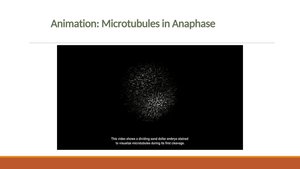
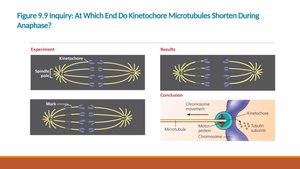
During anaphase, sister chromatids separate and move along kinetochore microtubules toward opposite ends of the cell.
Microtubule shortening: Occurs at kinetochore ends.
Motor proteins: Reel in chromosomes and depolymerize microtubules.
Cytokinesis
Cytokinesis: One Cell Splits into Two
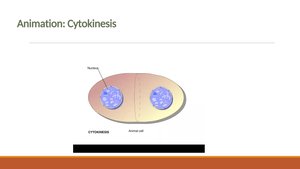
Cytokinesis is the process by which the cytoplasm divides, resulting in two daughter cells.
Animal cells: Occurs by cleavage, forming a cleavage furrow.
Plant cells: Occurs by formation of a cell plate.
Binary Fission in Bacteria
Prokaryotic Cell Division
Prokaryotes reproduce by binary fission, a simpler process than mitosis.
Origin of replication: Chromosome replication begins here.
Chromosome movement: Daughter chromosomes move apart as the cell elongates.
Cell division: Plasma membrane pinches inward, dividing the cell.
Control of the Cell Cycle
Checkpoints of the Cell Cycle Control System
The cell cycle is regulated by checkpoints, which ensure proper division and prevent errors.
G1 checkpoint: Most important; determines if cell will proceed with division.
G0 phase: Nondividing state if cell does not receive go-ahead signal.
Growth Factors and External Signals
External signals such as growth factors stimulate cell division. Platelet-derived growth factor (PDGF) is an example that stimulates fibroblast division.
Growth factors: Proteins released by cells to stimulate division in other cells.
PDGF: Stimulates division of human fibroblast cells in culture.
Loss of Cell Cycle Controls in Cancer Cells
Cancer Cell Characteristics
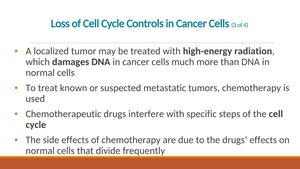
Cancer cells do not respond to normal cell cycle signals, leading to uncontrolled growth and division.
Abnormal control: Cancer cells may produce their own growth factors or have abnormal control systems.
Treatment: Radiation and chemotherapy target dividing cells, but can affect normal cells as well.
Summary Table: Phases of the Cell Cycle
Phase | Main Event |
|---|---|
G1 phase | Cell growth |
S phase | DNA synthesis (replication) |
G2 phase | Preparation for mitosis |
Mitosis | Division of chromosomes |
Cytokinesis | Division of the cell |
Key Equations and Concepts
Chromosome number in humans: (somatic cells) $23$ (gametes)
DNA replication:
Additional info:
Cell cycle checkpoints are critical for preventing uncontrolled cell division and cancer.
Binary fission is a simpler form of cell division in prokaryotes compared to mitosis in eukaryotes.
