 Back
The Cell Cycle and Cell Division: Mitosis, Meiosis, and Regulation
Study Guide - Smart Notes
 Tailored notes based on your materials, expanded with key definitions, examples, and context.
The Cell Cycle and Cell Division
Overview of Cell Division
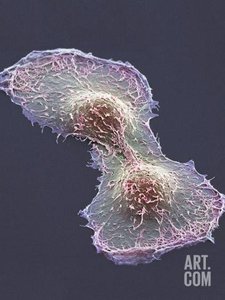
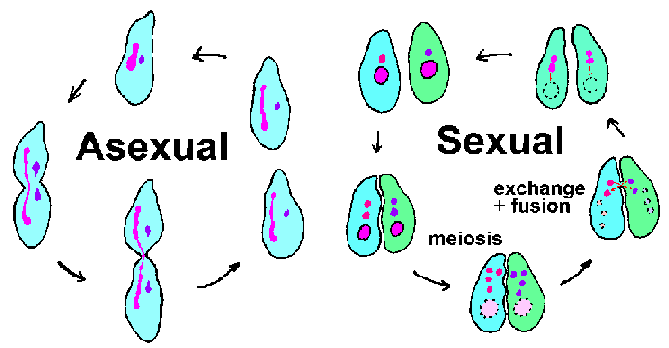
Cell division is a fundamental process in all living organisms, enabling growth, development, repair, and reproduction. There are two main types of cell division: mitosis and meiosis. Mitosis is responsible for asexual reproduction, growth, and tissue repair, while meiosis is essential for sexual reproduction and genetic diversity.
Mitosis: Produces two genetically identical daughter cells from a single parent cell. Occurs in somatic (body) cells.
Meiosis: Produces gametes (sperm and egg cells) with half the chromosome number of the parent cell. Occurs only in reproductive organs.
Chromosome Structure and Function
Chromosomes and Chromatin
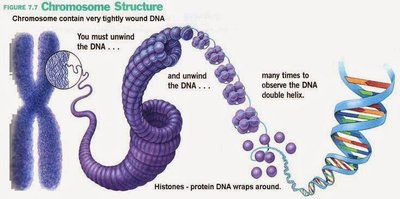
Chromosomes are structures composed of DNA and proteins that carry genetic information. During most of the cell cycle, DNA exists as chromatin, a less condensed form. Chromosomes condense only during cell division to facilitate their movement and segregation.
Chromatin: DNA-protein complex that makes up chromosomes.
Sister chromatids: Identical copies of a chromosome, joined at the centromere.
Centromere: Region where sister chromatids are attached.
Somatic Cells vs. Gametes
Somatic cells: Diploid (2N), produced by mitosis, mutations not passed to offspring.
Gametes: Haploid (N), produced by meiosis, mutations can be inherited.
Chromosome Number in Different Species
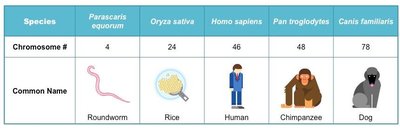
The number of chromosomes varies among species and does not correlate with organismal complexity.
Species | Chromosome # | Common Name |
|---|---|---|
Parascaris equorum | 4 | Roundworm |
Oryza sativa | 24 | Rice |
Homo sapiens | 46 | Human |
Pan troglodytes | 48 | Chimpanzee |
Canis familiaris | 78 | Dog |
The Cell Cycle
Phases of the Cell Cycle
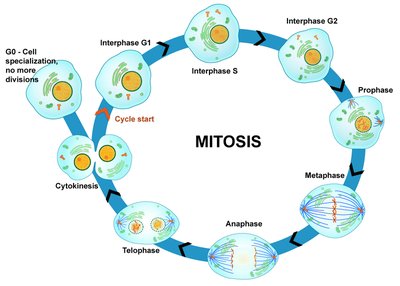
The cell cycle consists of a series of phases that prepare the cell for division and ensure accurate duplication and segregation of genetic material.
Interphase: The cell grows, performs its normal functions, and prepares for division. It includes G1, S, and G2 phases.
Mitosis (M phase): The nucleus divides, followed by cytokinesis (division of the cytoplasm).
G0 phase: A resting state where cells exit the cycle and do not divide.
Interphase Subphases
G1 phase: Cell grows and duplicates organelles.
S phase: DNA replication occurs; chromosomes are duplicated.
G2 phase: Cell checks for errors and prepares for mitosis; centrosomes form.
G0 Phase
Some cells enter the G0 phase, where they are metabolically active but no longer divide. Examples include nerve cells (permanently in G0) and liver cells (can re-enter the cycle if needed).
Mitosis: Stages and Events
Overview of Mitosis
Mitosis is the process by which a eukaryotic cell separates its duplicated chromosomes into two identical sets, followed by division of the cytoplasm (cytokinesis).
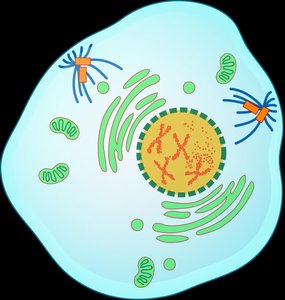
Prophase: Chromatin condenses, nucleoli disappear, mitotic spindle forms, centrosomes move to poles.
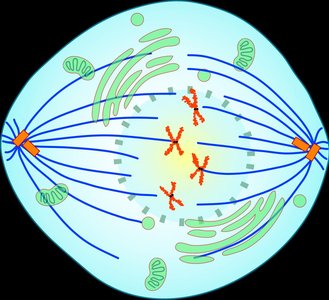
Prometaphase: Nuclear envelope fragments, chromosomes fully condense, microtubules attach to kinetochores.
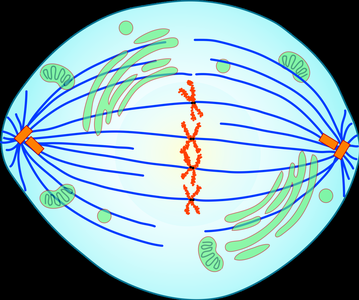
Metaphase: Chromosomes align at the metaphase plate, centrosomes at opposite poles.
Anaphase: Sister chromatids separate and move to opposite poles, cell elongates.
Telophase: Nuclear envelope reforms, nucleoli reappear, chromosomes decondense.
Cytokinesis: Cytoplasm divides, forming two daughter cells. In animals, a cleavage furrow forms; in plants, a cell plate forms.
Regulation of the Cell Cycle
Checkpoints and Control Mechanisms
The cell cycle is tightly regulated by checkpoints that ensure each phase is completed correctly before the next begins. Major checkpoints include:
G1 checkpoint: Checks for nutrients, growth factors, and DNA damage.
G2 checkpoint: Checks for cell size and successful DNA replication.
M checkpoint: Ensures chromosomes are properly attached to the spindle apparatus.
Key regulatory molecules include cyclins and cyclin-dependent kinases (Cdks). The MPF (Maturation Promoting Factor) is a complex of cyclin and Cdk that triggers mitosis.
Loss of Cell Cycle Control and Cancer
Growth factors: Proteins that stimulate cell division. Overproduction can lead to uncontrolled cell growth (cancer).
Density-dependent inhibition: Cells stop dividing when crowded.
Anchorage dependence: Most animal cells must be attached to a surface to divide.
Summary Table: Key Differences Between Mitosis and Meiosis
Feature | Mitosis | Meiosis |
|---|---|---|
Cell Type | Somatic cells | Gametes |
Number of Divisions | 1 | 2 |
Daughter Cells | 2 (identical) | 4 (genetically unique) |
Chromosome Number | Diploid (2N) | Haploid (N) |
Function | Growth, repair, asexual reproduction | Sexual reproduction |
Example: Human somatic cells have 46 chromosomes (diploid), while human gametes have 23 chromosomes (haploid).
