 Back
BackThe Cell Cycle and Cell Division: Regulation, Mechanisms, and Implications
Study Guide - Smart Notes
 Tailored notes based on your materials, expanded with key definitions, examples, and context.
The Cell Cycle and Cell Division
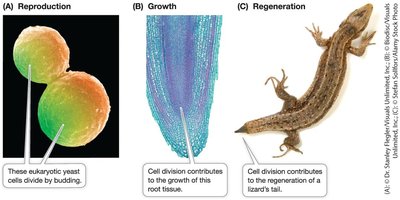
Key Roles of Cell Division
Cell division is fundamental to the life cycle of all organisms, enabling reproduction, growth, and regeneration. It ensures the continuity of life by producing new cells from existing ones.
Reproduction: Single-celled organisms reproduce by cell division; multicellular organisms use cell division for gamete production.
Growth: Cell division increases the number of cells, contributing to organismal growth.
Regeneration: Damaged tissues are repaired through cell division.
Key Events: Cell division signals, DNA replication, DNA segregation, and cytokinesis.
Cell Division in Prokaryotes
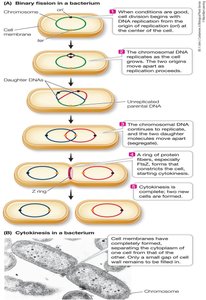
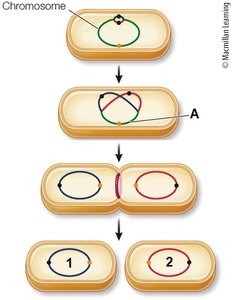
Prokaryotic cell division occurs via binary fission, a process that results in the reproduction of the entire organism. Division is typically triggered by external signals such as nutrient availability.
Chromosome Structure: Most prokaryotes have a single, circular DNA molecule.
Replication Origins: ori (origin of replication) and ter (terminus).
Segregation: After replication, ori regions move to opposite ends, segregating daughter chromosomes.
Cytokinesis: Cell membrane pinches in, forming a ring of protein fibers; new cell wall materials are synthesized.
Binary Fission Steps
DNA replication begins at ori.
Chromosomal DNA moves through the replication complex.
Segregation of daughter chromosomes.
Formation of Z ring and cytokinesis.
Cell Division in Eukaryotes
Eukaryotic cell division is more complex, regulated by internal and external signals, and involves multiple chromosomes. Division is often linked to the needs of the organism.
DNA Replication: Occurs at multiple origins; restricted to a specific cell cycle phase.
DNA Segregation: Mitosis separates replicated chromosomes into two nuclei.
Cytokinesis: Differs between animal (membrane pinching) and plant cells (cell plate formation).
Regulation of the Eukaryotic Cell Cycle
Phases of the Cell Cycle
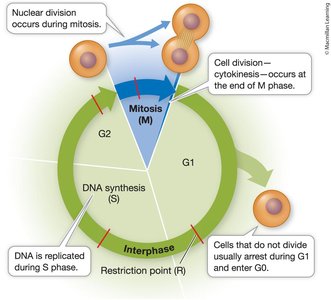
The eukaryotic cell cycle consists of interphase (G1, S, G2) and M phase (mitosis and cytokinesis). Interphase is when the cell grows and DNA is replicated; M phase is when nuclear and cytoplasmic division occur.
G1: Cell grows; chromosomes are unreplicated .
S: DNA synthesis; chromosomes replicate.
G2: Cell prepares for mitosis.
M: Mitosis and cytokinesis.
Cell Cycle Regulation
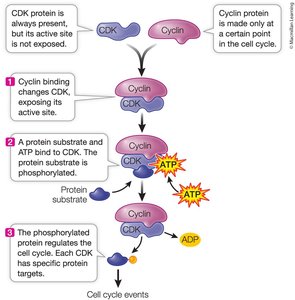
Progression through the cell cycle is controlled by cyclin-dependent kinases (CDKs) , which are activated by binding to cyclins. CDKs phosphorylate target proteins, regulating cell cycle events.
CDK Activation: Cyclin binding exposes CDK's active site.
Phosphorylation: CDKs transfer phosphate groups from ATP to proteins, altering their function.
Checkpoints: Cyclin-CDK complexes act at specific cell cycle checkpoints.
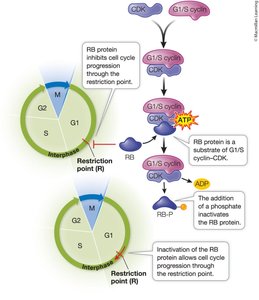
Restriction Point (R)
The G1-to-S transition is a critical control point. The retinoblastoma protein (RB) inhibits cell cycle progression; phosphorylation by cyclin-CDK inactivates RB, allowing the cycle to proceed.
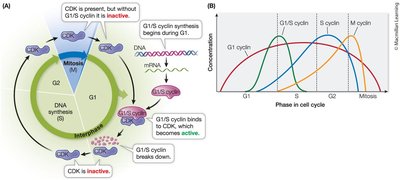
Cyclin Regulation
Cyclins are synthesized and degraded cyclically, ensuring CDK activity is tightly regulated.
External Regulation
Growth factors and other external signals can stimulate cell division by activating signal transduction pathways that lead to cyclin synthesis and CDK activation.
Platelet-derived growth factor: Stimulates skin cell division for wound healing.
Interleukins and erythropoietin: Stimulate blood cell division and specialization.
Eukaryotic Cell Division: Mitosis
Chromatin Structure and Chromosome Packing
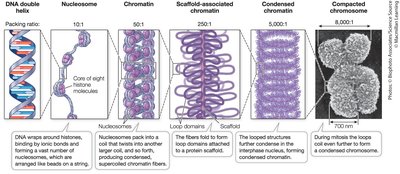
DNA is bound to histone proteins, forming chromatin. During mitosis, chromatin is highly compacted, making chromosomes inaccessible to replication and transcription factors.
Nucleosomes: Beadlike units formed by DNA wrapping around histones.
Condensins: Proteins that further compact DNA during mitosis.
Phases of Mitosis
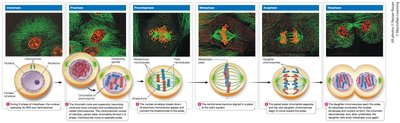
Mitosis is subdivided into prophase, prometaphase, metaphase, anaphase, and telophase. It produces two genetically identical nuclei.
Prophase: Chromosomes condense; spindle forms.
Prometaphase: Nuclear envelope breaks down; kinetochores form.
Metaphase: Chromosomes align at metaphase plate.
Anaphase: Sister chromatids separate.
Telophase: Nuclear envelopes reform.
Mitotic Spindle and Chromosome Movement
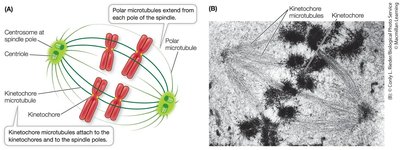
The spindle apparatus, composed of microtubules, moves sister chromatids apart. Centrosomes, containing centrioles, determine the division plane.
Chromatid Separation
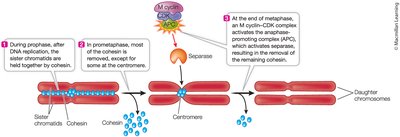
During anaphase, the anaphase-promoting complex (APC) is activated, leading to the hydrolysis of cohesin by separase and separation of chromatids.
Cytokinesis
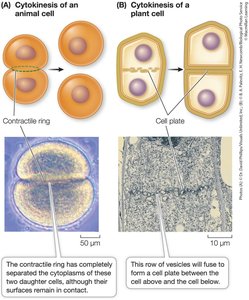
Cytokinesis divides the cytoplasm. In animal cells, a contractile ring pinches the cell in two; in plant cells, vesicles form a cell plate that becomes the new cell wall.
-
Cell Death: Necrosis and Apoptosis
Necrosis
Necrosis is accidental cell death due to damage or starvation. The cell swells, bursts, and releases contents, causing inflammation.
Apoptosis
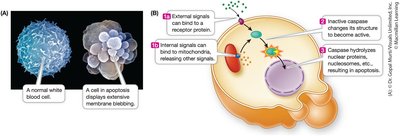
Apoptosis is programmed cell death, essential for development and preventing cancer. Cells detach, chromatin is digested, and the cell forms blebs that are ingested by neighbouring cells.
Initiation: Triggered by hormones, growth factors, toxins, or DNA damage.
Caspases: Proteases that hydrolyze membrane proteins and nucleosomes.
F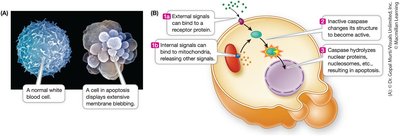
Unregulated Cell Division and Cancer
Cancer Cell Characteristics
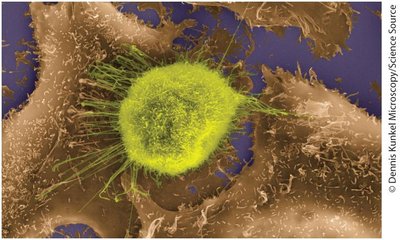
Cancer cells lose control over division, often dividing continuously and forming tumors. They may migrate (metastasize) to other parts of the body.
Benign Tumors: Localized, slow-growing, resemble parent tissue.
Malignant Tumors: Irregular, invasive, do not resemble parent tissue.
Regulation and Molecular Changes in Cancer
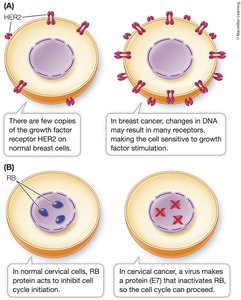
Oncogenes: Mutated positive regulators, overactive or in excess (e.g., HER2 in breast cancer).
Tumor Suppressors: Negative regulators (e.g., RB, p53) are inactive in cancer cells.
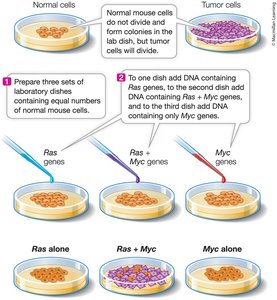
Multiple Mutations: Tumors often involve several oncogenes and tumor suppressor genes (e.g., Myc and Ras).
Cancer Treatments
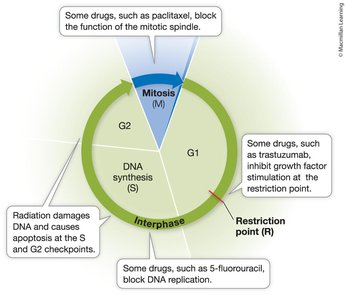
Treatments target cell cycle processes, including drugs that block DNA replication, spindle function, or growth factor stimulation. Radiation induces DNA damage and apoptosis.
5-fluorouracil: Blocks thymine synthesis.
Paclitaxel: Disrupts mitotic spindle.
Trastuzumab: Targets HER2 receptor in breast cancer.
Summary Table: Comparison of Cell Division in Prokaryotes and Eukaryotes
Feature | Prokaryotes | Eukaryotes |
|---|---|---|
Division Process | Binary fission | Mitosis (and meiosis) |
Chromosome Structure | Single, circular | Multiple, linear |
Division Signals | External (nutrients, environment) | Internal & external (growth factors, organismal needs) |
DNA Replication | Single origin | Multiple origins |
Segregation | Simple, via ori movement | Complex, via mitotic spindle |
Cytokinesis | Protein ring, cell wall formation | Contractile ring (animals), cell plate (plants) |
Key Terms
Binary fission: Prokaryotic cell division.
Mitosis: Eukaryotic nuclear division.
Cytokinesis: Division of cytoplasm.
CDK: Cyclin-dependent kinase, cell cycle regulator.
Oncogene: Mutated gene promoting cancer.
Tumor suppressor: Gene inhibiting cell division.
Apoptosis: Programmed cell death.
