 Back
The Cell Cycle and Cell Division: Structured Study Notes
Study Guide - Smart Notes
 Tailored notes based on your materials, expanded with key definitions, examples, and context.
The Cell Cycle (Cell Division)
Introduction to Cell Division
Cell division is a fundamental process in biology, enabling organisms to reproduce, grow, and repair tissues. The continuity of life depends on the accurate reproduction of cells, ensuring genetic information is faithfully transmitted to daughter cells.
Key Roles of Cell Division
Asexual reproduction: Single-celled organisms produce new individuals through cell division.
Growth and development: Multicellular organisms develop from a single cell via repeated cell divisions.
Tissue renewal: Cell division replaces damaged or dead cells in mature organisms.
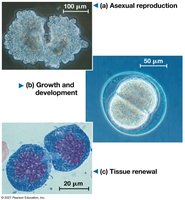
Distributing DNA Between Daughter Cells
A critical function of cell division is the distribution of identical genetic material (DNA) to daughter cells. This ensures genetic continuity across generations of cells.
Cellular Organization of Genetic Material
Genome: All the DNA in a cell; can be a single chromosome (prokaryotes) or multiple chromosomes (eukaryotes).
Chromosomes: DNA molecules packaged with proteins (chromatin) in eukaryotes; each chromosome contains hundreds to thousands of genes.
Chromatin: The complex of DNA and protein that forms chromosomes in eukaryotic cells.
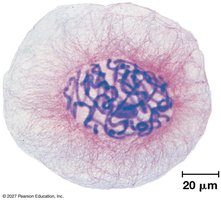
Distribution of Chromosomes During Eukaryotic Cell Division
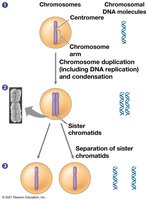
Before division, DNA is replicated and chromosomes condense.
Each duplicated chromosome consists of two sister chromatids, joined at the centromere.
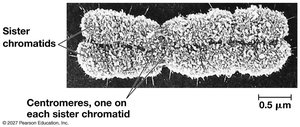
Separation of Sister Chromatids
During cell division, sister chromatids separate and move to opposite nuclei.
Once separated, chromatids are considered individual chromosomes.
Eukaryotic Cell Division: Mitosis and Cytokinesis
Eukaryotic cell division consists of two main processes:
Mitosis: Division of the nucleus and genetic material.
Cytokinesis: Division of the cytoplasm.
Reproductive cells (gametes) are produced by meiosis, which results in nonidentical daughter cells with half the chromosome number (covered in Chapter 13).
Phases of Cell Division
Mitosis is conventionally divided into five stages, followed by cytokinesis:
Prophase
Prometaphase
Metaphase
Anaphase
Telophase
Cytokinesis overlaps with telophase.
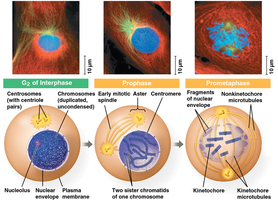
Prophase
Chromosomes condense and become visible.
Nucleoli disappear.
Centrosomes (in animals) organize microtubules and migrate to opposite sides.
Mitotic spindle and asters form.
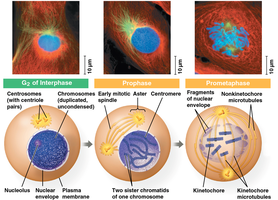
Prometaphase
Nuclear envelope breaks down.
Kinetochore forms at centromere of each chromatid.
Microtubules attach to kinetochores and begin to move chromosomes.
Cell elongates as microtubules push from opposite poles.
Metaphase
Centrosomes are at opposite poles.
Chromosomes align at the metaphase plate (equidistant between spindle poles).
Kinetochores of sister chromatids attach to microtubules from opposite poles.
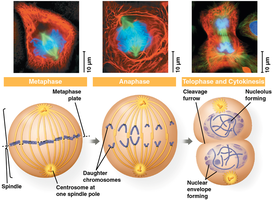
Anaphase
Sister chromatids separate and migrate toward opposite poles.
Cell elongates further.
Telophase
Two nuclear envelopes form.
Nucleoli reappear.
Chromosomes decondense.
Spindle microtubules depolymerize.
Cytokinesis
Division of cytoplasm occurs during telophase.
In animal cells, a cleavage furrow forms and contracts to create two daughter cells.
Microfilaments (actin) and motor proteins (myosin) drive contraction.
Cell Division in Plants
Plants lack centrosomes; spindle microtubules are organized differently.
Cytokinesis occurs via formation of a cell plate, which becomes the new cell wall separating daughter cells.
Binary Fission in Bacteria
Prokaryotes reproduce by binary fission.
Chromosome replication begins at the origin of replication.
Replicated chromosomes attach to opposite ends as the cell elongates.
Cell divides, producing two genetically identical cells.
The Cell Cycle
Overview of the Cell Cycle
The cell cycle describes the life of a cell from its formation to its division. It consists of:
Mitotic (M) phase: Includes mitosis and cytokinesis.
Interphase: Cell growth and chromosome duplication (preparation for division).
Phases of Interphase
G1 phase (first gap): Cell grows and prepares for DNA replication.
S phase (synthesis): Chromosomes are duplicated.
G2 phase (second gap): Cell continues to grow and prepares for mitosis.
G0 phase: Cells exit the cycle and stop dividing (common in mature tissues).
Regulation of the Cell Cycle
Cell Cycle Control System
The cell cycle is regulated by internal and external signals, ensuring proper timing and completion of each phase. Several checkpoints exist to monitor progress and integrity.
Checkpoints
G1 checkpoint: Most important; determines if cell will proceed to division or enter G0 phase.
M checkpoint: Ensures sister chromatids are properly aligned at metaphase plate for equal division.
External Signals
Growth factors: Chemical signals released by cells to stimulate division in other cells.
Physical signals: Cells respond to crowding and attachment to surfaces.
Cancer and Cell Cycle Control
Cancer cells lose normal cell cycle controls, leading to uncontrolled growth and division.
Summary Table: Phases of Mitosis
Phase | Main Events |
|---|---|
Prophase | Chromosomes condense, spindle forms, nucleoli disappear |
Prometaphase | Nuclear envelope breaks down, kinetochores form, microtubules attach |
Metaphase | Chromosomes align at metaphase plate, kinetochores attach to spindle |
Anaphase | Sister chromatids separate, move to opposite poles |
Telophase | Nuclear envelopes reform, chromosomes decondense, spindle disappears |
Cytokinesis | Cytoplasm divides, cleavage furrow (animals) or cell plate (plants) forms |
Key Terms and Definitions
Chromosome: A DNA molecule with associated proteins, carrying genetic information.
Sister chromatids: Two identical copies of a chromosome, joined at the centromere.
Centromere: Region where sister chromatids are most closely attached.
Kinetochore: Protein structure at the centromere, attaches to spindle microtubules.
Mitotic spindle: Structure of microtubules that separates chromosomes during mitosis.
Cleavage furrow: Indentation in animal cells where cytokinesis occurs.
Cell plate: Structure in plant cells that forms during cytokinesis, leading to new cell wall.
Binary fission: A type of cell division in prokaryotes.
Interphase: Period of cell growth and DNA replication between divisions.
Checkpoints: Regulatory points in the cell cycle.
Relevant Equations
DNA Replication:
Chromosome Number After Mitosis:
Example: Cell Cycle Checkpoints
If a cell fails the G1 checkpoint, it enters G0 and does not divide.
If chromosomes are not properly aligned at the M checkpoint, division is halted until errors are corrected.
Additional info: The cell cycle is a highly regulated process, and errors in regulation can lead to diseases such as cancer. Understanding the phases and control mechanisms is essential for studying cell biology and genetics.
