 Back
The Cell Cycle and Cellular Replication
Study Guide - Smart Notes
 Tailored notes based on your materials, expanded with key definitions, examples, and context.
The Cell Cycle
Overview of Cellular Replication
Cellular replication is a fundamental process in biology, enabling organisms to grow, repair tissues, and reproduce. The process involves three main steps: copying the DNA, separating the copies, and dividing the cytoplasm. These steps are tightly regulated and occur in distinct phases of the cell cycle.
Copy the DNA: DNA is duplicated so each new cell receives a complete set of genetic information.
Separate the copies: The replicated chromosomes are segregated to ensure each daughter cell gets an identical set.
Divide the cytoplasm: The cell physically splits, forming two new cells.
Phases of the Cell Cycle
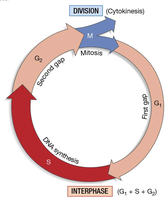
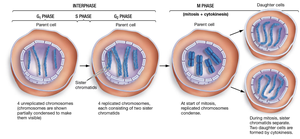
The cell cycle consists of interphase and the M (mitotic) phase. Interphase is subdivided into G1, S, and G2 phases, each with specific roles in cell growth and DNA replication.
G1 Phase: The cell performs its normal functions and prepares for division.
S Phase: DNA synthesis occurs, resulting in replicated chromosomes.
G2 Phase: The cell grows further and replicates organelles in preparation for division.
M Phase: Chromosomes are segregated, and the cell divides.
Cytokinesis: The cytoplasm divides, creating two daughter cells.
Chromosome Morphology During the Cell Cycle
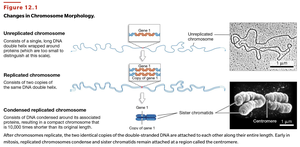
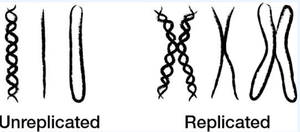
Chromosomes undergo structural changes during the cell cycle. Initially, chromosomes are unreplicated, consisting of a single DNA double helix. After DNA replication, each chromosome consists of two identical sister chromatids joined at the centromere. During mitosis, chromosomes condense and are segregated into daughter cells.
Unreplicated Chromosome: Single DNA double helix.
Replicated Chromosome: Two identical DNA double helices (sister chromatids).
Condensed Replicated Chromosome: Chromatids are tightly packed and attached at the centromere.
M Phase: Mitosis and Cytokinesis
Process of Mitosis
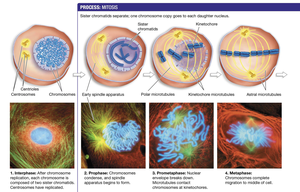
Mitosis is the process by which replicated chromosomes are separated into two daughter nuclei. It consists of several stages, each characterized by specific events and structures.
Interphase: Chromosomes are replicated but not yet condensed.
Prophase: Chromosomes condense, and the spindle apparatus begins to form.
Prometaphase: Nuclear envelope breaks down, and spindle fibers attach to chromosomes.
Metaphase: Chromosomes align at the cell's equator.
Chromosome Movement During Anaphase
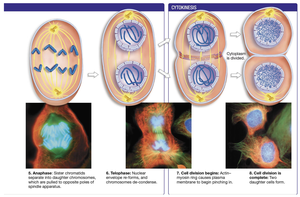
During anaphase, sister chromatids are pulled apart toward opposite poles of the cell by the spindle apparatus. This ensures each daughter cell receives an identical set of chromosomes.
Anaphase: Sister chromatids separate and move to opposite poles.
Telophase: Nuclear envelopes reform around the separated chromatids.
Cytokinesis
Cytokinesis is the final step of cell division, where the cytoplasm divides, resulting in two genetically identical daughter cells. In animal cells, this process involves the formation of a cleavage furrow, while in plant cells, a cell plate forms.
Cleavage Furrow: Actin and myosin filaments contract to pinch the cell in two.
Cell Plate: Vesicles fuse to form a new cell wall between daughter cells (in plants).
Result: Two daughter cells, each with a complete set of chromosomes.
Summary Table: Cell Cycle Phases and Key Events
Phase | Main Event | Chromosome State |
|---|---|---|
G1 | Cell growth, normal function | Unreplicated |
S | DNA replication | Replicated |
G2 | Preparation for division | Replicated |
M (Mitosis) | Chromosome segregation | Condensed, separated |
Cytokinesis | Division of cytoplasm | Separated |
Key Terms and Definitions
Chromosome: A structure composed of DNA and proteins that carries genetic information.
Sister Chromatids: Two identical copies of a chromosome connected at the centromere.
Centromere: The region where sister chromatids are joined.
Spindle Apparatus: Structure that separates chromosomes during mitosis.
Cytokinesis: Division of the cytoplasm to form two daughter cells.
Equations and Academic Context
DNA replication follows the semi-conservative model, where each new DNA molecule consists of one old strand and one new strand.
Equation for DNA content during cell cycle:
Equation for chromosome number:
Example: If a cell has 4 chromosomes before S phase, after S phase it will have 4 chromosomes, each consisting of two sister chromatids.
Additional info: The cell cycle is regulated by checkpoints that ensure DNA is properly replicated and segregated before division occurs. Errors in these processes can lead to genetic disorders or cancer.
