 Back
The Cell Cycle and DNA Replication: Core Concepts and Mechanisms
Study Guide - Smart Notes
 Tailored notes based on your materials, expanded with key definitions, examples, and context.
The Cell Cycle
Overview of the Cell Cycle
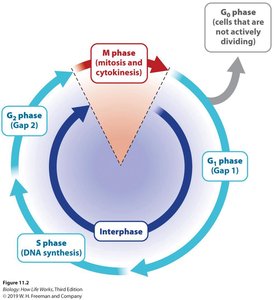
The cell cycle is the series of events that cells undergo to grow and divide. It is essential for organismal development, tissue renewal, and reproduction. The cycle consists of interphase (G1, S, G2 phases) and the M phase (mitosis and cytokinesis).
G1 phase: Cell growth and preparation for DNA replication.
S phase: DNA synthesis, where chromosomes are replicated.
G2 phase: Further growth and preparation for mitosis.
M phase: Mitosis (nuclear division) and cytokinesis (cytoplasmic division).
G0 phase: Cells that are not actively dividing exit the cycle.
Functions of Cell Division
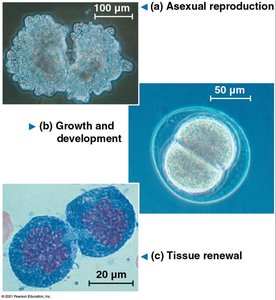
Cell division is crucial for the propagation of life, development, and maintenance of multicellular organisms.
Asexual reproduction: Single-celled organisms reproduce by dividing.
Growth and development: Multicellular organisms grow via cell division.
Tissue renewal: Cell division replaces damaged or dead cells.
DNA Replication
Purpose and Location of DNA Replication
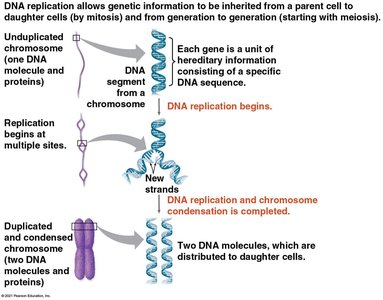
DNA replication is the process by which a cell makes an exact copy of its DNA, ensuring genetic information is accurately transmitted to daughter cells. It occurs during the S phase of the cell cycle in the nucleus of eukaryotic cells.
Inputs: Parental DNA, nucleotides, enzymes.
Outputs: Two identical DNA molecules.
Location: Nucleus (eukaryotes), cytoplasm (prokaryotes).
Key Concept: Complementary Base Pairing
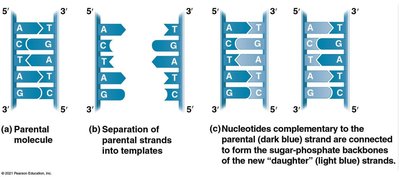
Complementary base pairing is the foundation of DNA replication. Each strand of DNA serves as a template for the synthesis of a new strand, following strict pairing rules: Adenine (A) pairs with Thymine (T), and Guanine (G) pairs with Cytosine (C).
Base pairing: A-T and G-C.
Antiparallel strands: DNA strands run in opposite directions (5' to 3' and 3' to 5').
Mechanism of DNA Replication
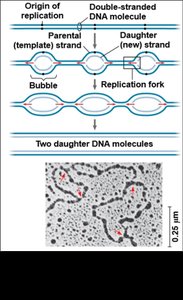
DNA replication is a semi-conservative process, meaning each new DNA molecule contains one original strand and one newly synthesized strand. Replication begins at origins of replication, forming replication bubbles and forks.
Origins of replication: Specific sites where replication starts.
Replication bubble: Region where DNA is unwound.
Replication fork: Y-shaped region where new DNA is synthesized.
Enzymes and Proteins Involved in DNA Replication
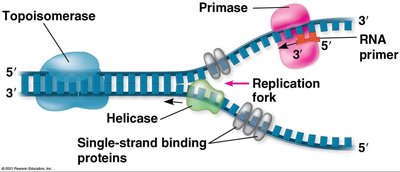
Multiple enzymes and proteins coordinate the replication process:
Helicase: Unwinds the DNA double helix.
Topoisomerase: Relieves strain caused by unwinding.
Single-strand binding proteins: Stabilize unwound DNA.
Primase: Synthesizes short RNA primers.
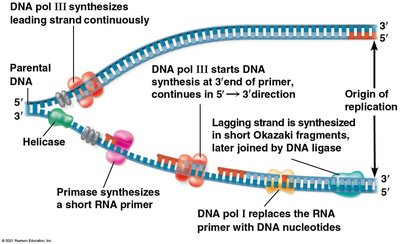
DNA polymerase: Adds nucleotides to the 3' end of the primer.
DNA ligase: Joins Okazaki fragments on the lagging strand.
Antiparallel Elongation: Leading and Lagging Strands
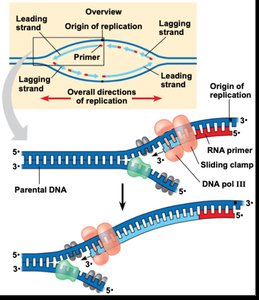
The antiparallel nature of DNA affects how replication occurs:
Leading strand: Synthesized continuously toward the replication fork.
Lagging strand: Synthesized discontinuously away from the fork in short segments called Okazaki fragments, which are later joined by DNA ligase.
Summary Table: DNA Replication Enzymes and Functions
Enzyme/Protein | Function |
|---|---|
Helicase | Unwinds DNA helix |
Topoisomerase | Relieves strain from unwinding |
Single-strand binding proteins | Stabilize single-stranded DNA |
Primase | Synthesizes RNA primer |
DNA polymerase | Adds nucleotides to primer |
DNA ligase | Joins Okazaki fragments |
DNA Replication vs. Transcription
Comparison Table
Process | Template | Product | Main Enzyme | Purpose |
|---|---|---|---|---|
DNA Replication | Both DNA strands | DNA | DNA polymerase | Copy genetic material |
Transcription | One DNA strand | RNA | RNA polymerase | Produce RNA for protein synthesis |
Proofreading and DNA Repair
Mechanisms of DNA Repair
DNA polymerases proofread newly synthesized DNA, correcting errors. Additional repair mechanisms include mismatch repair and nucleotide excision repair, which fix errors and damage caused by environmental factors.
Proofreading: DNA polymerase removes incorrect nucleotides.
Mismatch repair: Enzymes correct mismatched bases.
Nucleotide excision repair: Removes damaged DNA segments.
Mutations and Their Effects
Types of Mutations
Mutations are changes in the genetic information of a cell. They can affect protein structure and function, leading to various outcomes.
Substitution: One base pair is replaced by another.
Insertion: Addition of one or more base pairs.
Deletion: Removal of one or more base pairs.
Point mutation: Change of a single base pair.
Frameshift mutation: Insertion or deletion shifts the reading frame.
Silent mutation: No change in protein.
Missense mutation: Changes one amino acid.
Nonsense mutation: Introduces a stop codon, truncating the protein.
Gene Expression and Phenotype
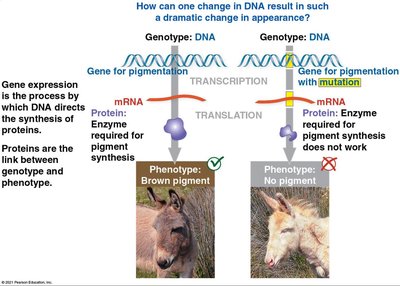
Gene expression is the process by which DNA directs the synthesis of proteins, linking genotype to phenotype. Mutations can alter gene expression, leading to changes in traits.
Evolutionary Significance of Mutations
Role of Mutations in Evolution
Although DNA replication is highly accurate, occasional errors (mutations) provide genetic variation. This variation is essential for evolution, as it allows natural selection to act and new species to arise.
Mutation: Source of genetic diversity.
Natural selection: Acts on genetic variation.
Environmental Factors Affecting DNA
DNA Damage from the Environment
Environmental agents such as UV radiation, carcinogens, and ionizing radiation can damage DNA, leading to mutations and potentially causing diseases like cancer.
UV rays: Cause thymine dimers and mispairing.
Carcinogens: Bind to DNA, causing misreading.
Radiation: Induces breaks, deletions, and inversions.
Summary Table: Types of Mutations and Effects
Mutation Type | Description | Effect on Protein |
|---|---|---|
Substitution | One base replaced | Silent, missense, or nonsense |
Insertion | Extra base(s) added | Frameshift or in-frame |
Deletion | Base(s) removed | Frameshift or in-frame |
Frameshift | Reading frame altered | Major change in protein |
Silent | No change in protein | None |
Missense | One amino acid changed | Possible functional change |
Nonsense | Stop codon introduced | Truncated, nonfunctional protein |
Key Equations and Concepts
Base Pairing Rules
Base pairing is governed by hydrogen bonding:
A-T: Two hydrogen bonds
G-C: Three hydrogen bonds
DNA Replication Equation
Generalized equation for DNA synthesis:
dNTP: Deoxynucleotide triphosphate; PPi: Pyrophosphate
Conclusion
Understanding the cell cycle and DNA replication is fundamental to biology. These processes ensure the continuity of life, accurate transmission of genetic information, and provide the basis for genetic diversity and evolution.
