 Back
The Cell Cycle and DNA Replication: Core Concepts and Mechanisms
Study Guide - Smart Notes
 Tailored notes based on your materials, expanded with key definitions, examples, and context.
The Cell Cycle
Overview of the Cell Cycle
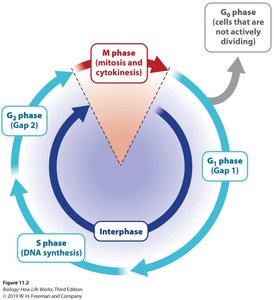
The cell cycle is the series of events that cells undergo to grow and divide. It consists of interphase (G1, S, G2 phases) and the M phase (mitosis and cytokinesis). The cycle ensures accurate duplication and distribution of genetic material.
Interphase: Includes G1 (cell growth), S (DNA synthesis), and G2 (preparation for mitosis).
M phase: Mitosis (nuclear division) and cytokinesis (cytoplasmic division).
G0 phase: Cells that are not actively dividing exit the cycle.
Importance of Cell Division
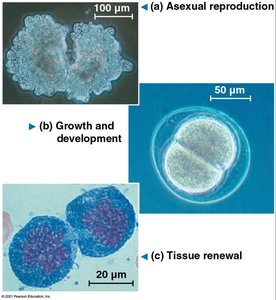
Cell division is essential for reproduction, growth, development, and tissue renewal in organisms. It ensures the transmission of genetic information from parent to daughter cells.
Asexual reproduction: Single-celled organisms reproduce by cell division.
Growth and development: Multicellular organisms grow and develop through repeated cell divisions.
Tissue renewal: Cell division replaces damaged or old cells in tissues.
DNA Replication
Concept and Significance
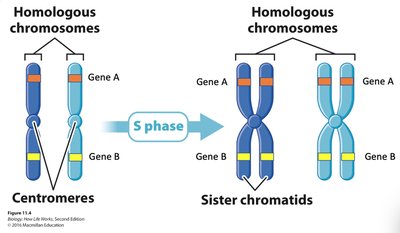
DNA replication is the process by which a cell makes an exact copy of its DNA before cell division. This ensures that each daughter cell receives identical genetic information.
Occurs during S phase: DNA synthesis takes place in the S phase of interphase.
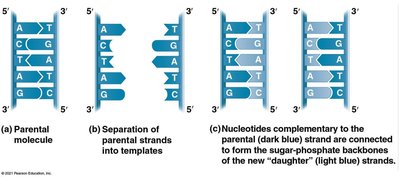
Key concept: Complementary base pairing enables accurate copying of genetic material.
Semiconservative mechanism: Each new DNA molecule consists of one parental and one newly synthesized strand.
Mechanism of DNA Replication
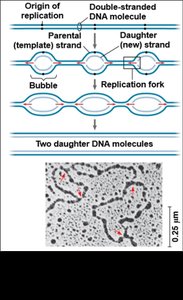
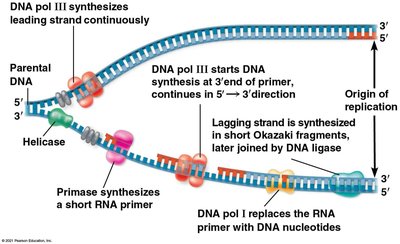
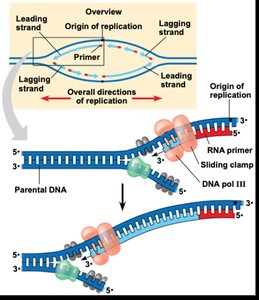
DNA replication begins at specific sites called origins of replication. Multiple enzymes and proteins coordinate the process, ensuring speed and accuracy.
Origins of replication: Replication starts at multiple sites along the chromosome, forming replication bubbles.
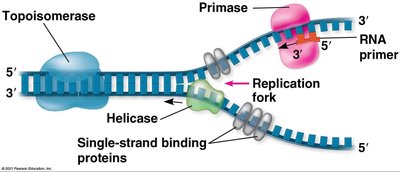
Replication fork: The site where DNA strands are separated and new strands are synthesized.
Enzymes involved: Helicase (unwinds DNA), topoisomerase (relieves strain), primase (synthesizes RNA primer), DNA polymerase (adds nucleotides), single-strand binding proteins (stabilize DNA).
Elongation: Leading and Lagging Strands
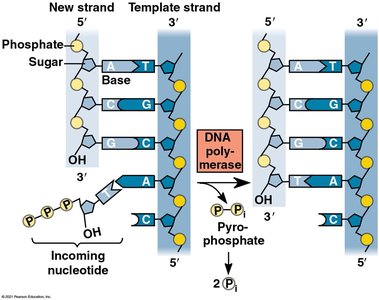
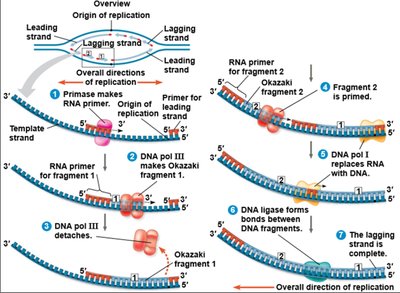
The antiparallel nature of DNA affects how new strands are synthesized. DNA polymerase can only add nucleotides to the 3' end, resulting in continuous synthesis on the leading strand and discontinuous synthesis on the lagging strand.
Leading strand: Synthesized continuously toward the replication fork.
Lagging strand: Synthesized in short segments (Okazaki fragments) away from the fork, later joined by DNA ligase.
Proofreading and DNA Repair
DNA polymerases proofread newly synthesized DNA, correcting errors. Additional repair mechanisms fix mismatches and damage caused by environmental factors.
Proofreading: DNA polymerase removes incorrect nucleotides during replication.
Mismatch repair: Enzymes replace incorrectly paired nucleotides.
Nucleotide excision repair: Damaged DNA segments are removed and replaced.
Environmental damage: UV rays, carcinogens, and radiation can cause mutations.
Mutations and Their Effects
Types of Mutations
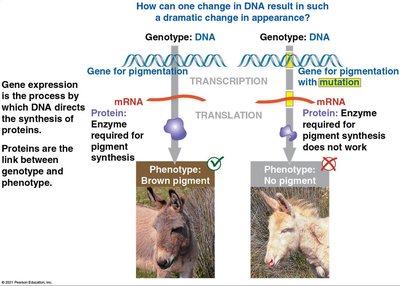
Mutations are changes in the genetic information of a cell. They can affect protein structure and function, leading to variations in traits.
Substitution: One base pair is replaced by another.
Insertion: Addition of one or more base pairs.
Deletion: Removal of one or more base pairs.
Point mutation: Change of a single base pair (substitution, insertion, or deletion).
Frameshift mutation: Insertion or deletion shifts the reading frame, altering subsequent amino acids.
Silent mutation: No change in protein (due to redundancy in genetic code).
Missense mutation: Changes one amino acid in the protein.
Nonsense mutation: Introduces a stop codon, resulting in a truncated, usually nonfunctional protein.
Mutation Consequences and Evolutionary Significance
Mutations are the source of genetic variation, which is essential for evolution. While most mutations are corrected, some become permanent and can be inherited.
Genetic variation: Mutations provide the raw material for natural selection.
Phenotypic effects: Mutations can alter traits, sometimes dramatically.
Environmental factors: UV light, chemicals, and radiation increase mutation rates.
Summary Table: Types of DNA Mutations
Type | Description | Effect on Protein |
|---|---|---|
Substitution | One base pair replaced by another | Silent, missense, or nonsense |
Insertion | One or more base pairs added | Frameshift or addition of amino acids |
Deletion | One or more base pairs removed | Frameshift or loss of amino acids |
Point Mutation | Change of a single base pair | Silent, missense, or nonsense |
Frameshift | Reading frame shifted | Major change in protein sequence |
Silent | No change in protein | Protein unchanged |
Missense | One amino acid changed | Protein altered |
Nonsense | Stop codon introduced | Protein truncated |
Key Terms and Concepts
DNA polymerase: Enzyme that synthesizes new DNA strands.
Helicase: Enzyme that unwinds the DNA double helix.
Primase: Enzyme that synthesizes RNA primers.
Okazaki fragments: Short DNA segments synthesized on the lagging strand.
Ligase: Enzyme that joins Okazaki fragments.
Mutation: Change in DNA sequence.
Gene expression: Process by which DNA directs protein synthesis.
Important Equations
DNA replication follows the rules of complementary base pairing:
Base pairing: $A = T$, $G = C$
Directionality: DNA polymerase adds nucleotides to the 3' end: $5' \rightarrow 3'$
Energy for DNA synthesis comes from nucleotide triphosphates:
$\text{dNTP} \rightarrow \text{dNMP} + 2 \text{P}_i$
Additional info: The notes expand on the original slides by providing definitions, examples, and a summary table for mutation types, ensuring completeness and academic quality for exam preparation.
