 Back
BackThe Cell Cycle and Meiosis: Structure, Function, and Genetic Variation
Study Guide - Smart Notes
 Tailored notes based on your materials, expanded with key definitions, examples, and context.
The Cell Cycle
Overview of Cell Division
The cell cycle is a fundamental process by which cells reproduce, ensuring continuity of life. It involves the accurate distribution of genetic material to daughter cells and is essential for growth, development, and tissue repair in multicellular organisms.
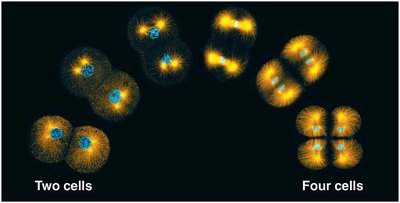
Cell division is the process by which a parent cell divides into two genetically identical daughter cells.
Single-celled organisms reproduce by cell division, while multicellular organisms use it for development and maintenance.
Cell division is highly accurate in passing DNA from one generation to the next.
Key Roles of Cell Division
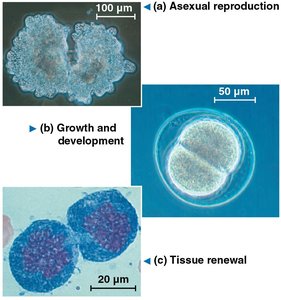
Asexual reproduction: Produces genetically identical offspring from a single parent.
Growth and development: Multicellular organisms grow and develop through repeated cell divisions.
Tissue renewal: Cell division replaces damaged or dead cells in tissues.
Cellular Organization of Genetic Material
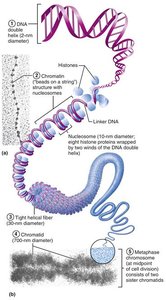
All the DNA in a cell constitutes its genome. DNA is packaged into chromosomes, which carry genes. Eukaryotic chromosomes are composed of chromatin, a complex of DNA and protein.
Somatic cells have two sets of chromosomes.
Gametes (sperm and eggs) have half as many chromosomes as somatic cells.
Chromosome Structure and Replication
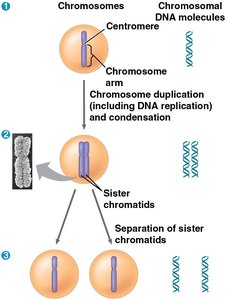
Before cell division, DNA is replicated and chromosomes condense.
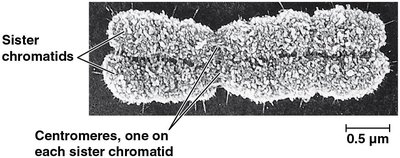
Each duplicated chromosome consists of two sister chromatids, joined by cohesins.
The centromere is the region where chromatids are most closely attached.
Distribution of Chromosomes During Cell Division
During cell division, sister chromatids separate and move into two nuclei.
Once separated, chromatids are called chromosomes.
Phases of the Cell Cycle
Interphase and Mitotic Phase
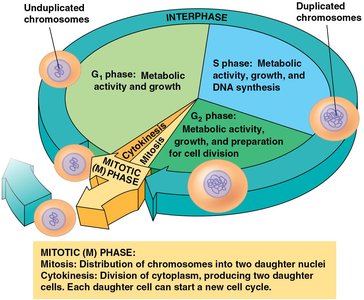
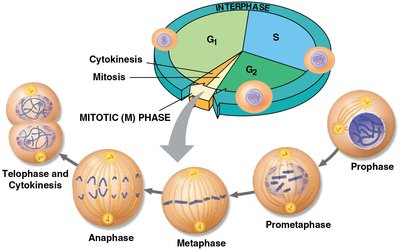
The cell cycle consists of interphase (cell growth and chromosome duplication) and the mitotic (M) phase (mitosis and cytokinesis).
Interphase (90% of the cycle) is divided into three phases:
G1 phase (first gap): Cell growth
S phase (synthesis): DNA replication
G2 phase (second gap): Preparation for cell division
Mitosis: Division of the nucleus
Cytokinesis: Division of the cytoplasm
Stages of Mitosis
Mitosis is conventionally divided into five stages:
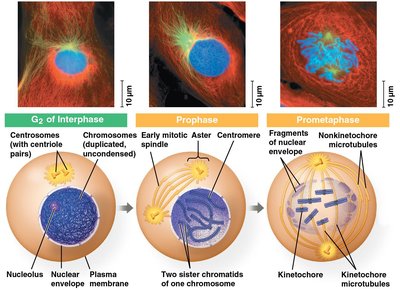
Prophase
Prometaphase
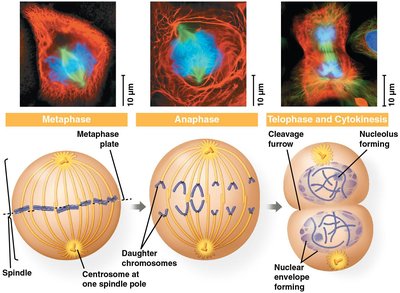
Metaphase
Anaphase
Telophase
The Mitotic Spindle
The mitotic spindle is a structure made of microtubules that controls chromosome movement during mitosis. The centrosome, a microtubule-organizing center, replicates and migrates to opposite ends of the cell.
Each sister chromatid has a kinetochore, a protein complex associated with the centromere.
Spindle microtubules attach to kinetochores during prometaphase.
Chromosomes align at the metaphase plate during metaphase.
During anaphase, sister chromatids separate and move toward opposite poles.
Cytokinesis
In animal cells, cytokinesis occurs by cleavage, forming a cleavage furrow.
In plant cells, a cell plate forms during cytokinesis.
Meiosis and Sexual Life Cycles
Inheritance and Chromosome Sets
Inheritance is the transmission of traits from one generation to the next. Genes are units of heredity made up of DNA segments, passed via gametes. Humans have 46 chromosomes in somatic cells, arranged in pairs.
Homologous chromosomes carry genes for the same traits.
Sex chromosomes (X and Y) determine sex; autosomes are the other 22 pairs.
A diploid cell (2n) has two sets of chromosomes; a haploid cell (n) has one set.
Sexual Life Cycles
Sexual life cycles alternate between meiosis and fertilization, maintaining chromosome number across generations. Three main types exist: animal, plant/algae (alternation of generations), and fungi/protists.
In animals, gametes are the only haploid cells.
In plants/algae, both diploid (sporophyte) and haploid (gametophyte) multicellular stages exist.
In fungi/protists, the only diploid stage is the zygote.
Meiosis: Reduction of Chromosome Sets
Meiosis reduces chromosome number from diploid to haploid, producing four genetically distinct daughter cells. It consists of two consecutive divisions: meiosis I and meiosis II.
Meiosis I: Homologous chromosomes separate.
Meiosis II: Sister chromatids separate (similar to mitosis).
Genetic Variation in Sexual Life Cycles
Genetic variation arises from independent assortment, crossing over, and random fertilization. These mechanisms ensure each offspring has a unique genetic identity.
Independent assortment: Homologous pairs orient randomly at metaphase I.
Crossing over: Exchange of genetic material between homologous chromosomes during prophase I.
Random fertilization: Any sperm can fuse with any ovum, increasing genetic diversity.
Comparison of Mitosis and Meiosis
Feature | Mitosis | Meiosis |
|---|---|---|
Number of divisions | 1 | 2 |
Number of daughter cells | 2 | 4 |
Genetic identity | Identical to parent | Genetically distinct |
Chromosome number | Same as parent | Half of parent |
Summary
The cell cycle and meiosis are essential for growth, development, and genetic diversity.
Accurate chromosome distribution is crucial for maintaining genetic stability.
Sexual reproduction introduces genetic variation, which is fundamental to evolution.
